How to Study for Finals Week: 7-Day AI-Powered Study Plan
Finals week doesn't have to be chaos. With the right plan and the right tools, you can walk into every exam feeling prepared and confident. Here's a proven 7-day study plan that leverages AI to maximize every hour of your prep time.
Written by Sarah Mitchell
Education Tech Researcher
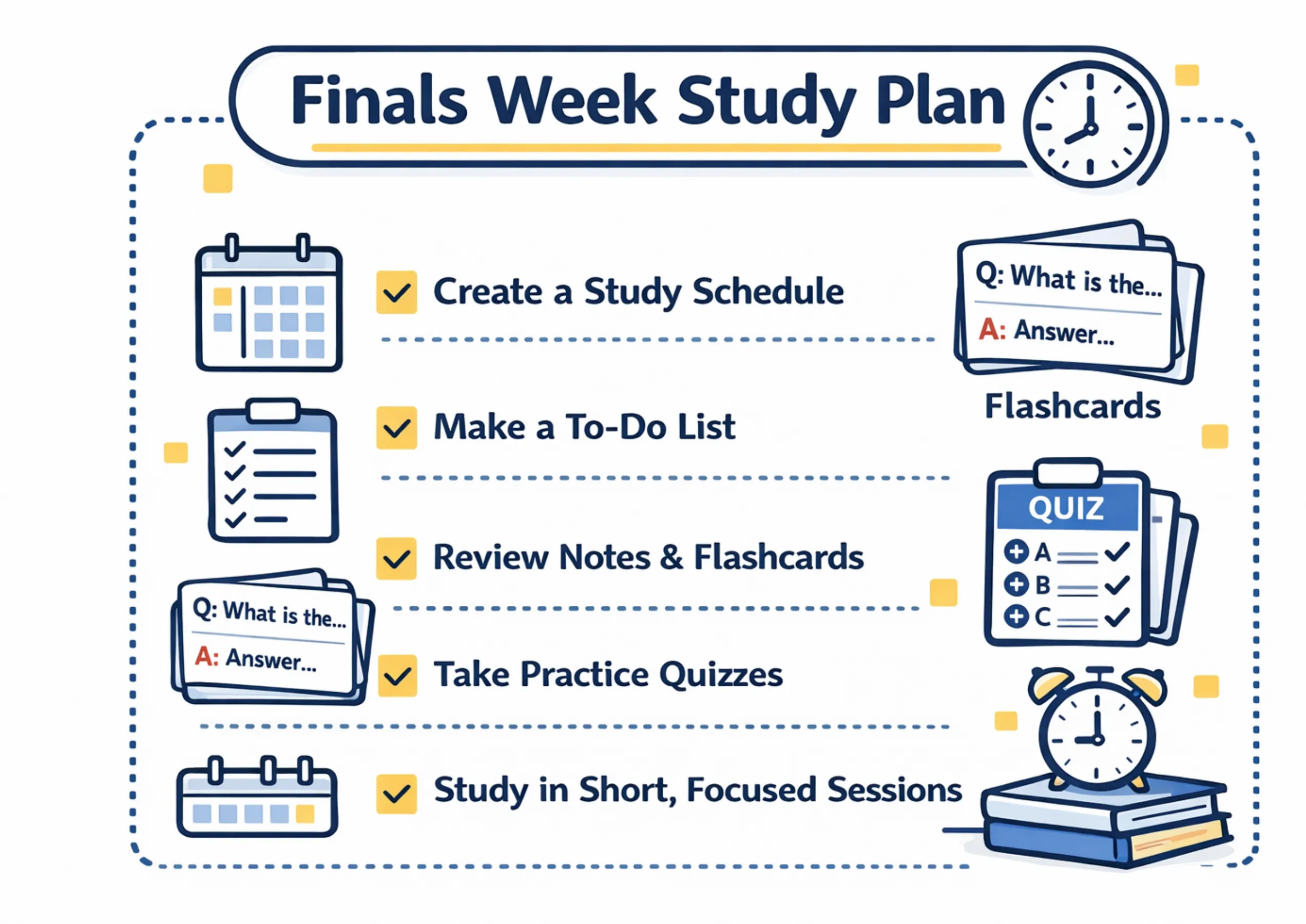
Your 7-Day Finals Plan at a Glance
- Day 1: Gather & organize all materials
- Day 2: AI summaries — identify what matters
- Day 3: Active recall with AI flashcards
- Day 4: Self-testing with AI quizzes
- Day 5: Deep dive on weak areas
- Day 6: Full practice run + spaced repetition
- Day 7: Light review + confidence building
Finals Week Doesn't Have to Be a Disaster
Every semester, the same scene plays out on campuses everywhere: students surrounded by towering stacks of notes, fueled by caffeine and desperation, trying to cram an entire semester's worth of knowledge into their brains in 48 hours. The result is predictable — exhaustion, anxiety, and exam performance that doesn't reflect what they actually know.
But here's the truth: if you have one week before finals start, you have more than enough time to prepare effectively. The difference between students who thrive during finals and those who barely survive isn't intelligence or how many hours they study — it's how they study. And in 2026, AI tools have made the most effective study strategies dramatically more accessible.
This guide gives you a concrete, day-by-day plan that combines proven cognitive science techniques (active recall, spaced repetition, interleaving) with AI tools that automate the tedious parts of studying. Whether you're a medical student facing boards or an undergrad with four exams in three days, this plan works.
Why AI Changes Everything for Finals Prep
The biggest time sink during finals isn't actually studying — it's organizing. Students spend hours re-reading notes, rewriting summaries, and creating flashcards before they ever start actively learning. AI tools like LectureScribe eliminate this preparation overhead entirely, letting you jump straight into the study methods that actually work.
The 7-Day AI-Powered Finals Study Plan
Follow this plan exactly, adjusting the time allocation based on how many exams you have and their relative difficulty. The key principle: front-load organization, then shift to active practice.
Gather & Organize All Materials
Day 1 is entirely about getting organized. This is the most important step — and the one AI accelerates the most.
Lecture recordings, slides, PDFs, handwritten notes, textbook chapters, past assignments, and any study guides your professor provided.
Upload all your lecture recordings, note photos, and PDFs. The AI will transcribe audio, OCR handwritten notes, and extract text from PDFs automatically. By tomorrow morning, you'll have searchable, organized digital versions of everything.
Write down every exam date, time, and location. Allocate proportionally more study time to harder exams and exams worth a larger percentage of your grade.
Time needed: 2-3 hours for gathering + uploading. AI processing happens overnight.
AI-Generated Summaries — Identify What You Actually Need to Know
Now that LectureScribe has processed your materials, it's time to figure out what matters most. Not everything your professor covered will be on the exam.
LectureScribe's summaries distill hours of lectures into the essential concepts. Read through each one and highlight the topics that keep appearing — those are your high-priority areas.
Check the AI summaries against your syllabus and any exam review guides. Mark topics that are explicitly mentioned as "on the exam."
For each major topic, honestly rate how well you understand it. Anything below a 3 gets priority attention on Days 4-5.
Time needed: 4-5 hours across all subjects. This is the strategic planning that makes the rest of the week efficient.
Active Recall with AI Flashcards
This is where real learning begins. Active recall — trying to retrieve information from memory rather than passively re-reading it — is the single most effective study technique backed by cognitive science.
LectureScribe automatically creates flashcards from your lecture content. These cards cover key definitions, concepts, processes, and relationships the AI identified as important.
For each flashcard, genuinely try to answer before revealing the answer. This struggle is where learning happens. Even getting it wrong strengthens the memory pathway.
Mark any card you couldn't answer or answered incorrectly. These flagged cards become your priority deck for Days 5-6.
Time needed: 5-6 hours. Study each subject's flashcards in 25-minute focused blocks with 5-minute breaks between.
Self-Testing with AI Quizzes — Find Your Weak Spots
Testing yourself is not just a way to measure what you know — it's one of the most powerful ways to learn. The testing effect shows that retrieving information during a quiz strengthens that memory more than additional study time.
LectureScribe generates practice quizzes from your lecture content. Take each quiz without looking at your notes — treat it like a real exam.
Don't just look at the overall score. Note which specific topics you got wrong. Any topic where you score below 70% needs focused attention tomorrow.
After each quiz, go back to the AI summary for every question you missed. Understanding why you got it wrong is more valuable than just seeing the correct answer.
Time needed: 5-6 hours. Take quizzes for each subject, then spend time reviewing incorrect answers.
Deep Dive on Weak Areas + Targeted Review
Day 5 is the most critical day. By now, you have a clear map of what you know and what you don't. Today, you attack the gaps.
Take the topics you scored below 70% on and the flashcards you flagged. Re-read the relevant AI summaries, then use the Feynman technique: explain the concept out loud as if teaching someone else.
Look at LectureScribe's visual infographics for difficult topics. Seeing relationships mapped visually often unlocks understanding that text alone doesn't.
After studying each weak topic, test yourself again. You should see noticeable improvement. If a topic is still below 70%, it needs one more focused session on Day 6.
Time needed: 6-7 hours. This is the hardest day — you're spending all your time on the material you find most difficult.
Full Practice Run — Timed Quizzes + Spaced Repetition
Day 6 is about building exam-day stamina and confidence. You simulate real exam conditions and do a comprehensive spaced repetition review.
Take practice quizzes under timed conditions that mirror your actual exam format. If your exam is 90 minutes, set a 90-minute timer. This builds time management skills and reduces exam-day anxiety.
Go through all your flashcard decks, but spend proportionally more time on the cards you flagged as difficult. The spaced repetition principle means reviewing these cards one more time before the exam dramatically improves retention.
Instead of studying one subject for hours, switch between subjects every 45-60 minutes. Research shows interleaving (mixing topics) improves your ability to discriminate between concepts and apply the right knowledge on exam day.
Time needed: 5-6 hours. Focus on practice testing and review. Stop studying by 9 PM to allow for proper rest.
Light Review + Confidence Building (No Cramming)
This is the day most students ruin by cramming. Don't. Your brain needs time to consolidate what you've learned over the past six days. Trust the process.
Skim through your AI-generated summaries one final time. Don't try to memorize new things — just refresh the big picture.
Go through your flagged/difficult flashcards one last time. Keep it to 60-90 minutes maximum. If you know it, great. If not, one more look won't change things.
Eat a good dinner, prepare your exam materials (calculator, pencils, ID), set multiple alarms, and go to bed early. 7-8 hours of sleep is non-negotiable — your brain consolidates memories during sleep.
Time needed: 2-3 hours of light review maximum. The rest of the day is for rest and preparation.
The Science Behind Why This Plan Works
This isn't just a study plan we made up — every element is grounded in decades of cognitive science research. Here are the three pillars that make it effective:
Active Recall
Testing yourself forces your brain to retrieve information, strengthening neural pathways far more than passive re-reading. Studies show active recall improves retention by 50-150% compared to re-reading alone.
Spaced Repetition
Reviewing material at increasing intervals (Day 3, then Day 5, then Day 6) exploits the spacing effect. Your brain remembers information better when exposure is distributed over time rather than massed into one session.
Interleaving
Mixing different subjects and types of problems during study sessions (Day 6) forces your brain to discriminate between concepts. This is harder in the moment but produces significantly better exam performance.
The AI component accelerates these techniques by eliminating the hours you'd normally spend creating flashcards, writing summaries, and designing practice questions manually. Instead, you spend 100% of your time on the activities that actually build knowledge and retention.
The Tool That Makes This Plan Possible: LectureScribe
This 7-day plan relies heavily on having AI-generated summaries, flashcards, and quizzes ready to go. LectureScribe is the only tool that provides the complete pipeline needed for every step:
How LectureScribe Supports Each Day:
Upload audio, video, images of handwritten notes, and PDFs. AI transcribes and digitizes everything.
AI-generated summaries distill each lecture into key concepts, saving hours of manual note consolidation.
Auto-generated flashcards from your actual course content — no manual card creation needed.
AI practice quizzes test your knowledge. Visual infographics provide alternative ways to understand complex topics.
Start your finals prep today
1 Free Upload | $9.99/month
No credit card required
Emergency Plan: What If You Only Have 3 Days?
Sometimes life happens and you don't get a full week. If you only have 3 days, here's the condensed version. It's not ideal, but it's far better than unstructured cramming.
Day 1 (Compressed): Organize + Summarize
Upload everything to LectureScribe in the morning. While AI processes, review your syllabus and identify the highest-priority topics. By afternoon, read through AI summaries and create your topic priority list. In the evening, start on auto-generated flashcards for your hardest exam.
Day 2 (Compressed): Test + Fix
Take AI quizzes for every subject. Identify all topics below 70%. Spend the rest of the day doing deep dives on those weak topics only. Re-quiz yourself on weak areas before bed. Study all flashcard decks once, flagging difficult cards.
Day 3 (Compressed): Review + Rest
Morning: One timed practice quiz per subject. Midday: Final flashcard pass focusing on flagged cards only. Afternoon: Light summary review. Stop studying by 5 PM. Evening: Prepare materials, eat well, sleep early. Do not study past 5 PM.
The 3-Day Plan Only Works With AI
Without AI tools, condensing a full study plan into 3 days is nearly impossible because you'd spend most of your time on organization and manual flashcard creation. LectureScribe compresses what normally takes 2-3 days of preparation into a few hours of upload time.
What NOT to Do During Finals Week
Knowing what to avoid is just as important as knowing what to do. Here are the most common mistakes students make during finals week, backed by research:
Sleep deprivation reduces cognitive performance by 20-30%. One study found that students who pulled all-nighters scored a full letter grade lower on average. Your brain literally consolidates memories during sleep — skip it and your studying is partially wasted.
Re-reading creates a dangerous illusion of knowledge — the material feels familiar, but you can't actually recall it on the exam. Active recall (flashcards, quizzes, explaining out loud) is 3-5x more effective than re-reading.
Research consistently shows that highlighting is one of the least effective study strategies. It gives you a false sense of engagement without requiring actual processing. Use AI summaries to identify what matters, then test yourself on it.
After about 50 minutes, your focus and retention drop sharply. Use the Pomodoro technique: 50 minutes of focused study, then a 10-minute break. Get up, move, drink water, and let your brain process.
Your brain runs on glucose and oxygen. Skipping meals impairs concentration and memory. Even a 20-minute walk significantly improves cognitive function and reduces stress hormones that interfere with recall.
Day 7 should be review only. Trying to learn entirely new concepts the night before an exam adds confusion and anxiety without meaningful retention. Trust what you've already prepared.
Frequently Asked Questions
How many hours a day should I study during finals week?
Aim for 6-8 hours of focused study per day during finals week, broken into 50-minute sessions with 10-minute breaks (the Pomodoro technique). Quality matters more than quantity. Using AI tools like LectureScribe to generate summaries and flashcards can reduce the hours needed by focusing your time on active recall rather than passive re-reading.
Is it possible to study for finals in one week?
Yes, one week is enough to prepare for finals if you study strategically. The key is using active recall and spaced repetition instead of passive re-reading. AI tools can compress weeks of preparation by automatically generating summaries, flashcards, and practice quizzes from your lecture materials, letting you focus on learning rather than organizing.
What is the best way to study for finals without cramming?
The best way to avoid cramming is to follow a structured plan that uses spaced repetition and active recall. Start by organizing all your materials on Day 1, use AI to generate summaries and identify key topics on Day 2, then alternate between flashcard review, self-testing, and targeted deep dives on weak areas. This approach is far more effective than last-minute marathon study sessions.
Can AI tools really help me study for finals?
Absolutely. AI tools like LectureScribe can save 5-10 hours of manual preparation by automatically generating summaries, flashcards, and practice quizzes from your lecture recordings, notes, and PDFs. This lets you skip the tedious organization phase and jump straight into active studying, which is the most effective use of limited finals week time.
Should I pull an all-nighter before a final exam?
No. Research consistently shows that all-nighters hurt exam performance. Sleep deprivation impairs memory consolidation, critical thinking, and recall. You are better off studying until 10-11 PM and getting 7-8 hours of sleep. Your brain consolidates memories during sleep, so a well-rested brain with slightly less study time will outperform an exhausted brain that studied all night.
What should I do the day before a final exam?
The day before a final, do a light review only: skim your AI-generated summaries, do one final pass through your flashcards focusing on flagged weak areas, and take one timed practice quiz. Avoid learning new material. Eat well, exercise lightly, and go to bed early. Confidence and rest matter more than cramming at this point.
Finals Are Coming — Start Your Study Plan Today
Upload your lectures and notes now. By tomorrow, you'll have AI summaries, flashcards, and quizzes ready to go.
Try 1 Free Upload - No Credit Card RequiredLecture transcription + Auto flashcards + AI quizzes + Visual infographics + 50+ languages
Related Articles
How to Study for Exams Using AI
Complete guide to using AI tools for exam preparation across every subject.
AI Study Hacks Every Student Should Know
Discover the AI-powered study techniques top students are using right now.
Auto-Generate Flashcards from Lectures
How AI creates study materials automatically from your lecture content.
10 Best AI Study Apps for Students in 2026
Complete reviews and comparisons of the top AI study tools available today.