LectureScribe Logo
lecturescribe.io
BlogFAQ
Managerial Accounting Flashcards

Managerial Accounting Flashcards
Master Cost Accounting & CVP

Free flashcards for managerial accounting—cost behavior, budgeting, variance analysis, and decision-making. Generate cards from your lectures or use our curated study sets.

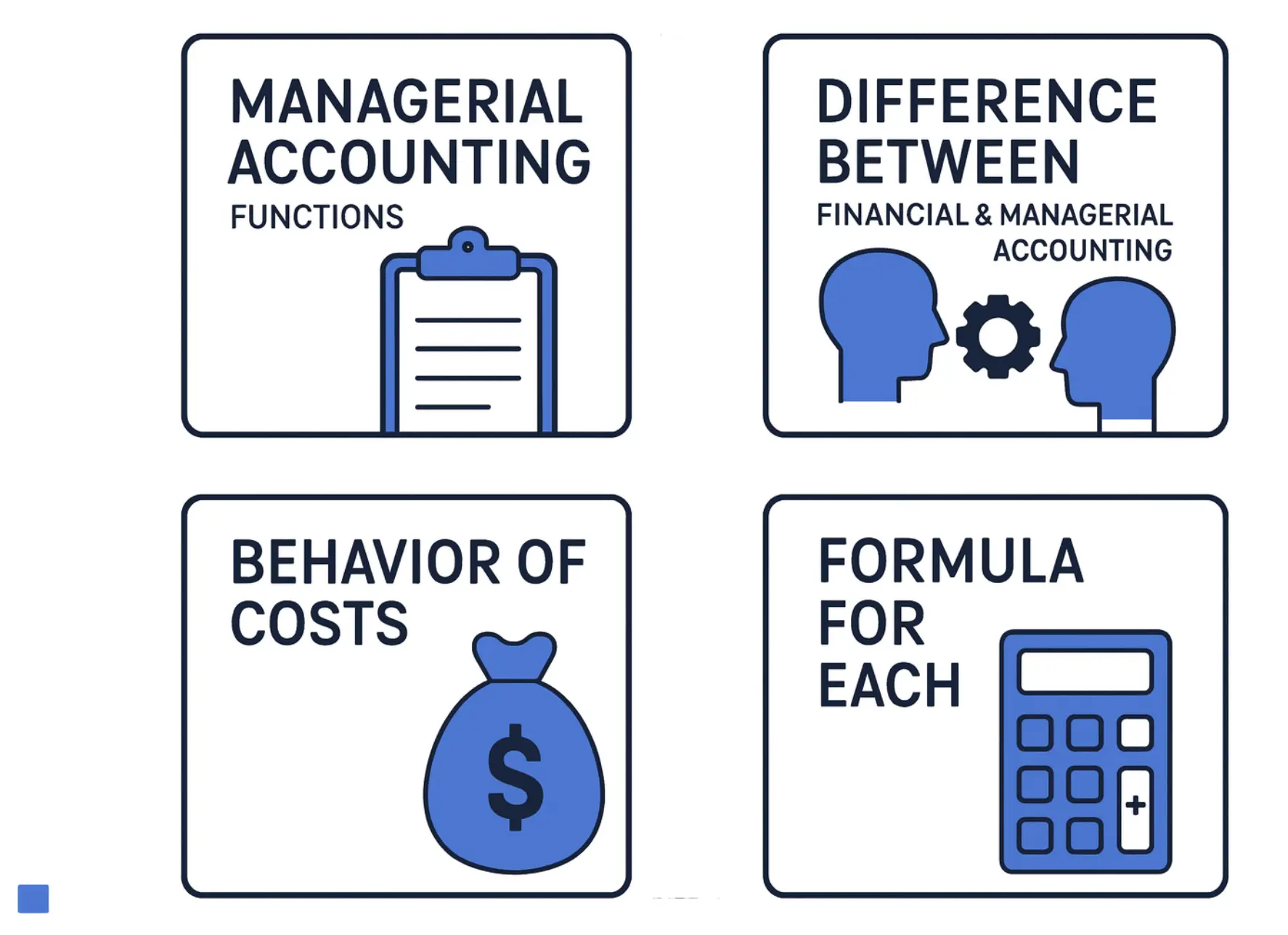
Managerial accounting flashcards showing CVP analysis formulas, break-even point calculations, contribution margin examples, variance analysis, and cost behavior concepts for business students

What are the best managerial accounting flashcards?

The best managerial accounting flashcards cover: (1) Cost behavior—fixed, variable, and mixed costs, (2) CVP analysis—contribution margin, break-even, target profit, (3) Budgeting—master budgets, flexible budgets, cash budgets, (4) Variance analysis—price, quantity, efficiency variances, (5) Activity-based costing and decision-making. AI-generated cards ensure you study exactly what your professor emphasizes.

Essential Managerial Accounting Topics:

  • Cost classification & behavior
  • CVP analysis & break-even
  • Job-order & process costing
  • Master & flexible budgets
  • Standard costing & variances
  • Activity-based costing (ABC)
  • Relevant costs for decisions
  • Performance evaluation (ROI, RI)

Sample Managerial Accounting Flashcards

Preview cards covering key concepts for cost and management accounting

Front

What is contribution margin?

Back

Sales revenue minus variable costs. CM = Sales - Variable Costs. It represents the amount available to cover fixed costs and generate profit. Can be expressed as total, per unit, or ratio.

Front

How do you calculate break-even point in units?

Back

Break-even units = Fixed Costs ÷ Contribution Margin per Unit. At break-even, total revenue equals total costs (profit = 0). Example: $100,000 fixed costs ÷ $25 CM/unit = 4,000 units.

Front

What is a favorable variance?

Back

A variance that increases operating income compared to budget. For revenues: actual > budget is favorable. For costs: actual < budget is favorable. Unfavorable variances decrease operating income.

Front

Define Activity-Based Costing (ABC)

Back

A costing method that assigns overhead costs to products based on activities that drive costs, not just volume. Uses cost drivers (e.g., machine hours, setups, inspections) to allocate costs more accurately than traditional methods.

Front

What is the formula for ROI (Return on Investment)?

Back

ROI = Operating Income ÷ Average Operating Assets. Can also be calculated as: Margin × Turnover = (Operating Income/Sales) × (Sales/Average Operating Assets). Used to evaluate division performance.

Front

What is a flexible budget?

Back

A budget adjusted for the actual level of activity achieved. Unlike static budgets, flexible budgets allow meaningful variance analysis by comparing actual results to what should have been spent at the actual activity level.

How to Create Managerial Accounting Flashcards

Turn your accounting lectures into study-ready flashcards in 3 steps

1

Upload Your Lecture

Record your managerial or cost accounting lecture. Works with any textbook—Garrison, Horngren, or Weygandt.

2

AI Generates Flashcards

Our AI identifies formulas, definitions, and calculation methods. Creates cards with examples automatically.

3

Study & Export

Review with spaced repetition or export to Anki/Quizlet. Ace your cost accounting exams.

The Complete Guide to Managerial Accounting Flashcards

Managerial accounting differs fundamentally from financial accounting—instead of reporting to external stakeholders, it provides internal decision-makers with the information they need to plan, control, and evaluate operations. This means formulas, not just definitions, are crucial. From calculating break-even points to analyzing variances, you need instant recall of these tools.

Why Formula Flashcards Matter in Managerial Accounting

Unlike some subjects where conceptual understanding alone suffices, managerial accounting demands computational fluency. On exams, you won't have time to derive the contribution margin ratio from first principles—you need to know it instantly:

  • CVP Analysis: Break-even units, target profit calculations, margin of safety, operating leverage
  • Variance Analysis: Price variance, quantity variance, efficiency variance, spending variance
  • Performance Metrics: ROI, Residual Income, EVA, balanced scorecard measures

Creating Application-Focused Cards

The best managerial accounting flashcards don't just test formula recognition—they test when and how to apply formulas:

Basic card: "What is the contribution margin formula?" → "Sales - Variable Costs"

Better card: "If sales are $500K and CM ratio is 40%, what's the contribution margin?" → "$200,000"

Best card: "Fixed costs: $150K, CM/unit: $25. Sales manager wants to know units needed for $50K profit. Formula and answer?" → "(FC + Target Profit) ÷ CM/unit = ($150K + $50K) ÷ $25 = 8,000 units"

Structuring Your Managerial Accounting Deck

  1. Cost Behavior: Fixed, variable, mixed costs, relevant range, high-low method (25-30 cards)
  2. CVP Analysis: Break-even, target profit, sensitivity analysis, multi-product scenarios (30-40 cards)
  3. Budgeting: Master budget components, flexible budgets, cash budgets (25-35 cards)
  4. Standard Costing: Setting standards, variance calculations, variance investigation (35-45 cards)
  5. Decision Making: Relevant costs, make-or-buy, special orders, constraint analysis (20-30 cards)

LectureScribe captures the exact examples and calculation methods your professor uses, creating flashcards tailored to your specific course's approach to managerial accounting.

Managerial Accounting Flashcards FAQ

What are the best managerial accounting flashcards?

The best cover cost behavior, CVP analysis, budgeting, variance analysis, and activity-based costing. LectureScribe generates flashcards from your specific course lectures.

How do I memorize managerial accounting formulas?

Create flashcards with formula name on front, formula + example on back. Group related formulas together. Practice calculations, not just recognition. Use spaced repetition.

What topics should I make flashcards for?

Essential topics: Cost classification, CVP analysis, job-order/process costing, budgeting, variance analysis, ABC, relevant costs, capital budgeting, and performance evaluation.

Can I create flashcards from my accounting lectures?

Yes! LectureScribe transcribes and generates flashcards automatically, recognizing accounting terminology and formulas.

How many flashcards do I need?

Typically 40-50 for definitions, 30-40 for formulas, 20-30 for calculation steps. Total: 90-120 cards per course.

Ready to Ace Managerial Accounting?

Generate flashcards from your lectures in minutes. Free to start.

Create Your Accounting Flashcards