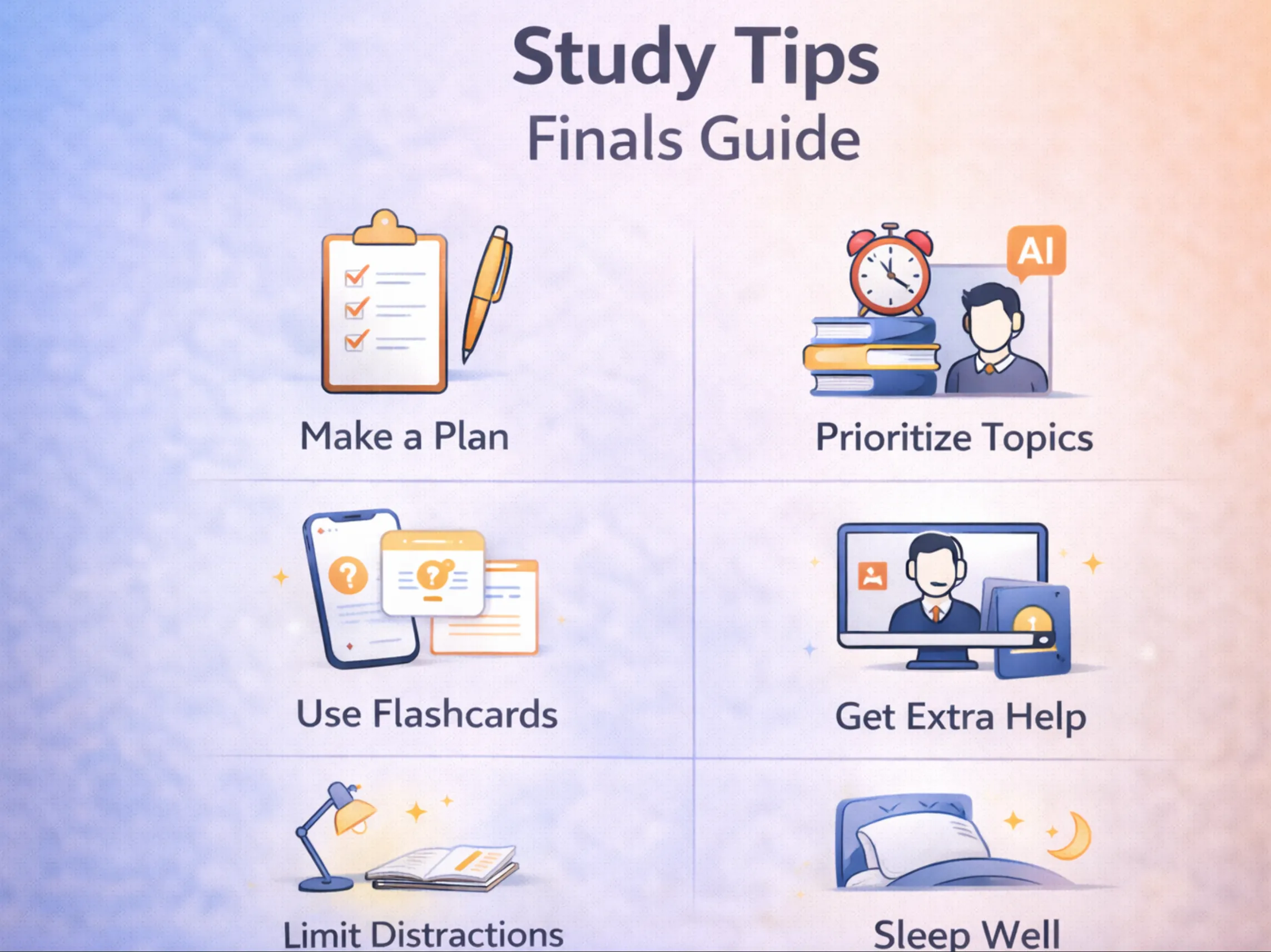
Finals season is here, and whether you're a college freshman facing your first round of spring exams or a seasoned upperclassman looking to optimize your study routine, these 10 proven study tips will help you prepare smarter, retain more, and walk into each exam with confidence.
Written by Sarah Mitchell
Education Tech Researcher
Sarah specializes in AI-driven learning tools and has spent over 5 years analyzing how technology improves student outcomes. She has helped thousands of students develop effective study strategies for high-stakes exams.
Quick Finals Study Summary
- Start Date: 3 weeks before your first final (the 21-day plan)
- Best Method: Active recall + spaced repetition (not re-reading)
- Study Blocks: 25 min focused / 5 min break (Pomodoro Technique)
- AI Tool: LectureScribe (convert notes & lectures into flashcards instantly)
- Sleep: 7-8 hours per night, even during finals week
- Key Insight: Quality over quantity — 6 focused hours beat 12 passive hours
Table of Contents
Why Spring Finals Feel Different
Spring finals carry a unique weight. Unlike fall midterms or even December finals, spring exams come at the end of an entire academic year. You're dealing with cumulative material from a full semester (sometimes two), warmer weather pulling you outdoors, and the mental fatigue of months of coursework. For many students, spring finals also determine whether they keep scholarships, maintain their GPA, or qualify for summer opportunities.
The good news? The strategies that work for finals haven't changed, but the tools available in 2026 have. AI-powered study platforms can now convert an entire semester's worth of lecture notes into organized flashcards in minutes. Spaced repetition apps use algorithms to schedule your reviews at scientifically optimal intervals. And AI tutors can explain any concept you're struggling with, available 24/7 without the cost of a human tutor.
This guide combines time-tested study techniques with modern AI tools to give you a complete game plan for crushing your spring 2026 finals. Whether you have three weeks or three days, these tips will help you make the most of your study time.
The Science of Finals Performance
Research from cognitive psychology consistently shows that students who use active recall and spaced repetition score 20-30% higher on exams than students who rely on passive re-reading. Yet a 2025 survey found that 72% of college students still list “re-reading notes” as their primary study method. The tips in this guide are designed to move you into the top-performing 28%.
Tip 1: Start 3 Weeks Early (The 21-Day Plan)
The single most impactful change you can make is starting earlier. Three weeks before your first final gives you enough runway to review all material without cramming. The 21-day plan works because it aligns with how your brain forms long-term memories: you need multiple exposures spread over time, not one marathon session the night before.
Week 1: Organize
- -Gather all notes, slides, and recordings
- -Create a master study schedule
- -Identify weak areas per course
- -Generate flashcards from semester notes
Week 2: Deep Review
- -Active recall sessions for each subject
- -Practice problems and past exams
- -Spaced repetition flashcard review
- -Study group sessions for hard topics
Week 3: Sharpen
- -Timed practice exams under real conditions
- -Focus exclusively on weak areas
- -Light review the day before each exam
- -Prioritize sleep and nutrition
Even if you're reading this with less than three weeks to go, the framework still applies. Compress the timeline, but keep the phases: organize first, then actively review, then sharpen. Any structured plan beats no plan.
Tip 2: Use AI to Convert Your Semester Notes into Flashcards
One of the biggest time sinks during finals prep is creating study materials from scratch. You have months of lecture notes, slides, and textbook highlights, and turning all of that into usable flashcards or summaries can take hours per course. This is where AI study tools save you a massive amount of time.
LectureScribe is purpose-built for this exact problem. Upload your lecture recordings, class notes, or PDF slides, and it generates targeted flashcards, organized summaries, and study guides in minutes. Instead of spending the first week of your 21-day plan just making flashcards, you can have AI create them and spend your time actually learning the material.
How LectureScribe Works for Finals Prep
Lecture recordings, PDF slides, handwritten notes, or even YouTube lecture links from the entire semester.
Within minutes, get organized flashcards covering key terms, concepts, and relationships your professor emphasized.
Use the built-in quiz mode or export to your favorite spaced repetition app for optimal review scheduling.
Get started in minutes
1 Free Upload | Plans from $9.99/month
The key advantage is speed and coverage. A student studying for 5 finals would need to create flashcards for 5 courses worth of material. With LectureScribe, you can process an entire semester of lecture recordings across all courses in a single evening, then spend the rest of your study time on active learning instead of material preparation.
Tip 3: Practice Active Recall, Not Re-Reading
This is arguably the most important tip in this entire guide. Active recall means forcing your brain to retrieve information from memory, rather than passively recognizing it while re-reading. Every time you successfully recall a fact, the neural pathway for that memory gets stronger.
The problem with re-reading is that it creates an illusion of competence. When you read your notes, the material feels familiar, so you think you know it. But recognition and recall are completely different cognitive processes. You need recall on the exam, not recognition.
Passive Methods (Less Effective)
- xRe-reading notes and textbooks
- xHighlighting or underlining
- xWatching lecture recordings passively
- xCopying notes word-for-word
Active Methods (Highly Effective)
- Self-quizzing with flashcards
- Practice problems without looking at solutions
- Teaching concepts to someone else
- Writing summaries from memory (blank page method)
A practical way to implement active recall: close your notes, take a blank sheet of paper, and write down everything you can remember about a topic. Then open your notes and check what you missed. Focus your next study session on the gaps. This simple technique is one of the most powerful study methods ever validated by research.
Tip 4: Use Spaced Repetition for Long-Term Memory
Spaced repetition is the practice of reviewing material at increasing intervals over time. Instead of reviewing all your flashcards every day, a spaced repetition system shows you cards right before you're about to forget them. This is based on Hermann Ebbinghaus's forgetting curve: without review, you forget roughly 70% of new information within 24 hours.
Spaced Repetition Schedule Example
Day 1
First review
Day 3
Second review
Day 7
Third review
Day 14
Fourth review
Day 21
Final review
This is why starting 3 weeks early matters: it gives you time for 4-5 spaced repetitions, which research shows transfers information into long-term memory.
The easiest way to implement spaced repetition is with flashcard apps that have built-in algorithms (like Anki). If you use LectureScribe to generate your flashcards, you can export them directly to Anki or use LectureScribe's own quiz mode to review them on a schedule. The combination of AI-generated flashcards and algorithmic review scheduling is one of the most time-efficient study workflows available in 2026.
Tip 5: Take Practice Tests Under Exam Conditions
Practice testing is one of the two most effective study strategies identified by cognitive science (alongside spaced repetition). But to get the full benefit, you need to simulate real exam conditions: set a timer, put away your notes, silence your phone, and work through the problems exactly as you would during the actual exam.
This does two things. First, it gives you an honest assessment of what you actually know versus what you think you know. Second, it reduces test anxiety by making the exam environment feel familiar. Students who take practice tests report significantly less anxiety on exam day because the experience no longer feels novel.
Where to Find Practice Tests
- Your professor: Many professors share past exams or practice tests. Ask during office hours.
- Course test banks: Check if your textbook includes online practice questions.
- AI-generated quizzes: Use LectureScribe to generate practice quizzes from your own lecture content.
- Study groups: Have members write questions for each other based on lecture material.
After each practice test, spend at least as much time reviewing your mistakes as you spent taking the test. Understand why you got each question wrong. Was it a content gap, a misread question, or a careless error? This analysis is where the deepest learning happens.
Tip 6: Use the Pomodoro Technique (25/5 Intervals)
The Pomodoro Technique is a time management method that breaks study sessions into 25-minute focused blocks separated by 5-minute breaks. After every four Pomodoros (about 2 hours), take a longer 15-30 minute break. This structure works because it aligns with your brain's natural attention span and prevents the diminishing returns that come from marathon study sessions.
Sample Pomodoro Study Day (6 Hours)
Repeat for afternoon session with different subjects...
The key rule: during a Pomodoro, you do nothing except study. No checking your phone, no responding to texts, no browsing. If a distracting thought pops up, write it down on a notepad and return to it during a break. This level of focus for 25 minutes is achievable for almost anyone, and the cumulative effect over a full study day is remarkable.
Tip 7: Prioritize Sleep Over Late-Night Cramming
This is the tip most students ignore, and it might be the one that matters most. Sleep is not wasted study time. It is when your brain consolidates memories, strengthens neural connections, and processes the information you studied during the day. Research from Harvard Medical School shows that sleep deprivation can reduce cognitive performance by up to 40%.
The math is simple: if you pull an all-nighter and study for 8 extra hours but perform 40% worse on the exam, you've net lost. Students who sleep 7-8 hours the night before an exam consistently outperform those who stayed up late cramming, even when the crammers studied more total hours.
Sleep Tips During Finals Week
- Set a hard stop: Stop studying at least 1 hour before bed to let your mind wind down.
- Keep a consistent schedule: Go to bed and wake up at the same time, even during finals.
- No screens in bed: Blue light suppresses melatonin. Read physical notes if you must review.
- Nap strategically: A 20-minute afternoon nap can boost memory consolidation without disrupting night sleep.
If you followed Tip 1 and started studying 3 weeks early, you won't need to pull all-nighters. The 21-day plan exists specifically so that by the time finals week arrives, you've already reviewed everything multiple times and can afford to prioritize rest.
Tip 8: Form Study Groups and Share AI-Generated Materials
Study groups work because they leverage the teaching effect: explaining a concept to someone else is one of the deepest forms of active recall. When you have to articulate an idea clearly enough for a classmate to understand it, you're forced to organize your thinking and identify gaps in your own knowledge.
In 2026, study groups are even more powerful because you can share AI-generated materials. If one group member uses LectureScribe to generate flashcards from a lecture that another member missed, the whole group benefits. You can divide and conquer: each person processes a different set of lectures, then shares the generated study materials with the entire group.
Study Group Best Practices
Do:
- - Keep groups small (3-5 people)
- - Set a specific agenda for each session
- - Quiz each other with flashcards
- - Take turns explaining difficult concepts
- - Share AI-generated study guides
Don't:
- - Let sessions turn into social hangouts
- - Rely solely on group study (review alone too)
- - Invite more than 5 people
- - Skip topics because “everyone gets it”
- - Meet without preparation
The ideal workflow: study alone first to identify what you know and what confuses you, then bring your questions to the group. Use the group session to work through difficult problems together, quiz each other, and share resources. Then study alone again afterward to reinforce what you learned.
Tip 9: Use AI Tutors for Concept Clarification
One of the most frustrating parts of finals prep is getting stuck on a concept at 11 PM when office hours are closed and your study group is asleep. In 2026, AI tutors solve this problem completely. They're available 24/7, they never judge you for asking a “basic” question, and they can explain the same concept in multiple different ways until it clicks.
LectureScribe's AI tutor is particularly useful during finals because it has context from your own course materials. Instead of getting a generic explanation of thermodynamics or macroeconomics, you get explanations grounded in the specific lectures and examples your professor used. This makes the AI tutor's responses directly relevant to what will appear on your exam.
When to Use an AI Tutor
A word of caution: use AI tutors for understanding, not as a shortcut to avoid thinking. The goal is to have the AI explain concepts until you genuinely understand them, then test yourself without the AI to confirm you've internalized the knowledge. Used correctly, an AI tutor during finals prep is like having unlimited office hours with a patient, knowledgeable teaching assistant.
Tip 10: Review Past Exams and Identify Patterns
Professors are creatures of habit. Most instructors draw from a relatively consistent pool of question types, topics, and formats across semesters. By reviewing past exams (if available), you can identify patterns that dramatically focus your study efforts.
Look for these patterns: Which topics appear on every exam? What question formats does the professor favor (multiple choice, short answer, essays, problem sets)? Are there any topics from the syllabus that are tested more heavily? Do the questions emphasize memorization, application, or analysis?
Past Exam Analysis Checklist
- Collect past exams from the professor, department, or older students
- Note which topics are tested most frequently
- Identify the question format breakdown (% multiple choice vs. free response)
- Look for “signature questions” the professor always includes
- Take each past exam under timed conditions as practice
- Focus your remaining study time on the highest-frequency topics
If you can't find past exams, use these alternatives: check if the textbook has chapter review questions that match the course, look at the learning objectives on the syllabus (professors often write exam questions directly from these), and pay special attention to topics the professor spent multiple lectures on or explicitly said “this will be on the exam.”
Frequently Asked Questions About Studying for Finals
How far in advance should I start studying for finals?
Ideally, start at least 3 weeks (21 days) before your first final exam. This gives you enough time to review all material using spaced repetition, which research shows is far more effective than cramming. During the first week, organize and review notes. During the second week, do active recall and practice tests. During the third week, focus on weak areas and do full practice exams under timed conditions.
What is the most effective study method for finals?
Active recall combined with spaced repetition is the most effective study method according to cognitive science research. Instead of re-reading notes, test yourself repeatedly on the material. Use flashcards, practice problems, and self-quizzing. AI tools like LectureScribe can convert your semester notes and lecture recordings into flashcards automatically, making active recall easy to implement across all your courses.
Is it better to study all night or sleep before a final?
Sleep is almost always the better choice. Research from Harvard Medical School shows that sleep deprivation can reduce cognitive performance by up to 40%. During sleep, your brain consolidates memories and strengthens neural connections formed during studying. Aim for 7-8 hours of sleep the night before each exam. If you must choose between one more hour of studying or one more hour of sleep, choose sleep.
How can AI tools help me study for finals?
AI study tools like LectureScribe can dramatically reduce preparation time by automatically converting lecture recordings, notes, and textbook content into flashcards, study guides, and practice quizzes. Instead of spending hours creating study materials manually, you can upload your semester content and have AI generate comprehensive review materials in minutes. AI tutors can also provide instant explanations for concepts you find confusing.
How many hours a day should I study during finals week?
Most experts recommend 6-8 hours of focused study per day during finals week, broken into 25-minute focused blocks with 5-minute breaks (the Pomodoro Technique). This totals about 12-16 Pomodoro sessions per day. However, quality matters more than quantity. Six focused hours with active recall are more effective than 12 hours of passive re-reading. Take longer breaks every 2 hours and stop studying at least 1-2 hours before bed.
Should I study alone or in a group for finals?
Both have benefits, and the ideal approach combines both. Study alone for initial review and memorization using flashcards and practice problems. Then use study groups to test each other, explain difficult concepts aloud (which deepens understanding), and share resources like AI-generated study materials from LectureScribe. Limit group sessions to 2-3 focused hours and keep groups small (3-5 people) to stay productive.
Ready to Crush Your Spring Finals?
Convert your entire semester of notes and lectures into flashcards, study guides, and practice quizzes in minutes
Try LectureScribe Free - No Credit Card RequiredUpload your lecture recordings and start generating study materials instantly
Related Articles
10 Best AI Study Apps for Students 2026
Complete guide to the top AI-powered study tools for academic success.
How to Study for AP Biology: AI Tools & Strategies
Expert guide covering all 8 units, exam format, study timeline, and best AI apps.
AI Flashcard Maker
Create flashcards instantly from any lecture, textbook, or notes using AI.
Browse All Study Materials
Explore our full library of AI-generated study materials across all subjects.