Bar Exam Final 3 Weeks: An AI-Powered Cram Plan for the July 2026 Sitting
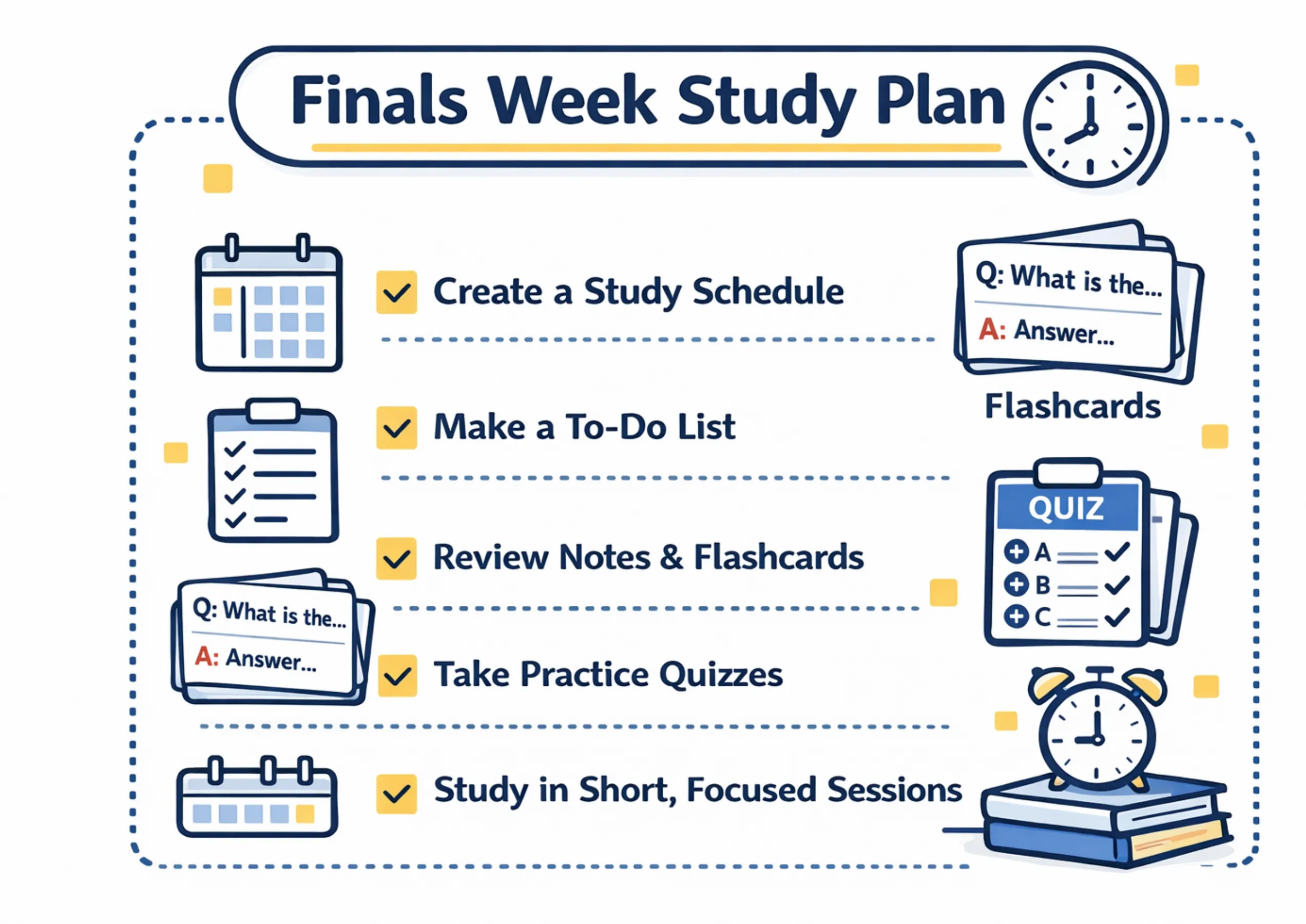
With the July sitting weeks away, your bar exam study plan can no longer be about learning new law. The final three weeks are won on high-volume MBE practice, airtight MEE rule statements, and timed MPTs. Here is a day-by-day plan that uses AI to do the busywork so you can spend your hours on the only thing that moves your score: active recall.
Written by Sarah Mitchell — Education Tech Researcher. Sarah covers the learning science behind effective studying and has spent years testing how AI tools change the way students prepare for high-stakes exams.
Key Takeaways
- The final three weeks are for consolidation and practice, not learning new material — if you are still seeing rules for the first time, triage ruthlessly.
- Spend the bulk of your hours on timed practice: 50–100 MBE questions daily, full MEE essays, and four to six full MPTs under the clock.
- Active recall and spaced repetition beat re-reading outlines; the research on this is decades deep and unusually consistent.
- AI tools like LectureScribe turn your existing outlines into flashcards and quizzes in seconds, so prep time goes to practice instead of formatting.
- Taper in the last 48 hours: light review, confirmed logistics, and a full night of sleep matter more than one more outline.
Why the Last Three Weeks Are Different
If you are reading this in late May or early July with the bar looming, your bar exam study plan has to change shape. For the first six or eight weeks of bar prep, the job is intake: watching lectures, building outlines, and getting a first pass at the substantive law. That phase has a ceiling, and you have likely hit it. The final three weeks are a different game entirely, governed by a simple principle from cognitive science: you remember what you practice retrieving, not what you re-read.
In our testing of how students prepare for dense, high-stakes exams, the single most common mistake in the home stretch is comfort studying — re-reading a familiar outline because it feels productive. It rarely is. The classic work of Karpicke and Roediger showed that students who tested themselves on material retained dramatically more than those who restudied it, even though the restudiers felt more confident. That confidence gap is the trap. The bar does not reward recognition; it rewards recall under time pressure.
So the entire plan below is built around retrieval. Every block of time is either a timed practice set, a self-test, or a spaced-repetition flashcard session. The role of AI here is narrow but valuable: it removes the friction of turning your outlines into practice material so that none of your scarce hours are lost to formatting cards or building quizzes by hand. If you have not yet centralized your materials, our study tools built for law students are a good place to start.
Know What You Are Actually Being Tested On
Most July takers sit the Uniform Bar Examination, which has three components, each weighted differently and each demanding a different skill. Allocating your final three weeks correctly means matching your effort to the weighting and to your personal weaknesses, not to whichever subject you happen to enjoy.
| Component | Format | UBE Weight | Core Skill |
|---|---|---|---|
| MBE | 200 multiple-choice questions, 7 subjects | 50% | Fast, accurate rule application |
| MEE | 6 essays, 30 minutes each | 30% | Issue spotting and precise rule statements |
| MPT | 2 tasks, 90 minutes each, closed-universe | 20% | Organization and time management |
Notice that the MBE alone is half your score, and that the MPT tests almost no memorized law — it is a closed-universe task where you are handed the rules and the facts and graded on how well you organize a response. That distinction should reshape your schedule. Pouring weeks into memorizing more black-letter law for the MPT is wasted effort; that 20% is earned through reps on the format itself.
Week 1 (Days 1–7): Diagnose and Attack Weaknesses
The first week is about honest diagnosis followed by targeted attack. Start with a timed 50-question mixed MBE set and grade it by subject. Take one or two MEE essays under timing as well. The point is not the score — it is the ranking. By the end of day one you should be able to list the seven MBE subjects from strongest to weakest, and that ranking dictates where your hours go for the next seven days.
Once you know your weak subjects, convert their outlines into practice material immediately. Upload each outline to a tool that turns lectures and outlines into flashcards and let it generate a deck per subject. If your weakest area is, say, Future Interests in Property or the hearsay exceptions in Evidence, you want a focused deck on exactly those rules within the hour, not after an evening of manual card-making. You can do the same with a saved PDF outline using our PDF-to-flashcards converter.
Your daily Week 1 rhythm: a morning block of 50 MBE questions in your two weakest subjects, a thorough review of every miss, an afternoon flashcard session on those subjects, and one full MEE essay in the evening. Reviewing wrong answers is the highest-yield activity of the entire three weeks, so do not rush it. When an explanation reveals a rule you keep botching, add it to your deck with our AI flashcard generator so it cycles back through spaced repetition.
Data point: In Dunlosky et al.'s widely cited 2013 review of learning techniques, practice testing and distributed (spaced) practice were the only two strategies rated "high utility" across the board. Highlighting, rereading, and summarizing — the things most students default to — were rated low. Spend your week accordingly.
Week 2 (Days 8–14): Volume, Mixed Practice, and Essays
Week 2 is the engine room. Now that your weakest subjects have had concentrated attention, shift to high-volume mixed practice that mirrors the real exam. Move from 50 to 75–100 MBE questions per day, drawn from all seven subjects at once rather than blocked by topic. Mixed practice is harder and feels worse, but it is one of Robert Bjork's "desirable difficulties" — the interleaving forces you to first identify which rule applies before applying it, which is exactly what the real MBE demands.
On the essay side, this is the week to drill MEE rule statements until they are automatic. The MEE rewards a clean, accurate rule followed by a tight application, and the rule statement is the part you can fully control in advance. Build a flashcard for every high-frequency issue with the trigger on the front and the precise rule on the back. A practice quiz built from your essay outlines is a fast way to test whether you can produce those rules cold, and our short-answer quiz format maps neatly onto essay rules.
Continue writing one full MEE essay daily under a strict 30-minute clock, then self-grade against the released model answer. Time management is half the battle: many strong students lose points on the MEE not because they do not know the law but because they spend 45 minutes on one essay and rush three others. The clock is part of the skill. If you commute or have dead time, our visual infographics and study shorts let you review high-yield rules in 60-second bursts without opening a full outline.
Pro tip: Keep a running "error log" of every rule you miss twice. By the end of Week 2 this log becomes your single most valuable document — a personalized map of exactly where you are weak. Turn it into a dedicated flashcard deck and prioritize it in your final week.
Week 3 (Days 15–19): Simulate, Refine, and Taper
The final week sharpens what you have built. Do at least one full-length simulated MBE session this week — a real 100- or 200-question block under exam timing — to build the stamina and pacing the real day demands. Concentration is a physical skill, and three hours of multiple-choice is exhausting if you have only ever done 50 questions at a sitting. Simulating it once or twice removes a nasty surprise on exam day.
This is also MPT week. If you have been deferring the MPT — and most people do — now is the time to do four to six full tasks under the strict 90-minute clock. Because the MPT is closed-universe, the skill is purely procedural: read the task memo first, skim the file, build a quick outline in the format the memo demands, and write. Self-grade against released point sheets, which show you exactly how points are allocated. Most MPT improvement comes from format and time discipline, both of which respond fast to a handful of timed reps.
Spend the rest of the week cycling your error-log deck and your weakest-subject flashcards, with spaced repetition surfacing the cards you are most likely to forget. If a rule still will not stick, ask the AI tutor to explain it step by step using your own outline as the source — unlike a generic chatbot, it grounds the explanation in the material you actually studied, so you are not second-guessing whether the answer matches your jurisdiction's framing. For the deeper science behind why this works, our guides on the active recall study method and spaced repetition are worth a quick read between practice sets.
The Final 48 Hours: Taper, Don't Cram
The last two days are about arriving rested and confident, not about squeezing in one more subject. Athletes taper before a race for a reason, and the same logic applies to a cognitively demanding two-day exam. Do light, confidence-building review: skim your highest-yield flashcards, read a one-page outline of your single weakest subject, and stop by early afternoon the day before.
Spend the rest of that final day on logistics. Confirm your test center, your admission ticket and ID, your laptop and exam software, what you are allowed to bring, and your route and timing. Lay everything out the night before. The number of capable examinees who stumble on a forgotten ID or a dead laptop battery is higher than it should be, and every one of those mistakes is avoidable. Then sleep. A full night of rest does more for your recall than the marginal outline ever could.
For a structured way to manage the whole runway and avoid the all-nighter spiral, our AI study plan builder can lay out the three weeks day by day, and our companion guide on how to study for the bar exam with AI tools goes deeper on the full prep timeline.
Where AI Fits — and Where It Doesn't
It is worth being honest about the limits. AI will not pass the bar for you, and no tool substitutes for the reps. A generic chatbot like ChatGPT or Gemini can summarize a doctrine, but it is not grounded in your outlines or your jurisdiction, and it will occasionally state a rule with misplaced confidence — dangerous when precision is the whole game. Commercial bar courses still do the heavy lifting of teaching the substantive law, and their question banks remain the gold standard for MBE practice.
What AI does well in the final three weeks is eliminate busywork. The hours you would have spent hand-typing flashcards from a 90-page outline, building practice quizzes, or re-reading to find the rule you keep missing — that is where a tool like LectureScribe earns its place. Upload your outlines, lecture recordings, or even photos of your handwritten notes, and it generates flashcards, quizzes, study guides, and 60-second shorts automatically, then lets you drill them with built-in spaced repetition. Its AI tutor answers your questions using your actual materials as the source, and you can export everything to Anki, Quizlet, or PDF, so you own your data and are never locked in.
Used this way, AI is not a shortcut around the work — it is a way to spend more of your scarce final hours doing the work that actually moves your score. If you want a head start, our study guide maker can consolidate a messy stack of outlines into one clean, high-yield document per subject.
Frequently Asked Questions
Is three weeks enough time to study for the bar exam?
Three weeks is enough to consolidate and sharpen, but not to learn the law from scratch. If you have completed a commercial course and finished most of the substantive material, the final three weeks should go to high-volume MBE practice, memorizing MEE rule statements, and timed MPT drills. This plan assumes you already have your outlines and are now converting them into active recall practice.
How many MBE questions should I do per day in the last three weeks?
Aim for 50 to 100 timed MBE questions per day, mixed across all seven subjects, plus a thorough review of every question you miss. Reviewing wrong answers is where the learning happens, so budget roughly twice as long for review as for answering. You can paste the explanations you struggle with into LectureScribe to auto-generate flashcards on those exact rules.
What is the best way to memorize MEE rule statements quickly?
Convert each rule into a flashcard with the issue on the front and the precise rule statement on the back, then drill them with spaced repetition. The goal is to write a clean, accurate rule from memory in under a minute. LectureScribe can turn your MEE outlines into flashcards and quizzes automatically, so you spend your time recalling rules rather than formatting cards.
How do I practice the MPT in the final weeks?
Do at least four to six full MPTs under strict 90-minute timing before exam day. The MPT is a closed-universe task that tests organization and time management more than memorized law, so the key skills are reading the file fast, outlining the answer, and writing in the format the task memo demands. Self-grade against released point sheets to calibrate your structure.
Should I keep studying the day before the bar exam?
Do only light, confidence-building review the day before, then stop by early afternoon. Skim your highest-yield flashcards and a one-page outline of your weakest subject, confirm your logistics and ID, and get a full night of sleep. Cramming new material the night before tends to increase anxiety and crowd out the rest your brain needs to perform.
How can AI tools help with last-minute bar exam prep?
AI tools save the hours you would otherwise spend formatting study materials, letting you spend that time on actual practice. LectureScribe turns your existing outlines, PDFs, and lecture recordings into flashcards, practice quizzes, and 60-second study shorts in seconds, and its AI tutor answers questions grounded in your own materials rather than generic web sources. That keeps your review aligned with the exact rules you outlined.
Turn your outlines into practice — free
Stop re-reading and start retrieving. Upload your bar outlines, lecture recordings, or photos of your handwritten notes and LectureScribe will generate flashcards, quizzes, and study shorts in seconds — ready to drill with spaced repetition. Join 25,000+ students studying smarter.
Upload a lecture and try it free