Spaced Repetition: The Science Behind Why It Works + Best Apps in 2026
Spaced repetition is the most powerful evidence-based study technique that most students still ignore. Learn how the forgetting curve works, why spacing your reviews dramatically boosts retention, and discover the best spaced repetition apps to transform your studying in 2026.
Written by Sarah Mitchell
Education Tech Researcher
Quick Summary: Best Spaced Repetition Apps 2026
- Best Overall: LectureScribe - Auto-generates SRS flashcards from lectures
- Best for Power Users: Anki - Gold standard algorithm, steep learning curve
- Best for Beginners: Quizlet - Easy to use, basic SRS
- Best Notes + SRS: RemNote - Combines note-taking with spaced repetition
- Best for Minimalists: Mochi - Clean, markdown-based flashcards
The #1 Evidence-Based Study Technique Most Students Ignore
Here is a frustrating truth about education: the single most effective study method backed by over 100 years of cognitive science research is used by fewer than 15% of students. That technique is spaced repetition, and it can increase your long-term retention by 200-400% compared to traditional studying.
If you have ever crammed the night before an exam, aced the test, and then forgotten everything within a week, you have experienced exactly what spaced repetition is designed to prevent. The problem is not your intelligence or effort. The problem is timing. Your brain has a predictable pattern for forgetting information, and spaced repetition exploits that pattern to lock knowledge into long-term memory permanently.
In this guide, I will walk you through the science behind why spaced repetition works, explain the algorithms powering today's best apps, show you data-backed comparisons against cramming, and review the best spaced repetition apps for students in 2026. Whether you are a medical student memorizing thousands of clinical terms, a nursing student studying pharmacology, or a language learner building vocabulary, this guide has you covered.
Key Takeaway
Spaced repetition is not just another study hack. It is the most scientifically validated learning technique in existence, supported by research spanning from 1885 to 2026. If you only change one thing about how you study, make it this.
The Science: The Ebbinghaus Forgetting Curve and How Spaced Repetition Fights It
In 1885, German psychologist Hermann Ebbinghaus conducted a groundbreaking experiment on himself. He memorized lists of nonsense syllables and then tested his recall at various intervals. What he discovered became one of the most replicated findings in all of psychology: the forgetting curve.
The Ebbinghaus Forgetting Curve
Based on Ebbinghaus's original 1885 research, replicated in modern studies (Murre & Dros, 2015)
The implication is stark: without intervention, you lose roughly 70% of what you learn within 24 hours. By the end of a month, only about 20% remains. This is not a reflection of your ability. It is how every human brain works.
How Spaced Repetition Resets the Curve
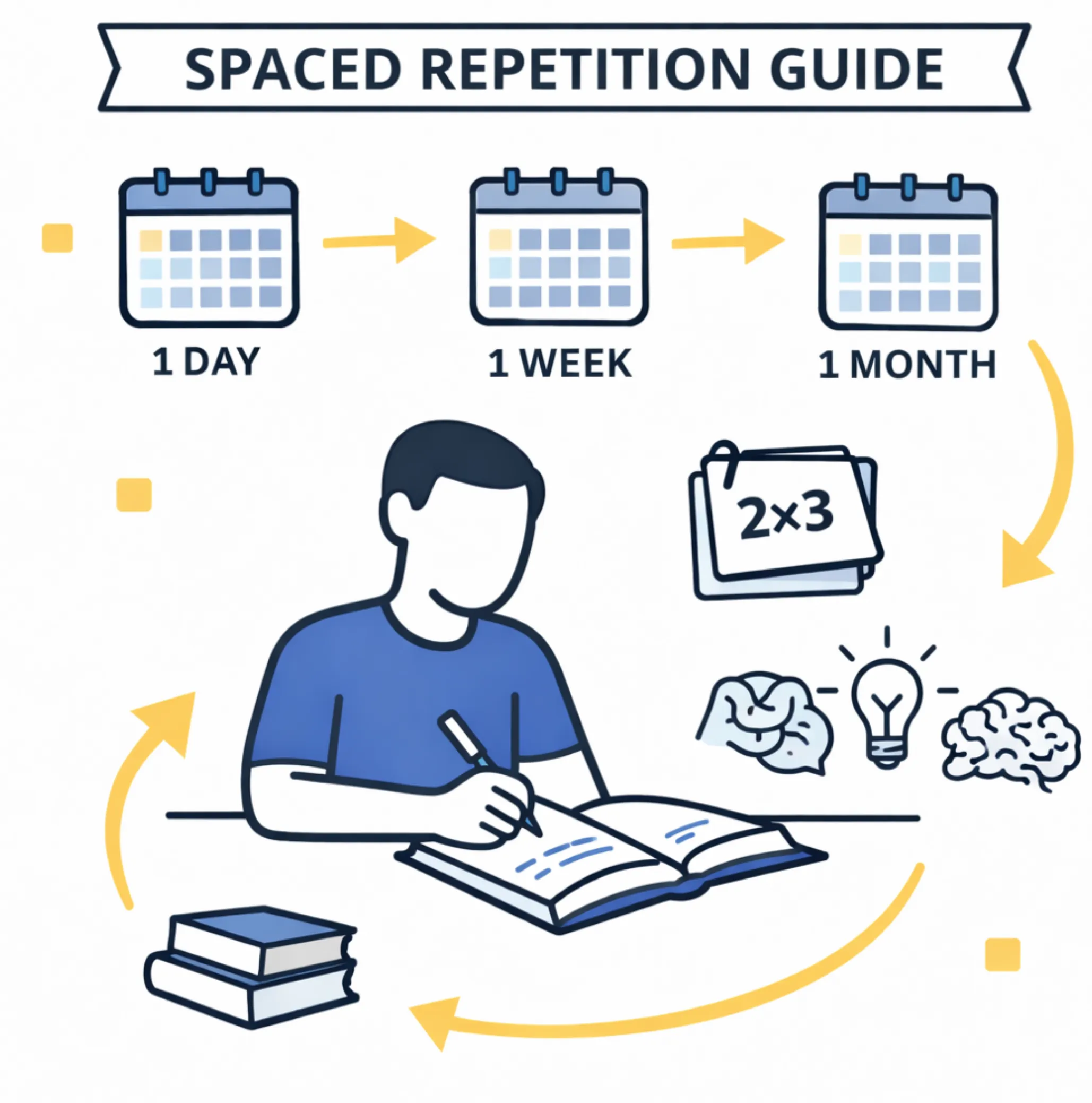
Spaced repetition works by reviewing information at strategic intervals just before you would naturally forget it. Each time you successfully recall something, the memory trace strengthens and the forgetting curve flattens. After several well-timed reviews, information moves from short-term to long-term memory, where it can persist for months or even years.
The Testing Effect
Actively retrieving information from memory (testing yourself) strengthens neural connections far more than passively re-reading. Each recall attempt literally rewires your brain. This is why flashcards work better than highlighting.
Desirable Difficulties
Psychologist Robert Bjork showed that making recall slightly difficult (by spacing it out) creates stronger memories. The effort of retrieving a fading memory signals to your brain that this information matters, triggering deeper encoding.
The Spacing Effect
Distributing study sessions over time produces dramatically better retention than the same total time spent in one session. A 2006 meta-analysis by Cepeda et al. found the spacing effect across 254 studies with 14,000+ participants.
Interleaving Bonus
Mixing different topics during spaced review sessions further enhances learning. Instead of reviewing all biology cards then all chemistry cards, interleaving them forces your brain to discriminate between concepts, building deeper understanding.
How Spaced Repetition Works: The Algorithm Explained Simply
At the heart of every spaced repetition app is an algorithm that decides when to show you each card. The most famous is the SM-2 algorithm, created by Piotr Wozniak in 1987 and still used (with modifications) by Anki and many other apps today.
The SM-2 Algorithm in Plain English
Here is how it works in simple terms:
You see a flashcard and rate your recall
After attempting to answer, you grade yourself: complete blackout, hard, good, or easy. This self-assessment drives the entire system.
The algorithm adjusts the interval
If you recalled it easily, the next review might be in 7 days. If you struggled, it could be tomorrow. Each card has its own "ease factor" that adapts based on your performance history.
Intervals grow exponentially
A typical progression: 1 day, 3 days, 8 days, 21 days, 60 days, 180 days. Each successful recall roughly doubles or triples the interval, while failures reset it.
The ease factor personalizes difficulty
Each card starts with an ease factor of 2.5. Cards you consistently recall well get higher ease factors (longer intervals). Cards you struggle with get lower factors (shorter intervals). The system learns what is easy and hard for you.
Modern Algorithms Go Further
Newer apps like LectureScribe use machine learning-enhanced algorithms (like FSRS) that track not just your answers but patterns in your forgetting behavior, time of day, and difficulty of related cards. These can be 20-30% more efficient than SM-2 at scheduling reviews, meaning less time studying for the same retention.
Spaced Repetition vs Cramming: The Data-Backed Comparison
Let us put numbers to the difference. Based on aggregated research from Cepeda et al. (2006), Karpicke & Roediger (2008), and Dunlosky et al. (2013), here is how spaced repetition compares to cramming at different time intervals:
| Time After Study | Cramming (Massed Practice) | Spaced Repetition | Advantage |
|---|---|---|---|
| Next day (exam) | 85-90% | 85-90% | ~Equal |
| After 1 week | 40-50% | 80-85% | +35-40% |
| After 1 month | 20-30% | 75-80% | +45-55% |
| After 1 year | 5-10% | 60-70% | +55-65% |
The critical insight: cramming and spaced repetition perform almost identically for next-day exams. This is why students keep cramming. It works in the short term. But the divergence after just one week is dramatic. For cumulative finals, professional licensing exams, or any knowledge you need to retain beyond a single test, spaced repetition is not just better. It is in an entirely different league.
The Real Cost of Cramming
A 2023 study in the Journal of Educational Psychology found that medical students who relied on cramming spent an average of 3.2x more total hours studying the same material compared to those using spaced repetition, because they had to re-learn forgotten content before every new exam. Spaced repetition is not just more effective. It ultimately saves time.
Best Spaced Repetition Apps for Students in 2026
Now that you understand the science, you need the right tool. I tested every major spaced repetition app over six months and here are the five best options for students in 2026, with honest pros and cons for each.
LectureScribe
AI-Generated Spaced Repetition Flashcards from Your Lectures
LectureScribe solves the biggest problem with spaced repetition: creating the cards. Most students abandon SRS because manually writing hundreds of flashcards is tedious and time-consuming. LectureScribe eliminates this barrier entirely by auto-generating high-quality spaced repetition flashcards from your lecture recordings, notes, PDFs, and handwritten materials.
Upload a lecture recording and get dozens of perfectly formulated flashcards in minutes. AI identifies key concepts, definitions, and relationships automatically. No manual card creation needed.
Cards are automatically scheduled using an optimized SRS algorithm. Open the app daily and review what is due. The system handles all the timing math for you.
Generate cards from audio lectures, video recordings, PDF textbooks, images of handwritten notes, and typed notes. Supports 50+ languages.
Beyond flashcards, get transcripts, summaries, practice quizzes, and visual infographics from the same material. One upload creates your entire study toolkit.
AI creates cards following best practices: one concept per card, clear question-answer format, context cues included. No "bad card" pitfalls that plague manual creation.
Power users who want to tweak every interval and parameter may prefer Anki's granular control. LectureScribe prioritizes simplicity.
Best For:
Pricing
1 Free Upload | $9.99/month
No credit card required for free trial
Anki
The gold standard spaced repetition system with unmatched customization
Anki is the most well-known spaced repetition tool and for good reason. Its SM-2 derived algorithm has been refined over 15+ years and is trusted by millions of medical students, language learners, and academics worldwide. It is free on desktop, open-source, and offers unparalleled control over every aspect of your review schedule. The trade-off is a steep learning curve and zero automation.
The most battle-tested SRS algorithm available. Now supports FSRS (Free Spaced Repetition Scheduler) for even better accuracy. Scientifically optimized for maximum retention.
Thousands of pre-made decks including AnKing for medical students, Core 2K/6K for Japanese, and community decks for nearly every subject.
Control intervals, ease factors, card types, templates, and display. Supports HTML, CSS, JavaScript, images, audio, and cloze deletions.
Complete functionality free on Windows, Mac, Linux, and AnkiWeb. Only the iOS app costs money ($25 one-time).
Interface is functional but dated. Understanding card types, note types, and scheduling options takes hours. Many students give up before seeing results.
Every card must be created by hand or downloaded. No AI generation from lectures or notes. This is the biggest time investment.
Cannot process audio, video, or PDFs. You must extract information manually and type each card.
Pricing
Free (desktop) | iOS: $25 one-time
Quizlet
Easiest flashcard platform with basic spaced repetition
Quizlet is the most accessible flashcard app with over 800 million study sets created by users worldwide. Its "Learn" mode incorporates basic spaced repetition principles, though the algorithm is significantly simpler than Anki's or LectureScribe's. It is ideal for students who want the easiest possible entry point into spaced studying.
The most intuitive interface of any flashcard app. Create an account, make or find cards, and start studying in under 5 minutes.
Find flashcard sets for nearly any course or textbook. Search by class name, professor, or topic and likely find something relevant.
Learn, Test, Match, and Flashcard modes keep studying varied. Games like Match make review more engaging.
The Learn mode uses spacing, but its algorithm is far less sophisticated than Anki or LectureScribe. Intervals are less optimized for long-term retention.
Recent pricing changes restrict many features to Plus subscribers. Free users face ads and limited study modes.
Cannot generate cards from audio or video. AI Magic Notes can create cards from pasted text but quality varies significantly.
Pricing
Free (limited) | Plus: $7.99/month
RemNote
Note-taking app with built-in spaced repetition
RemNote uniquely combines a full note-taking app with built-in spaced repetition. As you take notes, you can tag concepts as flashcards that automatically enter your SRS queue. The idea is compelling: your notes become your flashcards, eliminating the duplication of creating both notes and cards separately.
Highlight any text in your notes and it becomes an SRS card. No separate card creation step. Your knowledge base and review system are unified.
Uses a well-implemented spaced repetition algorithm comparable to Anki. Supports multiple card types including cloze deletions.
Visualize connections between concepts. Linked notes create a web of knowledge that helps with understanding, not just memorization.
Trying to be both a note-taking app and an SRS tool means it does neither as well as dedicated apps. The interface can feel cluttered.
Cannot transcribe audio or auto-generate cards from lectures. You still need to type or paste your notes manually.
Far fewer shared decks and community resources compared to Anki or Quizlet.
Pricing
Free (basic) | Pro: $8/month
Mochi
Clean, markdown-based spaced repetition flashcards
Mochi is for students who love the power of Anki but want a modern, clean interface. It uses markdown for card creation, making it fast and flexible for those comfortable with text formatting. The SRS algorithm is solid and the design is beautifully minimalist.
Where Anki looks like it was designed in 2006, Mochi feels contemporary and polished. Studying feels pleasant rather than like a chore.
Create cards using markdown syntax for fast formatting. Support for code blocks, LaTeX, and images makes it great for STEM students.
Implements a proven spaced repetition algorithm. Not as configurable as Anki but effective out of the box.
Very few shared decks available. You will be creating nearly all cards from scratch.
No lecture processing, no AI generation, no quiz modes. Purely a flashcard review tool with a nice interface.
Pricing
Free (100 cards) | Pro: $7.99/month
Spaced Repetition App Comparison Table
| App | Auto Card Creation | SRS Quality | Ease of Use | Lecture Support | Price |
|---|---|---|---|---|---|
| LectureScribe | Yes (AI) | Excellent | Very Easy | Yes | $9.99/mo |
| Anki | No | Excellent | Difficult | No | Free/$25 iOS |
| Quizlet | Partial | Basic | Very Easy | No | $7.99/mo |
| RemNote | From Notes | Good | Moderate | No | $8/mo |
| Mochi | No | Good | Easy | No | $7.99/mo |
How to Create the Perfect Spaced Repetition Schedule
One of the most common questions is: how do I fit spaced repetition into my semester? The key is starting early and staying consistent. Here is a sample schedule that works for a typical 15-week semester:
Weeks 1-2: Setup Phase
After each lecture, upload recordings to LectureScribe (or create cards manually in Anki). Aim for 20-30 cards per lecture. Start reviewing immediately. Daily review time: 10-15 minutes.
Weeks 3-8: Build Phase
Your card collection grows as new lectures happen. Continue adding cards after each class. Review all due cards daily. As older cards reach longer intervals, daily review time stabilizes at 20-30 minutes even as total cards increase.
Weeks 9-12: Consolidation Phase
Most early-semester cards now have intervals of 2-4 weeks. Focus on keeping up with reviews and adding new material. You will notice that concepts from Week 1 are still fresh in your memory. Daily review: 25-35 minutes.
Weeks 13-15: Exam Prep Phase
Stop adding new cards. Focus exclusively on reviewing. Because you have been spacing reviews all semester, you already know 80-90% of the material. Your "exam prep" is just normal daily reviews, perhaps slightly extended to 40-50 minutes. No all-nighters needed.
The Magic Number: 20 Minutes Per Day
Research by Kornell (2009) found that students who spent just 20 minutes per day on spaced repetition outperformed students who spent 3+ hours cramming the week before an exam. Consistency beats intensity every time. Set a daily alarm and treat your SRS review like brushing your teeth: non-negotiable.
Combining Spaced Repetition with Active Recall for Maximum Retention
Spaced repetition is powerful on its own, but combining it with active recall creates the ultimate study system. Active recall means testing yourself rather than passively re-reading or highlighting. When you use flashcards, you are already doing active recall. But you can amplify the effect.
Before You Review Cards
- 1.Close your notes and write everything you remember about the topic (brain dump)
- 2.Identify gaps in your knowledge
- 3.Then review your spaced repetition cards
- 4.Pay extra attention to cards covering your identified gaps
After You Review Cards
- 1.Explain difficult concepts out loud (the Feynman technique)
- 2.Create connections between cards (how does concept A relate to concept B?)
- 3.Take LectureScribe's auto-generated quizzes to test application, not just recall
- 4.Teach the material to a study partner or rubber duck
A 2019 study by Rowland found that combining spaced repetition with active recall produced 50% better retention than either technique alone. The synergy works because active recall strengthens memory traces while spacing optimizes the timing of that strengthening. If you want to learn more about combining evidence-based techniques, check out our guide on the best AI study apps that support these methods.
Common Spaced Repetition Mistakes (and How to Avoid Them)
Even students who adopt spaced repetition can undermine their results with these common errors. Avoid these pitfalls to get the most from your spaced repetition study method.
Creating Cards That Are Too Complex
Cards that contain multiple facts or require paragraph-long answers are ineffective. Your brain cannot efficiently space-review a complex concept as a single unit.
Fix: Follow the "minimum information principle." One simple fact per card. Instead of "List all symptoms of X," create one card per symptom. LectureScribe does this automatically.
Skipping Daily Reviews
Missing even a few days causes a backlog that feels overwhelming. The resulting "review debt" is the #1 reason students abandon SRS.
Fix: Do your reviews first thing in the morning before anything else. Even 10 minutes of reviews is better than skipping entirely. If backlog exceeds 200 cards, consider resetting difficult decks.
Adding Too Many New Cards at Once
Adding 200 new cards in one day creates an unmanageable review load in the following weeks as all those cards come due simultaneously.
Fix: Limit new cards to 20-30 per day. Most SRS apps let you set a daily new card limit. Spread your card creation across the semester rather than creating everything before exams.
Rating Cards Incorrectly
Hitting "Easy" when you only vaguely remembered the answer inflates intervals and causes future forgetting. Being too harsh also wastes time on unnecessary reviews.
Fix: Be honest with your ratings. If you hesitated for more than 5 seconds, it was not "Easy." If you needed a hint to recall, mark it "Hard" or "Again."
Using Spaced Repetition for Everything
SRS excels at factual recall (definitions, formulas, vocabulary) but is less effective for deep conceptual understanding, problem-solving skills, or creative thinking.
Fix: Use spaced repetition for foundational knowledge, then build understanding through practice problems, discussions, and application. Use LectureScribe's quizzes and infographics for the conceptual layer.
Frequently Asked Questions
How does spaced repetition work?
Spaced repetition works by reviewing information at gradually increasing intervals. When you first learn something, you review it after 1 day, then 3 days, then 7 days, then 14 days, and so on. Each successful review increases the interval. This exploits the spacing effect in memory science: your brain strengthens neural pathways more effectively when retrieval practice is spread out over time rather than massed together.
What is the best spaced repetition app for students in 2026?
LectureScribe is the best spaced repetition app for students in 2026 because it auto-generates flashcards from your lectures, notes, and PDFs with built-in spaced review scheduling. Unlike Anki which requires manual card creation, LectureScribe creates high-quality cards automatically and schedules reviews using an optimized SRS algorithm.
What is the Ebbinghaus forgetting curve?
The Ebbinghaus forgetting curve, discovered by German psychologist Hermann Ebbinghaus in 1885, shows that memory retention decays exponentially over time without reinforcement. Within 24 hours of learning, you forget approximately 70% of new information. After a week, retention drops to roughly 20%. Spaced repetition directly combats this curve by timing reviews at the optimal moments before forgetting occurs.
Is spaced repetition better than cramming?
Yes, research consistently shows spaced repetition is far superior to cramming. A 2024 meta-analysis of 29 studies found that spaced practice produced 25-50% better long-term retention than massed practice (cramming). After one month, students who used spaced repetition retained 80% of material versus only 30% for crammers. The difference is even more dramatic after one year.
How long should spaced repetition intervals be?
Optimal spaced repetition intervals typically follow an expanding schedule: 1 day, 3 days, 7 days, 14 days, 30 days, 60 days, and 120 days. However, the best apps adjust intervals dynamically based on how well you recall each item. Cards you find easy get longer intervals, while difficult cards are shown more frequently. Most students see significant results within 2-3 weeks of consistent practice.
Can I use spaced repetition for subjects other than languages?
Absolutely. While spaced repetition is popular for language learning, it works for any subject requiring memorization: medical terminology, law cases, history dates, science formulas, programming syntax, and more. Medical students are among the heaviest users of spaced repetition, using it to memorize thousands of clinical facts. The technique works for any factual knowledge you need to retain long-term.
Start Using Spaced Repetition Today
LectureScribe auto-generates flashcards from your lectures with built-in spaced review
Try 1 Free Upload - No Credit Card RequiredUpload a lecture, get AI-generated flashcards + automatic spaced repetition scheduling
Related Articles
10 Best AI Study Apps for Students in 2026
Complete guide and expert reviews of the top AI-powered study tools.
8 Essential Flashcard Apps for Students
Compare the best online flashcard makers for students.
Auto-Generate Flashcards from Lectures
How AI creates study materials automatically from your content.
How AI Is Changing How Students Learn
The ways artificial intelligence is reshaping education in 2026.