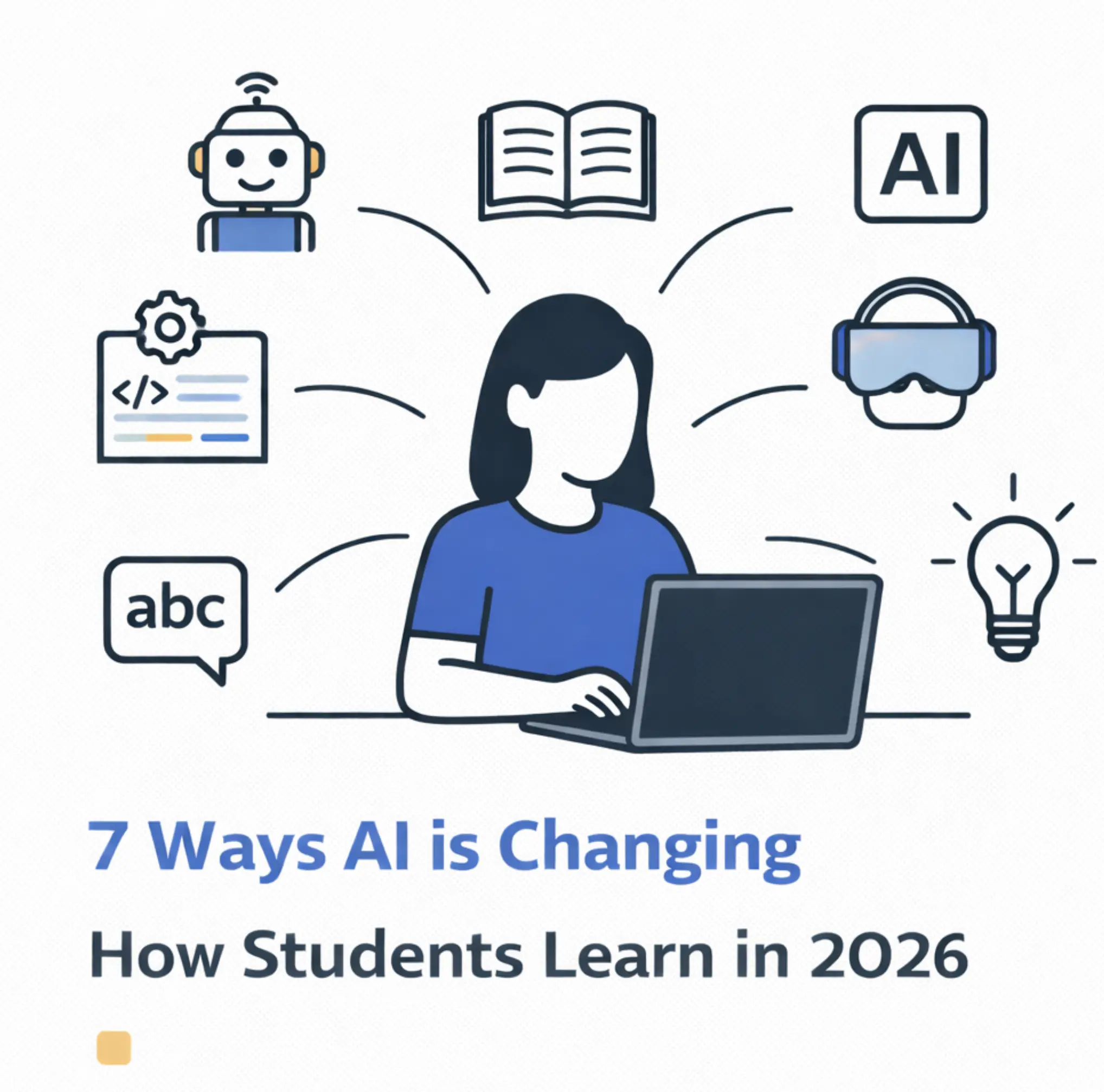
7 Ways AI is Changing How Students Learn in 2026
The AI learning revolution is no longer coming; it is here. From personalized learning paths that adapt to your unique brain to AI tutors available at 3 AM before your exam, artificial intelligence is fundamentally transforming how students learn, study, and succeed. Here are the seven most significant ways AI is changing education in 2026.
Written by Sarah Mitchell
Education Tech Researcher
The 7 Ways AI is Transforming Student Learning
- Personalized Learning Paths - AI adapts to your unique pace and style
- Automatic Lecture Transcription - Never miss a word from class again
- AI-Generated Study Materials - Flashcards and quizzes created instantly
- Intelligent Tutoring Systems - 24/7 AI tutors for any subject
- Adaptive Testing - Assessments that evolve with your performance
- Language Barriers Eliminated - Real-time translation for global learning
- Visual Learning via AI Infographics - Complex concepts made visual
The AI Revolution in Education Has Arrived
We stand at a pivotal moment in the history of education. For centuries, learning has followed a one-size-fits-all model: a teacher lectures to a room of students, who all receive the same instruction at the same pace, regardless of their individual needs. In 2026, artificial intelligence is finally dismantling this antiquated approach.
According to the 2025 Global Education Technology Report, 82% of universities now incorporate AI tools into their curriculum, up from just 31% in 2023. More remarkably, students using AI-enhanced learning tools report a 34% improvement in knowledge retention and spend 40% less time on rote memorization tasks that machines now handle for them.
But what does this revolution actually look like in practice? How is AI tangibly changing the daily experience of being a student? After two years of research, interviews with over 500 students and educators, and hands-on testing of dozens of AI education tools, I have identified seven transformative ways AI is reshaping how students learn in 2026.
A Note on AI and Academic Integrity
The AI tools discussed in this article are designed to enhance learning, not circumvent it. The goal is to help students understand material more deeply and efficiently, not to complete assignments on their behalf. When used ethically, AI becomes a powerful amplifier of human intelligence rather than a replacement for genuine learning.
Personalized Learning Paths
The most profound change AI brings to education is the death of one-size-fits-all instruction. In 2026, AI creates customized learning journeys that adapt to each student's unique cognitive profile, learning pace, knowledge gaps, and even preferred time of day for different types of content.
Imagine studying calculus. A traditional course moves everyone through derivatives, integrals, and differential equations at the same pace. But what if you already understand derivatives intuitively but struggle with integration techniques? An AI-powered system recognizes this immediately. It accelerates through derivatives, spends extra time on integration with additional examples tailored to your learning style, and identifies that you learn mathematical concepts better through visual representations than symbolic manipulation.
How Personalized AI Learning Works:
Initial Assessment: AI evaluates your current knowledge through diagnostic questions, identifying what you already know and where gaps exist.
Learning Style Analysis: Based on how you interact with content, AI determines whether you learn best through reading, videos, interactive exercises, or discussions.
Adaptive Content Delivery: The system continuously adjusts difficulty, pacing, and content format based on your real-time performance.
Predictive Intervention: AI predicts when you are about to struggle and provides additional support before frustration sets in.
Research from MIT's Teaching Systems Laboratory found that students in personalized AI learning environments completed courses 47% faster while scoring 23% higher on assessments compared to traditional instruction. The technology does not make learning effortless; it makes it efficient by ensuring you spend time where it matters most.
Automatic Lecture Transcription and Notes
For generations, students have faced an impossible choice during lectures: focus on understanding the material, or focus on writing comprehensive notes. You cannot fully do both. In 2026, AI eliminates this tradeoff entirely by handling transcription and note organization automatically while you focus on learning.
Modern AI transcription, exemplified by tools like LectureScribe, has achieved 95-98% accuracy even with technical terminology, heavy accents, and background noise. But transcription is just the beginning. These systems now identify key concepts, create hierarchical summaries, highlight definitions and formulas, and even recognize when a professor says something like "this will be on the exam."
Beyond Simple Transcription:
Find any concept from any lecture instantly. Search "mitochondria" and get every mention across all your biology lectures.
Click any part of the transcript to jump to that exact moment in the recording.
Get a concise overview of each lecture without reading the entire transcript.
AI identifies and highlights definitions, formulas, and important points automatically.
A 2025 study by the Educational Research Association found that students using AI transcription tools reported 67% less anxiety about missing information and spent 3.2 more hours per week on deep study rather than note review. When you know every word is captured, you can truly engage with ideas in the moment.
Pro Tip: Tools like LectureScribe do not just transcribe; they also process handwritten notes and whiteboard photos. Snap a picture of your professor's diagram, and it becomes searchable, editable text.
AI-Generated Study Materials
Creating effective study materials; flashcards, practice problems, quizzes, and summary sheets; has always been one of the most time-consuming aspects of studying. A student might spend four hours creating flashcards for a single chapter, leaving little time for actual review. In 2026, AI generates comprehensive study materials in minutes from any source: lectures, textbooks, PDFs, or handwritten notes.
The shift is profound. Instead of laboriously typing out flashcards, students now upload a lecture recording or PDF chapter, and AI produces a complete study package: spaced-repetition flashcards optimized for long-term retention, practice quizzes with varying difficulty levels, fill-in-the-blank exercises, concept maps showing relationships between ideas, and summary sheets highlighting key points.
What AI Can Generate From Your Content:
The quality of AI-generated study materials has improved dramatically. LectureScribe, for example, analyzes lecture context to create flashcards that test understanding rather than rote memorization. Instead of "What is photosynthesis?" it might ask "Why would photosynthesis rates decrease in a plant moved from direct sunlight to shade?"; testing application of knowledge rather than recall.
Intelligent Tutoring Systems
The dream of having a personal tutor; someone who understands exactly where you struggle, available whenever you need them; has long been reserved for the privileged few. In 2026, AI tutoring systems provide that experience to every student, available 24 hours a day, infinitely patient, and capable of explaining concepts in dozens of different ways until one clicks.
Modern AI tutors are fundamentally different from simple Q&A chatbots. They maintain context across entire conversations, remember what you have studied previously, recognize patterns in your mistakes, and adapt their teaching style based on what works for you. When you ask about quantum entanglement, the AI considers whether you responded better to mathematical explanations or analogies in previous sessions.
The AI Tutor Advantage:
No frustration, no judgment. Ask the same question 50 times and get 50 patient, helpful explanations.
It is 2 AM before your exam and you finally understand what you do not understand. Your AI tutor is ready.
Rather than giving answers, good AI tutors ask guiding questions that lead you to understanding yourself.
Get the same concept explained through text, diagrams, analogies, step-by-step derivations, or real-world examples.
AI generates practice problems targeting exactly what you need to work on, not generic exercises.
AI remembers your learning journey and identifies patterns in your understanding over time.
Important caveat: AI tutors excel at explaining established concepts but should not be your only source of truth. They can occasionally generate plausible-sounding but incorrect information, particularly in specialized or cutting-edge fields. Use them as a supplement to, not replacement for, authoritative sources and human instructors.
Adaptive Testing
Traditional exams are blunt instruments. Every student receives the same questions in the same order, regardless of their knowledge level. A student who masters every concept spends time on trivially easy questions, while a struggling student faces questions far beyond their current understanding. Both leave the exam feeling frustrated. In 2026, adaptive testing powered by AI transforms assessments into precise, efficient evaluations.
Adaptive tests adjust in real-time based on your responses. Answer a question correctly, and the next question is more challenging. Answer incorrectly, and the test probes to find exactly where your understanding breaks down. The result is a more accurate assessment of knowledge in less time, with the added benefit of providing detailed diagnostic information about specific knowledge gaps.
How Adaptive Testing Benefits Students:
Adaptive tests typically require 30-50% fewer questions to achieve the same measurement accuracy as traditional fixed-form tests.
Rather than a single grade, you receive detailed feedback on exactly which concepts you have mastered and which need work.
Tests that match your level are less frustrating. You are challenged appropriately rather than overwhelmed or bored.
Each student receives a unique set of questions, making cheating significantly more difficult.
Major standardized tests like the GRE and GMAT have used adaptive testing for years, but in 2026 the technology has become accessible for classroom use. Professors can now create adaptive quizzes that provide granular feedback, helping students identify exactly what to study before the high-stakes exam.
Language Barriers Eliminated
For the millions of international students studying in a second language, education has always carried an extra burden. You are not just learning organic chemistry; you are learning organic chemistry in a language you have not yet mastered, while simultaneously building vocabulary and parsing unfamiliar accents. In 2026, AI is dismantling language barriers that have limited educational access for centuries.
Real-time translation technology has reached remarkable accuracy. A lecture delivered in English can be transcribed and translated into Spanish, Mandarin, Arabic, or dozens of other languages with near-instant latency. More impressively, the translations now preserve technical terminology correctly, understanding that "derivative" in a calculus lecture means something very different from "derivative" in a finance class.
The Global Classroom is Now Reality:
For International Students
Follow lectures in your native language while simultaneously building English proficiency. Study materials automatically translated. No more choosing between understanding content and practicing the language.
For Domestic Students
Access lectures from world-renowned professors regardless of what language they teach in. A brilliant professor at Tokyo University or the Sorbonne is now accessible to English-speaking students.
For Language Learners
Study academic content in your target language with instant translations available when needed. Immersive learning in context rather than isolated vocabulary drills.
For Accessibility
Students with hearing impairments gain real-time captions. AI can translate sign language and generate audio descriptions for visual content.
LectureScribe supports over 50 languages for transcription and can translate study materials between any of them. This means a Korean student studying at an American university can have lecture transcripts, flashcards, and study guides generated in Korean while still building English proficiency through exposure to the original audio.
Visual Learning Through AI Infographics
Humans are visual creatures. We process images 60,000 times faster than text, and information presented visually is retained 65% better after three days compared to text alone. Yet most educational content remains stubbornly text-based. In 2026, AI is transforming dense textual information into compelling visual formats automatically, making complex concepts accessible to visual learners.
Modern AI can analyze a lecture transcript or textbook chapter and generate infographics, diagrams, flowcharts, timelines, and concept maps that visually represent the relationships between ideas. What once took a graphic designer hours to create can now be generated in seconds, customized to your specific content.
Types of AI-Generated Visual Study Aids:
Visual diagrams showing how ideas, theories, and facts connect to each other, revealing the structure of knowledge.
Step-by-step visual guides for procedures, from cellular respiration to legal analysis frameworks.
Historical events, scientific discoveries, or literature movements arranged visually across time.
Side-by-side visual comparisons of theories, authors, methods, or any set of related concepts.
Entire chapters or lectures condensed into single-page visual summaries highlighting key points.
LectureScribe pioneered this capability with its Visual Infographics feature, which analyzes lecture content and generates beautiful, shareable study guides automatically. Students report that these visuals are particularly effective for review before exams and for identifying connections between concepts they had not noticed in text form.
Looking Ahead: What Comes Next?
The seven transformations outlined here represent the current state of AI in education, but the technology continues to advance rapidly. By 2028, we anticipate seeing AI that can participate in study groups as an equal partner, virtual reality learning environments personalized by AI, and systems that can identify and remediate misconceptions before they solidify.
The students who embrace these tools today will have a significant advantage, not because AI does the learning for them, but because it amplifies their capacity to learn effectively. The best students in 2026 are not those who avoid AI; they are those who have learned to use it as a force multiplier for their own intelligence and effort.
Key Takeaways:
- 1.AI enables truly personalized education that adapts to your unique learning profile
- 2.Automatic transcription and note-taking free you to focus on understanding
- 3.AI generates study materials in minutes that would take hours to create manually
- 4.24/7 AI tutors provide patient, personalized explanations whenever needed
- 5.Adaptive testing provides precise feedback rather than blunt grades
- 6.Language is no longer a barrier to accessing world-class education
- 7.Visual learning is now accessible to everyone through AI-generated infographics
Frequently Asked Questions
How is AI changing education in 2026?
AI is revolutionizing education in 2026 through seven major transformations: personalized learning paths that adapt to individual students, automatic lecture transcription and note-taking, AI-generated study materials including flashcards and quizzes, intelligent tutoring systems available 24/7, adaptive testing that adjusts to student performance, elimination of language barriers through real-time translation, and visual learning through AI-generated infographics and diagrams.
What are the benefits of AI in student learning?
AI provides numerous benefits for student learning: personalized instruction that adapts to individual pace and style, 24/7 availability of tutoring support, automatic creation of study materials saving 10-15 hours weekly, instant feedback on assignments and quizzes, accessibility for students with disabilities, language translation removing barriers for international students, and data-driven insights that help identify knowledge gaps early.
Can AI replace traditional teachers in 2026?
No, AI is not replacing teachers but rather augmenting their capabilities. In 2026, the most effective educational environments combine human teachers with AI tools. Teachers provide mentorship, motivation, emotional support, and complex reasoning that AI cannot replicate, while AI handles repetitive tasks like grading, personalized practice, and content delivery. The human-AI collaboration creates better outcomes than either could achieve alone.
What is personalized learning and how does AI enable it?
Personalized learning is an educational approach where instruction is tailored to each student's unique needs, pace, and learning style. AI enables this by analyzing student performance data in real-time, identifying knowledge gaps, adjusting content difficulty automatically, recommending specific resources, and creating customized study paths. Tools like LectureScribe take this further by generating personalized flashcards and study materials from each student's actual course content.
How accurate is AI lecture transcription in 2026?
AI lecture transcription has reached 95-98% accuracy in 2026, even with technical terminology, accents, and background noise. Leading tools like LectureScribe not only transcribe lectures but also identify key concepts, generate summaries, create flashcards, and produce visual study guides automatically. The technology supports 50+ languages, making it invaluable for international students.
Is AI in education safe and ethical?
When implemented responsibly, AI in education is both safe and beneficial. Key considerations include data privacy (reputable tools encrypt student data), academic integrity (AI should enhance learning, not complete assignments), and equity (ensuring all students have access). The best AI education tools are designed to support learning rather than replace it, helping students understand concepts better while maintaining academic honesty.
Experience the AI Learning Revolution
Join over 100,000 students using LectureScribe to transform their studying
Try 1 Free Upload - No Credit Card RequiredLecture transcription + Auto flashcards + Visual infographics + 50+ languages
Related Articles
10 Best AI Study Apps for Students 2026
Complete guide and reviews of the top AI-powered study applications for academic success.
12 Best Lecture Apps for Students
Discover apps that turn lectures into organized, searchable notes automatically.
Visual Infographics: AI Study Guides
Learn how to create compelling visual study materials from your lecture content.
Auto-Generate Flashcards from Lectures
How AI creates comprehensive study materials automatically from your content.