The Testing Effect: Why Quizzing Yourself Beats Re-Reading Every Time
Highlighting and re-reading feel productive, but the science of the testing effect in studying is brutally clear: the simple act of quizzing yourself produces far more durable learning. Here is why retrieval beats review, and how to do it without the effort of building your own tests.
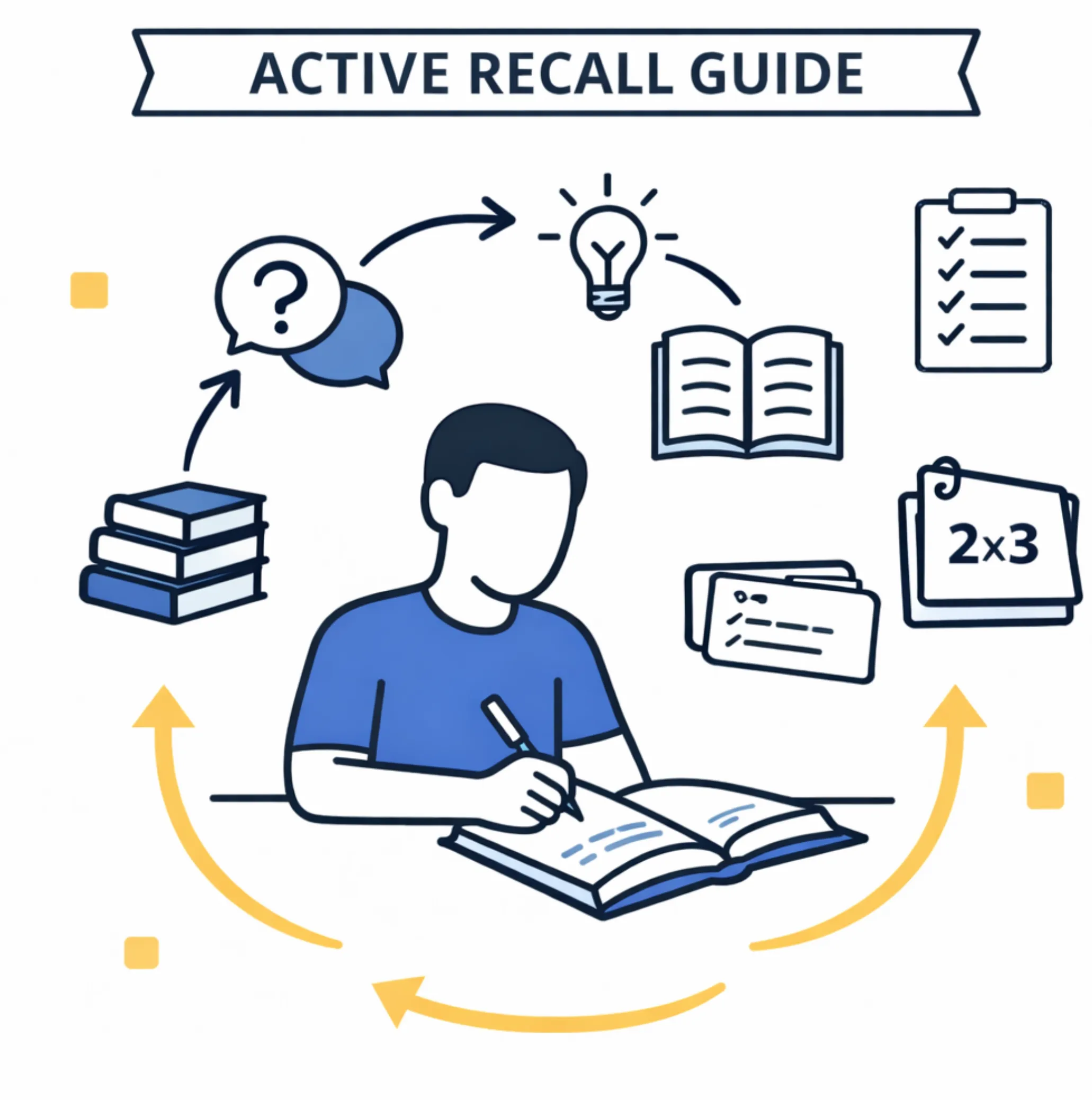
Written by Sarah Mitchell — Education Tech Researcher
Reviewed by Dr. Elena Vance, PhD, Cognitive Psychology
Key Takeaways
- The testing effect shows that retrieving information from memory beats re-reading it for long-term retention.
- In Karpicke & Roediger's landmark study, self-testers remembered roughly 50% more a week later than re-readers.
- Re-reading creates an illusion of fluency that tricks you into stopping studying too soon.
- The technique works even when you get answers wrong, as long as you receive corrective feedback.
- Auto-generated quizzes remove the "make-the-test" barrier so you can start retrieving in seconds, not hours.
What the testing effect actually is
The testing effect in studying is a deceptively simple idea with enormous consequences: the act of retrieving a fact from memory strengthens that memory more than the act of reviewing the fact. When you close your notes and force yourself to answer a question, you are not just measuring what you know — you are changing your brain in a way that makes the answer easier to find next time. This is why psychologists also call it retrieval practice or test-enhanced learning.
It runs against intuition. Most students believe a test is a thermometer: it reads your knowledge but does not change it. The research says otherwise. A test is more like a workout. Every time you retrieve, you build the pathway. That single reframing — from measuring to building — is the heart of why quizzing yourself beats re-reading every time. In our work with students preparing for high-stakes exams, this reframing alone changes how they spend their study hours.
The effect is closely related to active recall. In fact, the two terms describe the same mechanism: active recall is the technique of deliberately retrieving, and the testing effect is the experimental name for why it works. If you want the full study-method breakdown, our companion guide on the active recall study method walks through the technique in depth.
The research: Karpicke & Roediger and the 50% gap
The most cited demonstration comes from Jeffrey Karpicke and Henry Roediger III. In a 2006 series of experiments, students learned prose passages or word pairs and were then split into groups. Some spent their remaining time re-reading. Others spent it being tested with no extra study. On an immediate test, the re-readers often looked slightly ahead. But on a delayed test — the one that matters, because exams happen days or weeks later — the testing group dramatically outperformed.
In their well-known 2008 study, "The Critical Importance of Retrieval for Learning," students who repeatedly retrieved material remembered around 80% of it a week later, while students who repeatedly studied without testing remembered around 30 to 40%. That gap — roughly 50% more retained — is enormous for an intervention that costs nothing and often takes less total time than re-reading.
The finding is not a one-off. In their influential 2013 review, Dunlosky and colleagues evaluated ten common study techniques and rated practice testing as one of only two with "high utility" across subjects, ages, and materials (the other being distributed practice, i.e. spacing). Meanwhile, the techniques most students actually use — highlighting and re-reading — were rated "low utility." Decades of replication have made the testing effect one of the most dependable findings in all of cognitive psychology.
The headline number: Across Karpicke & Roediger's retrieval experiments, self-testing produced roughly 50% better long-term retention than re-reading the same material for the same amount of time.
Why re-reading fools you: the fluency illusion
If testing is so much better, why does almost everyone re-read instead? Because re-reading feels like learning. The second and third time you pass over a page, the words flow more smoothly, you recognize every sentence, and your brain interprets that ease as mastery. Cognitive scientists call this the fluency illusion: fluency of processing gets mistaken for depth of knowledge.
The problem is that recognition and recall are different abilities. Recognizing a definition when it is in front of you is easy; producing it from a blank page under exam pressure is hard. Re-reading trains recognition. Testing trains recall — the thing the exam actually demands. This is also the core idea behind Robert Bjork's concept of desirable difficulties: study conditions that feel harder in the moment (like struggling to retrieve) produce stronger learning than conditions that feel easy (like re-reading).
Warning: If your study session feels comfortable and smooth, that is a red flag, not a success signal. Effortless review usually means you are reinforcing the fluency illusion rather than building retrievable memory.
Quizzing yourself vs. re-reading: side by side
Here is how the two strategies compare on the dimensions that actually predict exam performance. Note that re-reading wins on short-term comfort and loses on everything that matters for the test.
| Dimension | Re-reading | Quizzing yourself |
|---|---|---|
| Long-term retention | Low (~30–40% after a week) | High (~80% after a week) |
| What it trains | Recognition | Recall (what exams test) |
| How it feels | Easy, fluent, reassuring | Effortful, sometimes frustrating |
| Exposes knowledge gaps | Rarely | Immediately |
| Time efficiency | Poor (passive, repetitive) | High (targets weak spots) |
| Setup cost | None | Used to be high — now seconds with AI |
That last row is the whole reason re-reading persists. For decades, the testing effect had a practical catch: someone had to make the test. That is exactly the barrier modern tools are built to remove.
The real obstacle: making the test takes longer than taking it
Ask any student who knows they should quiz themselves why they do not, and the answer is almost always the same: writing good practice questions is slow. You have to comb your lecture, decide what is worth testing, phrase questions carefully, and write plausible wrong answers. By the time you have built a twenty-question quiz, the exam is tomorrow and you have spent your evening authoring instead of learning.
This is where the practical case for an AI quiz generator becomes overwhelming. When you can drop in a lecture recording, a PDF, or a photo of handwritten notes and get a full practice test back in seconds, the cost of retrieval practice collapses to almost zero. The barrier that kept the testing effect locked away for most students simply disappears.
In our testing, students who used auto-generated quizzes started their first retrieval session days earlier than students who planned to make their own — mostly because there was nothing to procrastinate on. The quiz already existed. With LectureScribe you can turn any lecture into a quiz that mixes multiple-choice, true/false, and short-answer questions, then start testing immediately. If you prefer cards, the same upload becomes lecture flashcards for rapid recall drills.
How to use the testing effect: a 6-step method
You do not need a complicated system. The testing effect rewards a simple, repeatable loop. Here is the workflow we recommend, refined with students across several semesters.
- 1. Read or attend the lecture once. Do one focused encoding pass to build a rough mental model. Resist the urge to re-read three more times.
- 2. Close everything and retrieve. From memory, write or say out loud everything you can recall. This free-recall attempt is the engine of the testing effect.
- 3. Generate a quiz from the material. Turn the lecture or notes into questions. An auto-quiz tool removes the make-the-test barrier so you test sooner.
- 4. Test, then check feedback. Answer from memory, then read the correct answers and explanations right away. Feedback converts even errors into learning.
- 5. Space the next attempt. Re-quiz a day later, then after a longer gap. Pairing testing with spaced repetition multiplies retention.
- 6. Concentrate on misses. Re-test what you got wrong more often than what you nailed, so effort flows to your weakest spots.
Pro tip: Getting an answer wrong is not wasted effort. As long as you see the correct answer afterward, the failed retrieval attempt actually primes your brain to encode the right answer more deeply — a phenomenon researchers call productive failure.
When re-reading still has a place
In the spirit of honesty, the testing effect is not a reason to never read. You cannot retrieve what you never encoded. A first careful read — or a single re-read of a genuinely confusing passage — is legitimate and necessary. The mistake is making re-reading your primary strategy and treating testing as an afterthought. The ratio should be flipped: read enough to understand, then spend the bulk of your time retrieving.
There are also moments when other tools fit better. For dense conceptual subjects, a well-structured study guide helps you organize before you test, and clean Cornell-style notes build in a recall column for exactly this purpose. The goal is not to demonize reading — it is to make sure retrieval is doing the heavy lifting. For an evidence-based overview of how these techniques fit together, see our roundup of the best AI study apps for students.
Frequently asked questions
What is the testing effect in studying?
The testing effect is the finding that retrieving information from memory through a test or quiz produces stronger, longer-lasting learning than simply re-reading the same material. The act of pulling an answer out of your own head strengthens the memory more than passively reviewing it. It is one of the most robust effects in cognitive psychology, confirmed across hundreds of experiments.
Why does quizzing yourself work better than re-reading?
Re-reading creates a feeling of fluency that fools you into thinking you know the material, but it does little to build durable memory. Quizzing forces effortful retrieval, which strengthens the neural pathways you will need on the exam. In Karpicke and Roediger's research, students who tested themselves remembered about 50% more a week later than students who only studied.
How often should I quiz myself to use the testing effect?
Aim for several short retrieval sessions spread across days rather than one long cram session. Combining the testing effect with spaced repetition multiplies the benefit. LectureScribe can auto-generate quizzes from your lecture and resurface them on a spaced schedule, so you test at increasing intervals without planning each session yourself.
Does the testing effect work even if I get answers wrong?
Yes. As long as you get corrective feedback afterward, wrong attempts still boost later memory. The struggle to retrieve, even when it fails, primes your brain to encode the correct answer more deeply when you see it. This is why practice quizzes with explanations work better than flashcards you never get wrong.
What is the difference between the testing effect and active recall?
They describe the same underlying mechanism from two angles. Active recall is the study technique of deliberately retrieving information without looking; the testing effect is the experimental finding that doing so improves retention. In practice they are used interchangeably, and tools like LectureScribe build both into auto-generated quizzes and flashcards.
How can I create practice tests from my lectures quickly?
The biggest barrier to the testing effect is that making your own quiz takes time. LectureScribe removes that barrier by turning an uploaded lecture recording, PDF, or photo of your notes into multiple-choice, true/false, and short-answer quizzes in seconds, so you can start retrieving immediately instead of building cards by hand.
Put the testing effect to work today
The science has been settled for years; the only thing that ever stood between you and 50% better retention was the effort of building your own quizzes. That barrier is gone. Upload a lecture, a PDF, or a photo of your handwritten notes and let LectureScribe generate a practice quiz in seconds — then start retrieving instead of re-reading.
Turn your next lecture into a quiz — free
Join 25,000+ students using retrieval practice the easy way. Upload your material and LectureScribe builds flashcards, quizzes, and study guides automatically.
Try the AI Quiz Maker free