About Economics
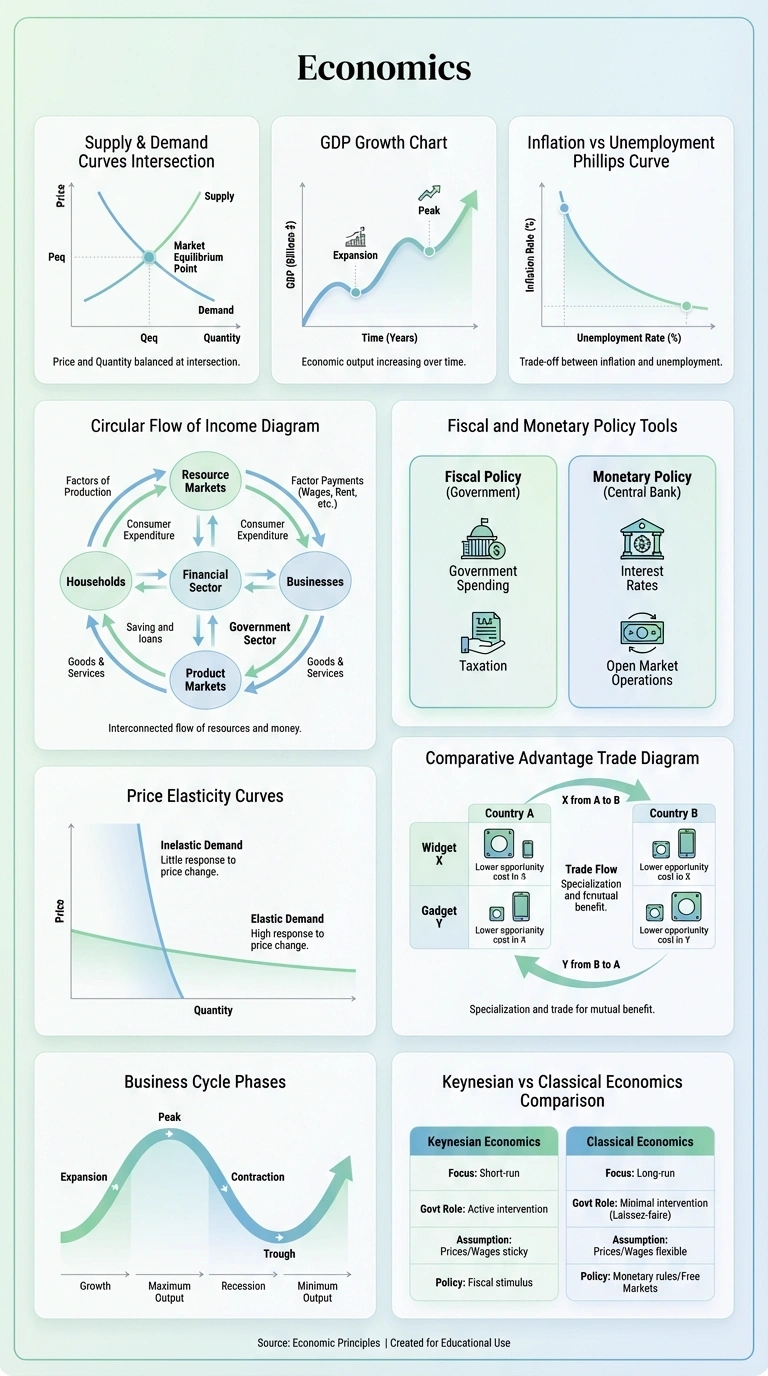
Economics is the study of how individuals, businesses, and governments make choices about allocating limited resources. It provides frameworks for understanding markets, trade, policy, and human behavior in the face of scarcity and incentives.
The field divides into microeconomics (individual and firm decisions) and macroeconomics (economy-wide phenomena like inflation, unemployment, and growth). Both use mathematical models to analyze behavior and predict outcomes, though they also incorporate insights from psychology and other social sciences.
Economics has profound policy implications. Economists advise governments on taxation, trade, regulation, and monetary policy. They analyze markets from healthcare to housing to labor. Economic thinking shapes debates on inequality, climate change, and international development.
Modern economics increasingly uses big data and computational methods. Behavioral economics incorporates psychological insights. The field continues to evolve while maintaining its core focus on incentives, trade-offs, and efficiency.
Study Economics Smarter with LectureScribe
Visual learning has been proven to improve retention by up to 65%. That's why LectureScribe lets you create custom Economics infographics from your own lecture content. Upload a recording, notes, or PDF, and our AI generates beautiful visual study guides that highlight key concepts and relationships. Combined with AI-generated quizzes and flashcards, LectureScribe gives you everything you need to master Economics.