About Physics
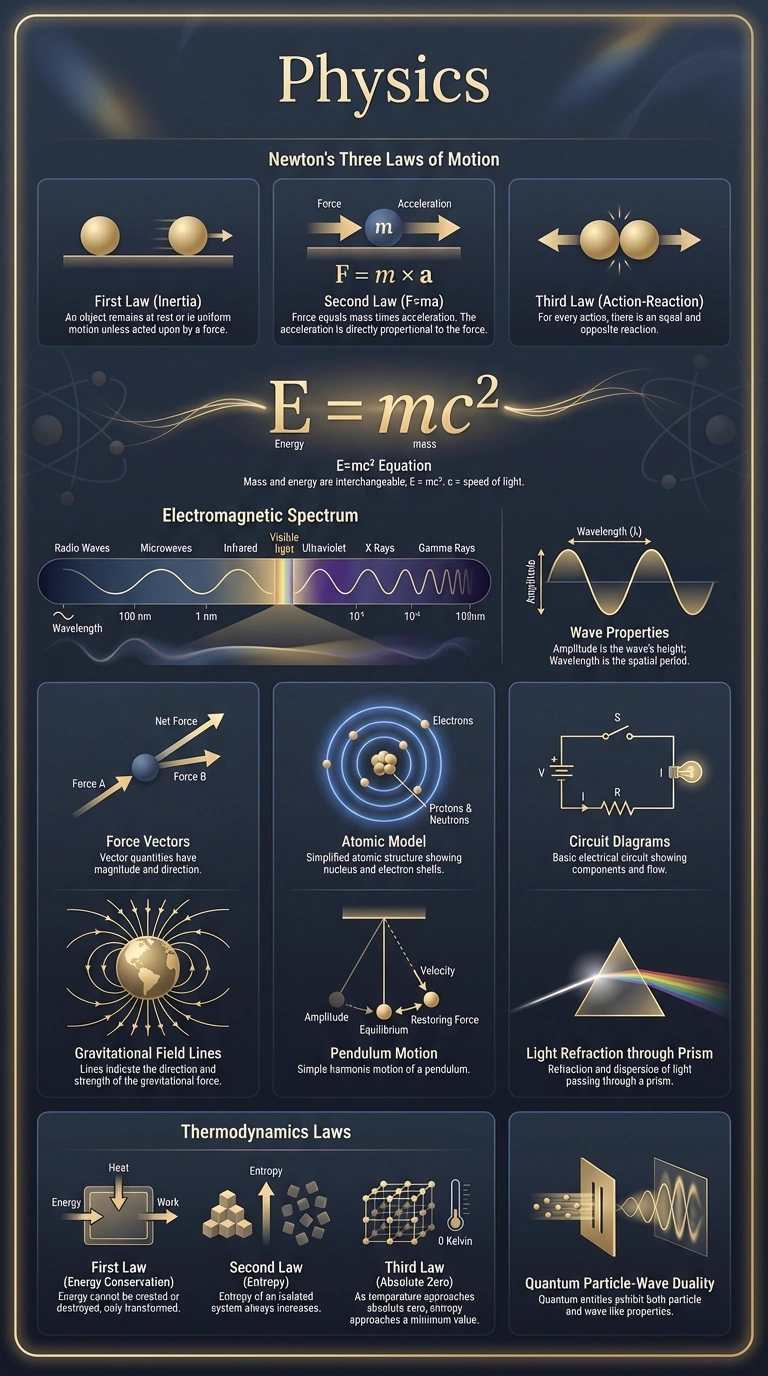
Physics is the most fundamental of the natural sciences. It seeks to understand the basic laws that govern the universe, from the smallest subatomic particles to the largest cosmic structures. Physics asks the deepest questions: What is the universe made of? How did it begin? What are the fundamental forces of nature?
The history of physics is a story of revolutions. Newton's mechanics explained motion and gravity. Maxwell unified electricity and magnetism. Einstein's relativity transformed our understanding of space and time. Quantum mechanics revealed the strange behavior of the subatomic world. Each revolution built on and transcended what came before.
Modern physics operates at the frontiers of human knowledge. Particle physicists probe the smallest constituents of matter. Cosmologists study the origin and fate of the universe. Quantum information scientists develop new paradigms for computation. Condensed matter physicists discover new states of matter.
Physics has driven technological civilization - from electronics to nuclear power to lasers to GPS. The next generation of physicists will likely revolutionize energy production, computing, and our understanding of reality itself.
Study Physics Smarter with LectureScribe
Visual learning has been proven to improve retention by up to 65%. That's why LectureScribe lets you create custom Physics infographics from your own lecture content. Upload a recording, notes, or PDF, and our AI generates beautiful visual study guides that highlight key concepts and relationships. Combined with AI-generated quizzes and flashcards, LectureScribe gives you everything you need to master Physics.