Written by Sarah Mitchell
Education Tech Researcher
Sarah specializes in AI-driven learning tools and has spent over 5 years analyzing how technology improves student outcomes on standardized exams and college finals. She has guided thousands of students through structured study plan creation.
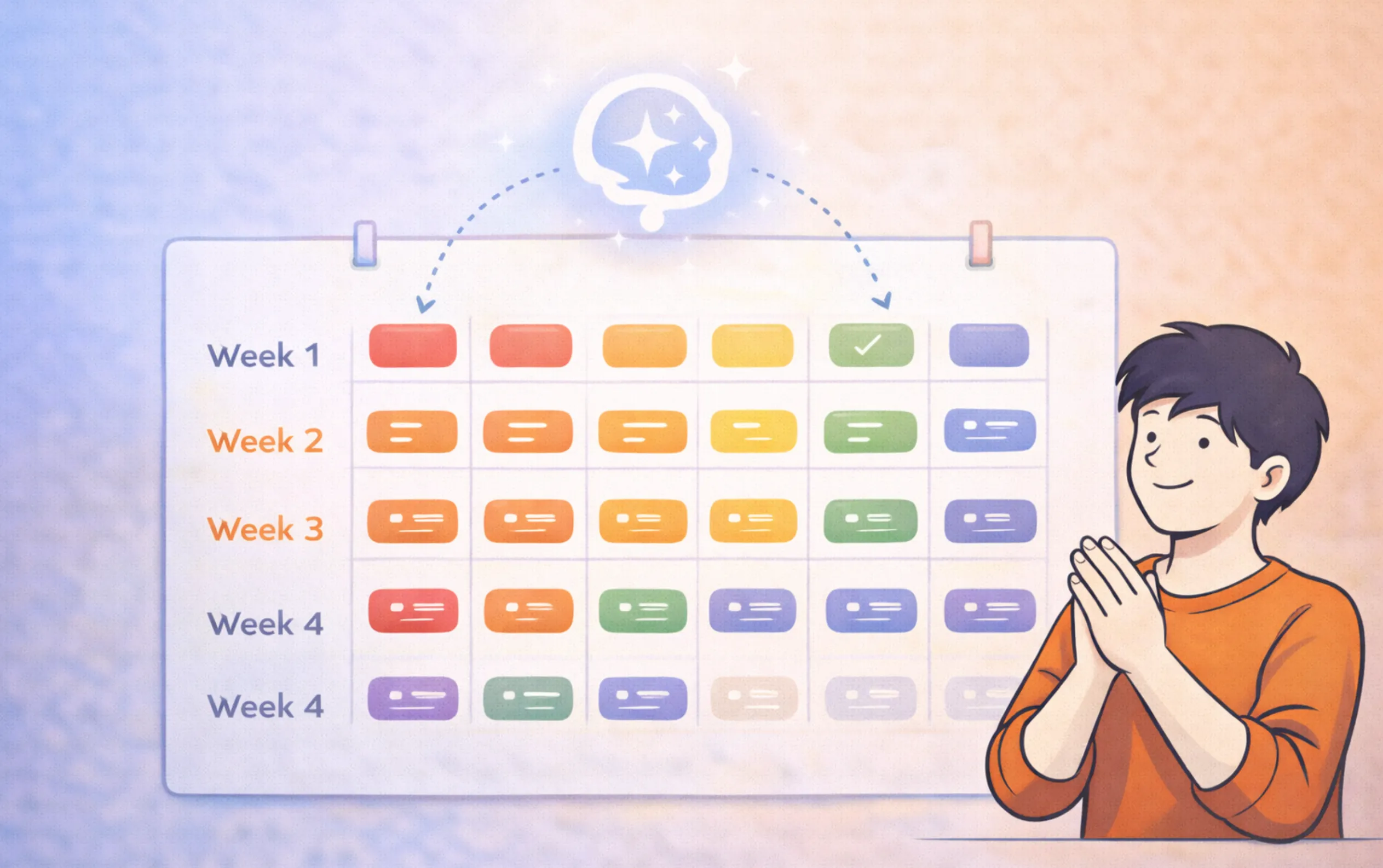
4-Week Study Plan at a Glance
- Week 1: Content review and material organization with AI
- Week 2: Active learning with AI quizzes and practice problems
- Week 3: Practice tests and deep review under exam conditions
- Week 4: Final review, spaced repetition, and confidence building
- Best AI Tool: LectureScribe (flashcards, quizzes, AI tutor, study shorts)
- Key Principle: Spaced repetition beats cramming by 200%+ in retention
Table of Contents
Why a 4-Week Plan Works Better Than Cramming
The science is clear: distributed practice dramatically outperforms cramming. A landmark study published in Psychological Science in the Public Interest found that students who spaced their study over multiple weeks retained 200% more material than those who crammed the same content into a single session. Yet every semester, millions of students still wait until the last 48 hours to start studying.
A 4-week plan works because it aligns with how your brain actually forms long-term memories. The spacing effect means that each time you revisit material after a gap, your brain strengthens the neural pathways associated with that information. By week 4, concepts you first reviewed in week 1 have been reinforced multiple times at increasing intervals, making them nearly automatic to recall under exam pressure.
The other advantage is psychological. Students who follow a structured plan report significantly lower anxiety during finals week compared to those who wing it. When you know exactly what to study each day, you eliminate the paralysis of "where do I even start?" and replace it with clear, actionable steps.
The Research on Spacing vs. Cramming
Students who use spaced repetition retain 90% of material after 30 days, compared to just 20-30% for those who cram. The forgetting curve, first described by Hermann Ebbinghaus, shows that without review, you lose 70% of new information within 24 hours. A 4-week plan with built-in review cycles directly counters this effect.
Your 4-Week Finals Study Timeline
Organize & Review
- Upload all lectures and notes to LectureScribe
- Generate AI flashcards for each subject
- Create a master topic list per course
- Identify weak areas with initial self-assessment
Active Learning
- Take AI-generated quizzes for each subject
- Work through practice problems daily
- Use AI tutor to clarify confusing concepts
- Track weak areas and adjust focus
Practice Tests
- Take full-length practice exams under timed conditions
- Review every missed question thoroughly
- Deep dive into persistent weak spots
- Simulate real exam environment and timing
Review & Confidence
- Spaced repetition review of all flashcards
- Watch AI study shorts for quick refreshers
- Light review only — no new material
- Rest, sleep well, and build exam confidence
Week 1: Content Review & Material Organization
Week 1 is your foundation. The goal is simple: get every piece of study material organized, digitized, and ready for active learning. Most students waste precious study hours hunting for notes, re-reading textbooks passively, or trying to figure out what topics each exam covers. This week eliminates all of that.
Start by gathering every lecture recording, set of notes, PDF, slide deck, and textbook chapter for each of your courses. Then upload everything to LectureScribe. Within minutes, the AI will transcribe your lectures, generate organized summaries, and create targeted flashcards from each upload. What used to take an entire weekend of manual work now happens automatically.
Week 1 Daily Checklist
Pro Tip: The Power of AI Flashcard Generation
A typical 50-minute lecture uploaded to LectureScribe generates 40-60 targeted flashcards in under 2 minutes. If you have 5 courses with 30 lectures each, that is 6,000-9,000 flashcards created automatically instead of by hand. This alone saves 40-60 hours of manual flashcard creation, letting you jump straight into active recall practice.
Week 2: Active Learning & Practice Problems
Week 2 is where the real learning happens. Passive review (re-reading notes, highlighting textbooks) is the least effective study method. Instead, you will shift entirely to active recall: forcing your brain to retrieve information rather than simply recognizing it.
Use LectureScribe's AI quiz generator to create practice questions from your lecture materials. Unlike generic practice problems, these quizzes are tailored to exactly what your professors covered. The AI tutor feature lets you ask follow-up questions on any topic you find confusing, giving you on-demand explanations without waiting for office hours.
This is also the week to identify and attack your weak areas. After taking AI quizzes, review your results to see which topics consistently trip you up. Spend extra time on these areas rather than reviewing material you already know well. The AI tutor can break down complex concepts into simpler explanations and generate additional practice problems targeting your specific gaps.
Active Recall Techniques
- -Take AI-generated quizzes before reviewing notes
- -Close your notes and try to explain concepts aloud
- -Use the Feynman technique: teach it simply
- -Write practice answers from memory, then check
Weak Area Identification
- -Track quiz scores by topic, not just by subject
- -Ask AI tutor to explain missed questions
- -Generate extra practice on weak topics
- -Revisit flagged flashcards from week 1
Week 3: Practice Tests & Deep Review
Week 3 is about simulating exam conditions. Taking practice tests under realistic conditions is one of the single most effective exam preparation strategies, yet most students skip it entirely. Practice tests do more than assess your knowledge; they train your brain to perform under pressure, manage time effectively, and recognize question patterns.
For each subject, set a timer matching your actual exam length, put away all notes and aids, and take a full-length practice test. Use past exams from your professor if available, or generate comprehensive practice exams using LectureScribe's AI. After each practice test, the critical step is reviewing every single question you missed. Do not just look at the correct answer. Understand why you got it wrong and what concept you need to revisit.
Practice Test Protocol
- 1.Set a timer for the full exam duration. No breaks unless the real exam allows them.
- 2.No notes, no phone, no AI. Simulate real conditions exactly.
- 3.Score yourself honestly. Do not round up or give partial credit unless the real exam does.
- 4.Review every missed question. Use AI tutor to understand the correct reasoning.
- 5.Create new flashcards for concepts you missed. These become priority review items for week 4.
Aim to take at least 2 full practice tests per subject during week 3. If a subject has multiple exam formats (e.g., multiple choice plus essay), practice both. Track your scores to see improvement between the first and second attempt. If your score is not improving, it signals that you need to go back and strengthen foundational concepts rather than continuing to take more practice tests.
Week 4: Final Review & Confidence Building
Week 4 is not about learning new material. It is about consolidating everything you already know and walking into each exam with confidence. The biggest mistake students make in the final week is panicking and trying to cram new content. If you have followed the plan for 3 weeks, you already know far more than you think.
Focus on spaced repetition review of your flashcards. By now, your spaced repetition system (whether through LectureScribe or Anki) has identified which cards you know cold and which still need work. Trust the algorithm and focus on the cards it serves you. Watch LectureScribe's AI study shorts for quick 2-3 minute video refreshers on key topics. These are perfect for reinforcing concepts without the cognitive load of a full study session.
Spaced Repetition
Review flashcards using the algorithm. Focus on cards you still struggle with. 30-45 min per subject daily.
AI Study Shorts
Watch 2-3 minute video summaries for quick refreshers on key concepts. Great for review on the go.
Rest & Confidence
Get 7-8 hours of sleep every night. Light exercise. No all-nighters. Trust your preparation.
The Night Before Each Exam
Do a single light review session of no more than 60 minutes: skim your AI-generated summaries, do one final pass through flagged flashcards, and then stop. Eat a good meal, avoid caffeine after 2 PM, and get a full night of sleep. Your brain consolidates memories during sleep, which means resting is literally part of studying. Students who sleep 8 hours before an exam consistently outperform those who study through the night.
How to Prioritize Multiple Subjects
Most students have 4-6 finals to prepare for simultaneously. Trying to give equal time to every subject is a mistake. Instead, use a weighted prioritization system that allocates your study time based on impact and need.
Subject Priority Matrix
Rate each subject on these four factors (1-5 scale), then add up the total to determine priority:
Grade Impact
How much is the final worth? A final worth 40% of your grade deserves more time than one worth 15%.
Current Grade Risk
A B- that could drop to a C needs more attention than a solid A. Focus on protecting grades at risk of dropping a letter.
Exam Date
Earlier exams need front-loaded preparation. If your hardest exam is first, it should get priority in weeks 1-2.
Material Difficulty
Harder subjects need more time. A cumulative organic chemistry final demands more prep than a non-cumulative elective.
Once you have ranked your subjects, allocate your daily study time proportionally. Your highest-priority subject should get about 35-40% of your study time, the second gets 25-30%, and the remaining subjects share the rest. Use AI-generated flashcards and study shorts for lower-priority subjects so you maintain knowledge without dedicating full study sessions.
Daily Schedule Template
Research on circadian rhythms and cognitive performance shows that your brain has distinct peaks for different types of thinking throughout the day. This schedule is designed to match your study activities to your cognitive peaks.
Morning: Hard Subjects & New Learning
Your cortisol levels peak in the morning, making this the best time for challenging material. Tackle your hardest subject here. Work through practice problems, take AI quizzes, and engage with difficult concepts. Use the Pomodoro technique: 50 minutes of focused study, 10-minute break.
Afternoon: Review & Second Subject
After lunch, switch to your second-priority subject. This period is ideal for review, reading AI-generated summaries, and consolidating notes. If you feel an energy dip, use this time for lighter activities like organizing materials or watching AI study shorts.
Evening: Flashcard Review & Spaced Repetition
Evening is perfect for spaced repetition flashcard review across all subjects. This lighter cognitive load works well when your brain is winding down. Review 30-45 minutes of flashcards, then stop. Do not study past 10 PM. Your brain needs sleep to consolidate the day's learning.
Important: Build in Breaks and Rest
This schedule includes about 6-7 hours of active study time per day. Research shows diminishing returns beyond this. Include a proper lunch break (at least 45 minutes away from study materials), short walks between sessions, and at least one full rest day per week. Studying 7 days a week for 4 weeks leads to burnout, not success.
Tools to Supercharge Your 4-Week Plan
The right tools can cut your preparation time in half while improving retention. Here are the essential tools for each phase of your study plan.
LectureScribe
AI Flashcards, Quizzes, Tutor, Video Lectures & Study Guides
LectureScribe is the single most powerful tool for a 4-week finals plan because it handles every phase: content organization (week 1), active learning with AI quizzes and tutor (week 2), practice test generation (week 3), and spaced repetition with study shorts (week 4). Upload your lectures, notes, and PDFs, and the AI generates everything you need to study effectively.
Upload a lecture and get flashcards, multiple-choice quizzes, and study guides within minutes. Covers exactly what your professors taught.
Ask the AI tutor any question about your course material. Get instant explanations tailored to your uploaded content, not generic answers.
Auto-generated 2-3 minute video summaries of key topics. Perfect for week 4 quick reviews and studying on the go between exams.
Works with lecture recordings, YouTube videos, PDFs, slides, and even photos of handwritten notes. One tool for all your materials.
Pricing
1 Free Upload | $9.99/month
Anki
Free spaced repetition for long-term memorization
Anki's spaced repetition algorithm is the gold standard for memorization. Export flashcards from LectureScribe into Anki format for optimized review scheduling. Anki automatically determines when you need to see each card again based on how well you remembered it. Daily 15-20 minute Anki sessions during weeks 2-4 keep knowledge fresh across all subjects.
Pricing
Free (Desktop & Android) | $24.99 (iOS)
Google Calendar / Notion
Block scheduling for structured daily study
Time-blocking your study sessions in a calendar app transforms your 4-week plan from a vague intention into a concrete commitment. Schedule each study block as a non-negotiable appointment. Color-code by subject so you can visually confirm you are allocating time proportionally. Notion is especially useful for tracking your progress through the weekly checklists alongside your calendar.
Pricing
Free tiers available for both
Recommended Finals Study Stack
Combine these tools for maximum efficiency:
- 1LectureScribe — Generate flashcards, quizzes, summaries, and study shorts from all your materials ($9.99/mo)
- 2Anki — Spaced repetition review of exported flashcards (Free)
- 3Google Calendar — Time-block your daily study sessions (Free)
- 4Notion — Track progress through weekly checklists (Free)
Total investment: ~$10/month. Compare to private tutoring at $50-100 per hour.
What to Do If You're Behind Schedule
Life happens. Maybe you started late, got sick for a week, or underestimated how much material you needed to cover. The worst thing you can do is panic and abandon the plan entirely. Instead, compress and prioritize.
If You Have 2 Weeks Left
Combine weeks 1 and 2: spend days 1-2 uploading everything to LectureScribe and generating all study materials at once. Days 3-7 focus on active learning with AI quizzes, prioritizing your weakest and highest-impact subjects. Days 8-12 do practice tests and targeted review. Days 13-14 light review and rest. Skip the detailed organization phase and let AI handle it.
If You Have 1 Week Left
Focus ruthlessly on the highest-impact subjects. Upload materials to LectureScribe and immediately start with AI quizzes to identify your biggest knowledge gaps. Spend 80% of your time on your weakest areas in your most important classes. Use AI study shorts for quick review of subjects where you are already reasonably strong. Check out our full 7-day finals study plan for a detailed day-by-day breakdown.
If You Have 3 Days Left
Triage mode. Pick the 2-3 exams where your grade is most at risk. Upload key materials to LectureScribe and use AI-generated summaries as your primary study resource. Do rapid flashcard sessions focusing on core concepts only. Take one practice test per subject if time allows. Most importantly, do not pull all-nighters. Sleep deprivation will hurt your performance more than the extra study hours help.
The 80/20 Rule for Catching Up
When time is short, apply the Pareto principle: 20% of the material typically accounts for 80% of exam questions. Focus on the core concepts, formulas, and themes that your professor emphasized most. AI-generated summaries from LectureScribe naturally highlight the most important material from each lecture, making it easy to identify that critical 20%.
Frequently Asked Questions
How far in advance should I start studying for finals?
Ideally, start 4 weeks before your first final exam. This gives you one week to organize materials, one week for active learning, one week for practice tests, and one final week for review and confidence building. Starting 4 weeks out lets you use spaced repetition effectively, which research shows is far more effective than cramming. If you have less time, even 2 weeks with AI tools like LectureScribe can make a significant difference.
Can AI tools really help me create a study plan for finals?
Yes. AI tools like LectureScribe can save 10-15 hours of manual preparation by automatically generating flashcards, quizzes, and study summaries from your lecture recordings and notes. The AI tutor feature identifies your weak areas and suggests what to focus on, essentially creating a personalized study plan. This lets you spend your limited time on active studying rather than organizing materials.
How many subjects should I study per day during finals prep?
Study 2-3 subjects per day maximum. Studying too many subjects in one day leads to interference, where the information from different courses gets mixed up in your memory. A good approach is to dedicate your morning session (when cognitive energy is highest) to your hardest subject, afternoon to a second subject for review, and evening to flashcard review across all subjects using spaced repetition.
What is the best daily study schedule for finals?
A proven daily schedule is: Morning (9-12 PM) for your hardest or most important subject using active recall and practice problems; Afternoon (1-4 PM) for a second subject focusing on review and note consolidation; Evening (7-9 PM) for flashcard review across all subjects using spaced repetition apps. Take 10-minute breaks every 50 minutes and a longer break at lunch.
What should I do if I only have 2 weeks before finals?
If you only have 2 weeks, compress the 4-week plan: spend days 1-2 uploading all materials to LectureScribe and generating AI summaries and flashcards. Days 3-7 focus on active learning with AI quizzes, targeting your weakest topics first. Days 8-12 do practice tests and review missed questions. Days 13-14 do light review and rest. AI tools are especially valuable when time is short because they eliminate hours of manual organization.
How do I prioritize which subjects to study first for finals?
Prioritize using a weighted system: consider each exam's weight toward your final grade, your current grade in the class (a B- that could become a C needs more attention than a solid A), the exam date (earlier exams get priority), and the difficulty of the material. Create a matrix ranking each subject by urgency and impact. Focus the most study time on high-impact, high-difficulty subjects and use AI-generated flashcards for quick review of subjects you already know well.
Ready to Build Your 4-Week Study Plan?
Upload your lectures and notes, and LectureScribe will generate flashcards, quizzes, and study guides instantly
Try LectureScribe Free — No Credit Card RequiredStart building your study plan today and walk into finals feeling prepared
Related Articles
How to Study for Finals Week: 7-Day Plan
A day-by-day emergency study plan when you only have one week before finals.
Spaced Repetition Guide & Best Apps 2026
Deep dive into the science of spaced repetition and the best tools to implement it.
Active Recall Study Method Guide
Master the most effective study technique backed by decades of cognitive science research.
Best AI Study Apps for Students 2026
Complete guide to the top AI-powered study tools for academic success.