LectureScribe Logo
lecturescribe.io

LOCK IN VALENTINE PRICING BEFORE SALE ENDS!

Use code — New joiners get 40% OFF on annual plans

Plans will have higher prices after this sale ends

0days
:
0hours
:
0minutes
:
0seconds
Biochemistry2,500+ words5 slides
🧪

Amino Acid Structures: 20 Amino Acids Chart and Properties

Learn the structures and properties of all 20 amino acids with a comprehensive amino acid chart. Covers essential amino acids, side chain classification, and key biochemistry concepts.

L
LectureScribeAI-Powered Study Platform

Study Infographic

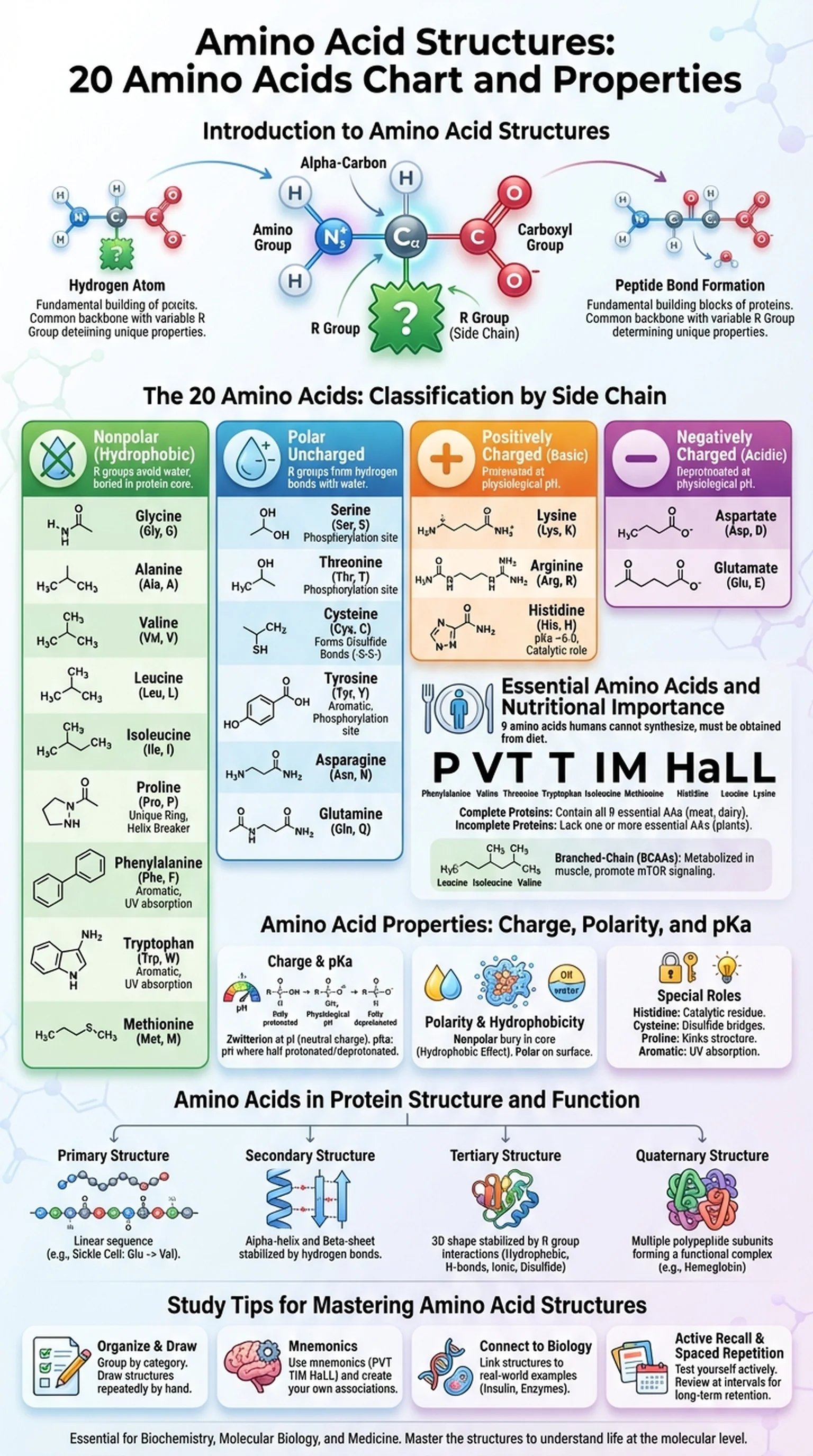
Comprehensive amino acid chart displaying all 20 amino acid structures organized by polarity and charge, with key properties highlighted.

Download
Amino acid chart showing the structures and properties of all 20 amino acids grouped by side chain classification

Interactive Study Short

Swipe through 5 slides about Amino Acid Structures: 20 Amino Acids Chart and Properties

1 / 5

Introduction to Amino Acid Structures

Amino acid structures form the molecular alphabet of life, encoding the information needed to build every protein in the human body. There are 20 amino acids that are genetically encoded and incorporated into proteins during translation. Each amino acid shares a common backbone consisting of a central alpha-carbon bonded to an amino group (-NH2), a carboxyl group (-COOH), a hydrogen atom, and a unique side chain (R group). It is the side chain that gives each amino acid its distinctive chemical personality and determines how it contributes to protein folding, function, and interactions.

Understanding amino acid structures is foundational for biochemistry, molecular biology, and medicine. When students encounter an amino acid chart for the first time, the diversity of R groups can seem overwhelming. However, the 20 amino acids can be organized into logical categories based on side chain properties: nonpolar (hydrophobic), polar uncharged, positively charged (basic), and negatively charged (acidic). This classification system transforms a seemingly random list into a structured framework that is far easier to learn and apply.

The importance of amino acid properties extends well beyond memorization for exams. Mutations that swap one amino acid for another can dramatically alter protein function, as seen in diseases like sickle cell anemia where a single glutamate-to-valine substitution changes hemoglobin's behavior. Drug design frequently targets specific amino acid residues in enzyme active sites. Clinical laboratory tests measure levels of particular amino acids to diagnose metabolic disorders. In short, a thorough knowledge of the 20 amino acids and their structural features is indispensable for any student pursuing a career in the biomedical sciences.

Key Terms

Amino Acid Structures

The molecular arrangements of the 20 genetically encoded amino acids, each consisting of a common backbone and a unique R group (side chain).

R Group (Side Chain)

The variable chemical group attached to the alpha-carbon that distinguishes one amino acid from another and determines its chemical properties.

Alpha-Carbon

The central carbon atom of an amino acid to which the amino group, carboxyl group, hydrogen, and R group are all attached.

Peptide Bond

A covalent bond formed between the carboxyl group of one amino acid and the amino group of another during protein synthesis.

The 20 Amino Acids: Classification by Side Chain

The 20 amino acids are most commonly classified by the chemical nature of their side chains, which dictates their behavior in aqueous environments and their roles in protein structure. The four major categories are nonpolar, polar uncharged, positively charged, and negatively charged amino acids.

The nonpolar amino acids include glycine, alanine, valine, leucine, isoleucine, proline, phenylalanine, tryptophan, and methionine. Their hydrophobic side chains tend to cluster in the interior of globular proteins, away from water. Proline is unique among the 20 amino acids because its side chain cyclizes back onto the backbone nitrogen, creating a rigid ring structure that introduces kinks in protein chains. Phenylalanine and tryptophan contain aromatic rings that participate in hydrophobic interactions and can absorb ultraviolet light at 280 nm, a property exploited in laboratory protein quantification.

The polar uncharged amino acids are serine, threonine, cysteine, tyrosine, asparagine, and glutamine. Serine and threonine bear hydroxyl groups that can form hydrogen bonds and serve as sites for phosphorylation, a critical post-translational modification in cell signaling. Cysteine contains a sulfhydryl (-SH) group that can form disulfide bonds with another cysteine, stabilizing protein tertiary and quaternary structure.

The positively charged (basic) amino acids at physiological pH are lysine, arginine, and histidine. Lysine and arginine carry full positive charges under most conditions, while histidine has a pKa near 6.0, allowing it to switch between protonated and deprotonated states at physiological pH. The negatively charged (acidic) amino acids are aspartate and glutamate, both of which carry a negative charge at pH 7.4 due to deprotonation of their carboxyl side chains. This amino acid chart of classification is the single most important organizational tool for mastering amino acid properties.

Key Terms

20 Amino Acids

The set of genetically encoded amino acids incorporated into proteins during translation, classified by their side chain properties.

Hydrophobic Amino Acids

Nonpolar amino acids with side chains that avoid water and tend to be buried in the interior of folded proteins.

Disulfide Bond

A covalent bond formed between the sulfhydryl groups of two cysteine residues, stabilizing protein three-dimensional structure.

Amino Acid Chart

A reference table organizing the 20 amino acids by their structures, side chain classifications, single-letter codes, and chemical properties.

Essential Amino Acids and Nutritional Importance

Of the 20 amino acids required for protein synthesis, humans can synthesize only eleven through endogenous metabolic pathways. The remaining nine must be obtained from the diet and are therefore called essential amino acids. These are histidine, isoleucine, leucine, lysine, methionine, phenylalanine, threonine, tryptophan, and valine. The mnemonic PVT TIM HaLL (Phenylalanine, Valine, Threonine, Tryptophan, Isoleucine, Methionine, Histidine, Leucine, Lysine) is a popular study aid for remembering the complete list of essential amino acids.

The distinction between essential and nonessential amino acids has profound nutritional and medical implications. Complete proteins, found in animal products such as meat, eggs, and dairy, contain all nine essential amino acids in sufficient quantities. Incomplete proteins, typical of most plant sources, lack or are low in one or more essential amino acids. Vegetarians and vegans must therefore combine complementary plant proteins, such as rice and beans, to ensure they receive all essential amino acids. Deficiency in even a single essential amino acid can impair protein synthesis, leading to muscle wasting, immune dysfunction, and impaired growth in children.

Branched-chain amino acids (BCAAs) are a subset of essential amino acids that include leucine, isoleucine, and valine. They are unique because they are metabolized primarily in skeletal muscle rather than the liver. Leucine, in particular, has been shown to stimulate the mTOR signaling pathway and promote muscle protein synthesis, making BCAAs a popular supplement among athletes. Understanding the amino acid properties of BCAAs and their metabolic fate illustrates how the chemical structure of individual amino acids translates directly into physiological function.

Key Terms

Essential Amino Acids

The nine amino acids that cannot be synthesized by the human body and must be obtained through dietary intake.

Complete Protein

A food source that contains all nine essential amino acids in adequate proportions for human nutrition.

Branched-Chain Amino Acids (BCAAs)

Leucine, isoleucine, and valine; essential amino acids with branched aliphatic side chains that are primarily metabolized in muscle tissue.

mTOR Pathway

A cell signaling pathway activated by leucine that promotes protein synthesis and cell growth.

Amino Acid Properties: Charge, Polarity, and pKa

The amino acid properties of charge, polarity, and pKa govern how each residue interacts with water, neighboring residues, and biological molecules. These properties are determined entirely by the amino acid structures of the side chains and are crucial for understanding protein folding, enzyme catalysis, and drug binding.

At physiological pH (approximately 7.4), the amino group of the backbone is protonated (-NH3+) and the carboxyl group is deprotonated (-COO-), giving the amino acid a zwitterionic form with no net charge on the backbone. The overall charge of an amino acid at any given pH depends on the ionizable groups present in its side chain. Aspartate and glutamate have acidic side chains with pKa values around 3.7 and 4.1, respectively, meaning they are deprotonated and negatively charged at pH 7.4. Lysine (pKa ~10.5) and arginine (pKa ~12.5) are protonated and positively charged at physiological pH. Histidine, with its imidazole side chain pKa of approximately 6.0, occupies a special position: it can act as both a proton donor and acceptor near physiological pH, making it an ideal catalytic residue in enzyme active sites.

Polarity determines whether an amino acid side chain prefers to be in an aqueous environment or buried in the hydrophobic core of a protein. Polar amino acids like serine, threonine, and asparagine tend to be found on protein surfaces where they can hydrogen-bond with water. Nonpolar amino acids like leucine, valine, and phenylalanine cluster in the interior, driven by the hydrophobic effect. This partitioning is one of the primary driving forces behind protein folding.

Students preparing for exams should be able to predict the charge state of any amino acid at a given pH by comparing the pH to the pKa of each ionizable group. If the pH is above the pKa, the group is deprotonated; if below, it is protonated. Mastering this relationship is essential for solving isoelectric point problems and interpreting electrophoresis experiments.

Key Terms

Amino Acid Properties

The chemical characteristics of amino acids including charge, polarity, hydrophobicity, and pKa that determine their behavior in proteins.

Zwitterion

The dipolar form of an amino acid at its isoelectric point, carrying both a positive charge on the amino group and a negative charge on the carboxyl group.

pKa

The pH at which half of the ionizable group is protonated and half is deprotonated; a measure of acid strength.

Isoelectric Point (pI)

The pH at which an amino acid or protein carries no net electrical charge.

Amino Acids in Protein Structure and Function

The amino acid structures and properties discussed in the preceding sections come together to determine the three-dimensional architecture and biological function of every protein. Protein structure is organized into four hierarchical levels, and the nature of the amino acid side chains drives the folding at each level.

Primary structure refers to the linear sequence of amino acids linked by peptide bonds. This sequence is determined by the genetic code and is specific to each protein. Even a single amino acid substitution can have dramatic consequences, as illustrated by the sickle cell mutation where glutamate (charged, hydrophilic) is replaced by valine (nonpolar, hydrophobic) at position 6 of the beta-globin chain. Secondary structure involves local folding patterns stabilized by hydrogen bonds between backbone atoms. The alpha-helix and beta-sheet are the two most common secondary structures, and certain amino acids have strong preferences for one or the other. Proline, for instance, is a helix breaker due to its cyclic side chain, while alanine and leucine are strong helix formers.

Tertiary structure describes the overall three-dimensional fold of a single polypeptide chain, stabilized by interactions among amino acid side chains including hydrophobic interactions, hydrogen bonds, ionic bonds, and disulfide bridges between cysteine residues. Quaternary structure refers to the arrangement of multiple polypeptide subunits into a functional protein complex, such as the four subunits of hemoglobin.

Understanding how specific amino acids contribute to each level of structure allows biochemists to predict the effects of mutations, design recombinant proteins, and develop targeted therapeutics. A solid grasp of the amino acid chart and the properties of all 20 amino acids is the foundation upon which protein biochemistry is built.

Key Terms

Primary Structure

The linear sequence of amino acids in a polypeptide chain, determined by the gene encoding the protein.

Secondary Structure

Local folding patterns (alpha-helices and beta-sheets) stabilized by hydrogen bonds between backbone amino and carbonyl groups.

Tertiary Structure

The overall three-dimensional shape of a single polypeptide, stabilized by side chain interactions including hydrophobic effects, hydrogen bonds, and disulfide bonds.

Quaternary Structure

The arrangement of two or more polypeptide subunits into a multi-subunit protein complex.

Study Tips for Mastering Amino Acid Structures

Memorizing the structures and properties of all 20 amino acids is one of the foundational tasks in any biochemistry course, and it can feel daunting at first. However, with the right strategies, students can internalize this material efficiently and retain it for exams and beyond.

First, organize before you memorize. Use an amino acid chart that groups the 20 amino acids by side chain category (nonpolar, polar uncharged, positive, negative). Within each group, note the distinguishing features: methionine has a sulfur atom, cysteine has a thiol, tryptophan has the largest aromatic ring, and so on. Patterns within categories are much easier to remember than isolated facts. Second, draw the structures by hand. Research consistently shows that the physical act of drawing amino acid structures enhances spatial memory. Start with the shared backbone, then add the unique R group. Practice until you can draw all 20 amino acids from memory.

Third, use mnemonics and memory aids. The PVT TIM HaLL mnemonic for essential amino acids is a classic example, but you can create your own for other groupings, such as the aromatic amino acids (phenylalanine, tyrosine, tryptophan: "Fit Youngsters Train"). Fourth, connect structures to real-world biology. When you learn that cysteine forms disulfide bonds, immediately think of insulin, which has three disulfide bridges essential for its function. When you learn that histidine is a catalytic residue, recall its role in the active site of serine proteases.

Finally, use active recall and spaced repetition to test yourself. Platforms like LectureScribe can automatically generate flashcards and quizzes from your amino acid notes, helping you practice retrieving amino acid structures and amino acid properties at optimal intervals for long-term retention.

Key Terms

Active Recall

A study method that involves actively retrieving information from memory rather than passively reviewing it.

Spaced Repetition

A learning technique in which review sessions are spaced at increasing intervals to optimize long-term memory.

MCAT

The Medical College Admission Test; a standardized exam that extensively tests knowledge of amino acid structures and protein biochemistry.

Frequently Asked Questions

How many amino acids are there in human proteins?

There are 20 standard amino acids that are genetically encoded and incorporated into proteins during translation. These 20 amino acids are specified by codons in mRNA and represent the complete set used for ribosomal protein synthesis.

What is an amino acid chart used for?

An amino acid chart is a reference tool that organizes all 20 amino acids by their structures, side chain properties, abbreviations, and chemical characteristics. It helps students and researchers quickly identify amino acid classifications and compare their properties for studying protein biochemistry.

What are the essential amino acids?

The nine essential amino acids are histidine, isoleucine, leucine, lysine, methionine, phenylalanine, threonine, tryptophan, and valine. They are called essential because the human body cannot synthesize them, so they must be obtained from dietary protein sources.

How are amino acid structures related to protein folding?

Amino acid structures determine protein folding through their side chain properties. Nonpolar amino acids drive hydrophobic collapse of the protein core, polar residues form hydrogen bonds on the surface, charged residues create ionic interactions, and cysteines form disulfide bonds. The sequence of amino acid structures dictates the final three-dimensional shape.

What determines amino acid properties like charge and polarity?

Amino acid properties are determined primarily by the chemical nature of the R group (side chain). The presence of ionizable groups (carboxyl, amino, imidazole, sulfhydryl) determines charge at a given pH, while the presence of polar functional groups (hydroxyl, amide) or hydrophobic groups (aliphatic, aromatic) determines polarity.

Why is cysteine important among the 20 amino acids?

Cysteine is uniquely important because its sulfhydryl (-SH) side chain can form covalent disulfide bonds with other cysteine residues. These bonds stabilize protein tertiary and quaternary structure and are especially critical for secreted proteins like antibodies and hormones such as insulin.

What is the best way to memorize all 20 amino acid structures?

The most effective approach combines categorization (grouping by side chain properties), hand-drawing of structures, mnemonic devices (like PVT TIM HaLL for essential amino acids), and active recall with spaced repetition. Using an amino acid chart as a study reference and testing yourself regularly leads to strong long-term retention.

Study Biochemistry Smarter

Upload your lecture notes and get AI-generated flashcards, quizzes, infographics, and study guides tailored to your curriculum.

Try LectureScribe Free

Create Study Materials

Transform your Biochemistry lectures into flashcards, quizzes, and visual study guides with AI.

  • AI-generated flashcards & quizzes
  • Visual infographics from notes
  • Interactive study shorts
Start Studying Free

Quick Facts

SubjectBiochemistry
Word Count2,500+
Slides5
InfographicIncluded
AuthorLectureScribe

Master Biochemistry with LectureScribe

Upload your lecture notes and get AI-powered flashcards, quizzes, infographics, and study guides in minutes.