LectureScribe Logo
lecturescribe.io

LOCK IN VALENTINE PRICING BEFORE SALE ENDS!

Use code — New joiners get 40% OFF on annual plans

Plans will have higher prices after this sale ends

0days
:
0hours
:
0minutes
:
0seconds
Biology2,500+ words5 slides
🩸

Blood Type Genetics: ABO System and Inheritance Patterns

Learn blood type genetics and the ABO blood type system. Understand blood type inheritance patterns including codominance and multiple alleles with Punnett square examples.

L
LectureScribeAI-Powered Study Platform

Study Infographic

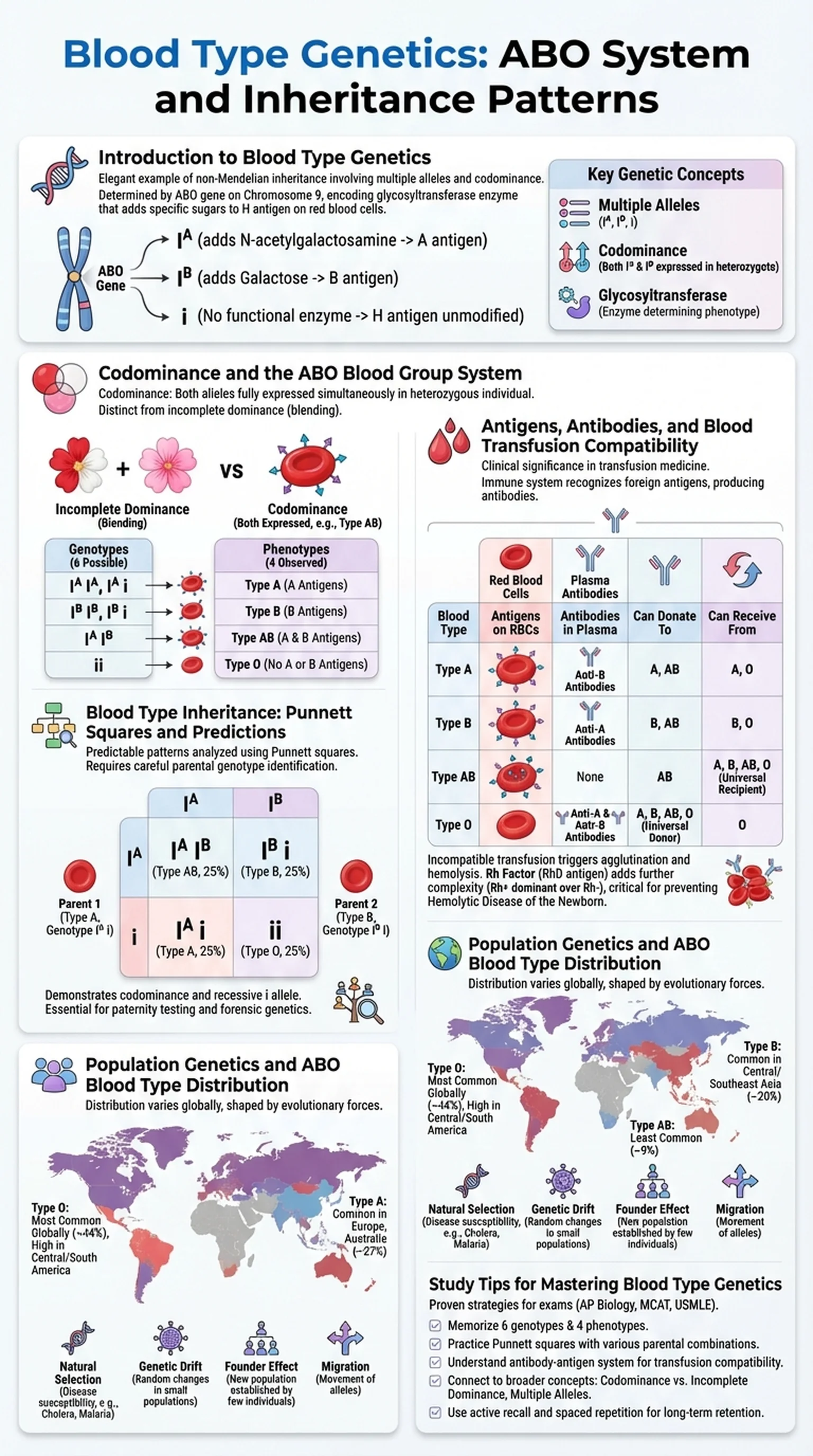
Complete blood type genetics overview illustrating the ABO blood type system, multiple alleles, codominance in type AB, and blood transfusion compatibility chart.

Download
Blood type genetics diagram showing ABO alleles, genotypes, phenotypes, codominance, and transfusion compatibility

Interactive Study Short

Swipe through 5 slides about Blood Type Genetics: ABO System and Inheritance Patterns

1 / 5

Introduction to Blood Type Genetics

Blood type genetics is one of the most elegant examples of non-Mendelian inheritance in human biology. Unlike simple dominant-recessive traits, the ABO blood type system involves multiple alleles and codominance, making it a rich topic for understanding how genes determine phenotypes. The ABO blood group was first described by Karl Landsteiner in 1901, a discovery that earned him the Nobel Prize and transformed the safety of blood transfusions worldwide.

The ABO blood type is determined by a single gene located on chromosome 9, known as the ABO gene. This gene encodes a glycosyltransferase enzyme that adds specific sugar molecules to a precursor molecule called the H antigen on the surface of red blood cells. The type of sugar added determines whether the blood cell displays A antigens, B antigens, both, or neither. Blood type genetics is therefore fundamentally a story about enzyme variants and their biochemical products.

The ABO system features three alleles: I^A, I^B, and i. The I^A allele produces an enzyme that adds N-acetylgalactosamine to the H antigen, creating the A antigen. The I^B allele produces an enzyme that adds galactose, creating the B antigen. The i allele produces no functional enzyme, leaving the H antigen unmodified. Because every individual inherits two alleles (one from each parent), there are six possible genotypes that produce four phenotypes: type A, type B, type AB, and type O. This system illustrates both codominance and multiple alleles, two key genetic concepts that extend beyond the simple Mendelian framework.

Key Terms

Blood Type Genetics

The study of how ABO blood types are inherited through multiple alleles and codominance, determined by the ABO gene on chromosome 9.

ABO Blood Type

A blood classification system based on the presence or absence of A and B antigens on red blood cells, determined by three alleles of the ABO gene.

Multiple Alleles

A pattern of inheritance in which a single gene has more than two allelic forms in the population, as seen with the I^A, I^B, and i alleles of the ABO system.

Glycosyltransferase

The enzyme encoded by the ABO gene that adds specific sugar residues to the H antigen, determining the A or B blood type phenotype.

Codominance and the ABO Blood Group System

Codominance is a pattern of inheritance in which both alleles of a gene are fully expressed in the heterozygous individual, producing a phenotype that displays characteristics of both alleles simultaneously. The ABO blood type system provides the classic textbook example of codominance: an individual who inherits one I^A allele and one I^B allele has blood type AB, expressing both A and B antigens on their red blood cells in equal measure. Neither allele masks or dominates the other.

This codominance relationship between I^A and I^B is distinct from the relationship each has with the i allele. Both I^A and I^B are dominant over i. An individual with the genotype I^A i has blood type A because the I^A allele produces the A antigen while the i allele produces no antigen. Similarly, I^B i yields blood type B. Only individuals with the genotype ii have blood type O, in which no A or B antigens are present on red blood cells. This combination of codominance between I^A and I^B, and dominance of each over i, creates the nuanced blood type inheritance patterns that make this system so instructive for genetics students.

The six possible ABO genotypes and their corresponding phenotypes are: I^A I^A and I^A i both produce type A; I^B I^B and I^B i both produce type B; I^A I^B produces type AB; and ii produces type O. Understanding these genotype-phenotype relationships is essential for solving blood type genetics problems, predicting offspring blood types, and interpreting paternity testing results. The ABO blood type system thus serves as a gateway to understanding more complex genetic phenomena including epistasis, pleiotropy, and population genetics.

Codominance should not be confused with incomplete dominance, where the heterozygote shows a blending of traits (such as pink flowers from red and white parents). In codominance, both phenotypes are expressed fully and distinctly, which is precisely what occurs with blood type AB, where both A and B antigens are detectable on every red blood cell.

Key Terms

Codominance

A pattern of inheritance in which both alleles are fully and simultaneously expressed in the heterozygote, as seen in the AB blood type where both A and B antigens appear.

Genotype

The genetic makeup of an individual for a particular trait; in the ABO system, genotypes include I^A I^A, I^A i, I^B I^B, I^B i, I^A I^B, and ii.

Phenotype

The observable physical expression of a genotype; in the ABO system, the four phenotypes are blood type A, B, AB, and O.

Incomplete Dominance

A pattern of inheritance in which the heterozygous phenotype is intermediate between the two homozygous phenotypes, distinct from codominance.

Blood Type Inheritance: Punnett Squares and Predictions

Blood type inheritance follows predictable patterns that can be analyzed using Punnett squares, the foundational tool of genetic analysis. Because the ABO system involves multiple alleles and codominance, setting up these crosses correctly requires careful attention to the genotypes of both parents.

Consider a cross between a parent with blood type A (genotype I^A i) and a parent with blood type B (genotype I^B i). Setting up the Punnett square, the possible offspring genotypes are: I^A I^B (type AB), I^A i (type A), I^B i (type B), and ii (type O). This single cross produces all four blood types with equal probability of 25 percent each, beautifully demonstrating both codominance and the recessive nature of the i allele. This classic problem appears on nearly every genetics exam.

Now consider a cross between two parents who are both blood type AB (I^A I^B). The offspring can only be I^A I^A (type A), I^A I^B (type AB), or I^B I^B (type B), in a ratio of 1:2:1. Notably, two type AB parents cannot produce a type O child, because neither parent carries the i allele. This principle has practical implications in paternity testing and forensic genetics, where blood type inheritance patterns can exclude suspected parents.

A third instructive example involves two type O parents (both ii). All of their offspring must be ii and therefore type O, because neither parent has an I^A or I^B allele to contribute. Conversely, if a child has blood type AB, both the I^A and I^B alleles must have come from the parents, meaning one parent must carry at least one I^A allele and the other must carry at least one I^B allele.

Mastering blood type genetics problems requires practice with a variety of crosses. Students should be comfortable predicting offspring ratios, working backward from offspring phenotypes to determine parental genotypes, and explaining how codominance and multiple alleles produce the observed inheritance patterns. These skills transfer directly to more complex genetic scenarios involving epistasis and polygenic traits.

Key Terms

Punnett Square

A diagram used to predict the genotype and phenotype ratios of offspring from a genetic cross, essential for solving blood type inheritance problems.

Blood Type Inheritance

The pattern by which ABO blood types are passed from parents to offspring through the segregation and independent assortment of I^A, I^B, and i alleles.

Allele Segregation

The separation of two alleles for a gene during meiosis, so that each gamete receives only one allele for the ABO blood type.

Paternity Testing

The use of genetic markers, including ABO blood type, to determine biological parentage by comparing alleles between parent and child.

Antigens, Antibodies, and Blood Transfusion Compatibility

The clinical significance of blood type genetics extends directly to blood transfusion medicine. The A and B antigens on red blood cells are recognized by the immune system, and individuals naturally produce antibodies against the antigens they lack. This antibody-antigen relationship determines which blood types are compatible for transfusion and which combinations can trigger life-threatening transfusion reactions.

Individuals with blood type A have A antigens on their red blood cells and produce anti-B antibodies in their plasma. Those with blood type B have B antigens and produce anti-A antibodies. People with blood type AB have both A and B antigens and produce neither anti-A nor anti-B antibodies, making them universal recipients who can receive red blood cells from any ABO blood type. Individuals with blood type O have neither A nor B antigens and produce both anti-A and anti-B antibodies, making them universal donors because their red blood cells can be transfused into recipients of any blood type without triggering an ABO-mediated immune reaction.

When incompatible blood is transfused, the recipient's antibodies bind to the foreign antigens on the transfused red blood cells, triggering agglutination (clumping) and hemolysis (destruction of red blood cells). This acute hemolytic transfusion reaction can cause fever, kidney failure, shock, and death. The ABO blood type system is therefore the most important blood group system in transfusion medicine, and accurate blood typing before every transfusion is an absolute requirement.

The Rh factor (Rh positive or Rh negative) adds another layer of complexity to blood type genetics and transfusion compatibility. The Rh system involves the RhD antigen, and its inheritance follows a simple dominant-recessive pattern separate from ABO. Rh incompatibility between an Rh-negative mother and an Rh-positive fetus can cause hemolytic disease of the newborn (HDN), a condition that is now preventable with RhoGAM injections. Together, the ABO and Rh systems form the foundation of clinical blood type genetics.

Key Terms

Antigens

Molecules on the surface of red blood cells (A and B antigens in the ABO system) that can trigger an immune response if transfused into an incompatible recipient.

Antibodies (Anti-A, Anti-B)

Immune proteins in the plasma that recognize and bind to foreign blood type antigens, causing agglutination and hemolysis during incompatible transfusions.

Universal Donor

Blood type O negative; can donate red blood cells to recipients of any blood type because the cells lack A, B, and RhD antigens.

Rh Factor

A blood group antigen (RhD) that is either present (Rh positive) or absent (Rh negative) on red blood cells, inherited separately from the ABO blood type.

Hemolytic Disease of the Newborn

A condition in which maternal antibodies cross the placenta and destroy fetal red blood cells, most commonly caused by Rh incompatibility.

Population Genetics and ABO Blood Type Distribution

The distribution of ABO blood types varies dramatically across human populations, providing a fascinating window into evolutionary genetics and human migration patterns. Blood type genetics on a population scale is governed by allele frequencies, which are shaped by natural selection, genetic drift, founder effects, and migration.

Globally, blood type O is the most common phenotype, found in approximately 44 percent of the world's population. Blood type A accounts for about 27 percent, blood type B for about 20 percent, and blood type AB for about 9 percent. However, these averages mask enormous regional variation. Indigenous populations of Central and South America have some of the highest frequencies of type O, with some groups approaching 100 percent. Blood type B is most common in Central and Southeast Asia, while blood type A is relatively more frequent in European and Australian populations.

Several hypotheses attempt to explain these patterns of ABO blood type distribution. One leading theory proposes that natural selection driven by infectious disease has shaped allele frequencies over millennia. Certain pathogens may preferentially infect individuals with specific blood types. For example, some studies suggest that blood type O individuals are more susceptible to severe cholera, while blood type A individuals may be at higher risk for severe malaria caused by Plasmodium falciparum. These selective pressures, acting over thousands of generations, could explain why different alleles of the ABO gene predominate in different regions.

Genetic drift and founder effects have also played roles in shaping blood type genetics across populations. When a small group of individuals colonizes a new territory, the allele frequencies in the founding population may differ significantly from the source population. Over generations, drift can further alter these frequencies, especially in small, isolated communities. The study of ABO blood type distribution thus connects blood type inheritance at the individual level to evolutionary processes acting on entire populations, making it a powerful teaching tool for population genetics.

Key Terms

Allele Frequency

The proportion of a specific allele among all alleles for a gene in a population, used to describe the genetic composition of populations.

Genetic Drift

Random changes in allele frequencies over generations, most pronounced in small populations, that can alter ABO blood type distribution independently of natural selection.

Founder Effect

A reduction in genetic variation that occurs when a new population is established by a small number of individuals from a larger population.

Natural Selection

The process by which traits that enhance survival and reproduction become more common in a population, potentially shaping ABO allele frequencies through differential disease susceptibility.

Study Tips for Mastering Blood Type Genetics

Blood type genetics is a staple of biology exams at every level, from high school AP Biology to the MCAT and USMLE. Questions typically test your ability to perform Punnett square crosses with multiple alleles, explain codominance, predict offspring blood types, and connect blood type inheritance to clinical transfusion scenarios. Here are proven strategies for mastering this material.

First, memorize the six genotypes and four phenotypes of the ABO blood type system. Know that I^A I^A and I^A i produce type A, I^B I^B and I^B i produce type B, I^A I^B produces type AB, and ii produces type O. Understanding why type AB demonstrates codominance (both antigens expressed) while types A and B demonstrate dominance over type O (i allele produces no antigen) is essential for answering conceptual questions.

Second, practice Punnett squares extensively. Work through every possible parental combination: A x B, A x O, B x O, AB x O, AB x A, AB x B, and so on. For each cross, predict the genotypic and phenotypic ratios of the offspring. Pay special attention to crosses where both parents are heterozygous, as these produce the widest variety of offspring blood types and are the most commonly tested.

Third, understand the antibody-antigen system for transfusion questions. Create a table listing each blood type with its antigens, antibodies, who it can donate to, and who it can receive from. Remember that type O is the universal donor (no antigens) and type AB is the universal recipient (no antibodies). This clinical connection makes blood type genetics more memorable and is heavily tested on medical entrance exams.

Fourth, connect blood type genetics to broader genetic concepts. Use the ABO system to explain codominance versus incomplete dominance, multiple alleles versus two-allele systems, and how phenotype can differ from genotype. These conceptual links help you answer complex questions that integrate multiple genetic principles.

Finally, use active recall and spaced repetition to reinforce your knowledge. Platforms like LectureScribe can generate flashcards, slide decks, and practice questions directly from your lecture notes on blood type inheritance and other genetics topics, helping you test yourself consistently and retain the material long-term.

Key Terms

Active Recall

A study technique in which learners actively retrieve information from memory rather than passively reviewing notes, proven to enhance long-term retention.

Spaced Repetition

A learning strategy that involves reviewing material at increasing intervals to strengthen long-term memory retention.

MCAT

The Medical College Admission Test; a standardized exam required for admission to medical schools in the United States and Canada.

Frequently Asked Questions

How is blood type inherited?

Blood type inheritance follows the ABO system, where three alleles (I^A, I^B, and i) determine blood type. Each person inherits one allele from each parent. I^A and I^B are codominant with each other and both are dominant over i. The combination of alleles determines whether a person is type A, B, AB, or O.

What is codominance in blood type genetics?

Codominance in blood type genetics occurs when an individual inherits both the I^A and I^B alleles. Both alleles are fully expressed, producing both A and B antigens on red blood cells, resulting in blood type AB. Neither allele masks the other, and both phenotypes are simultaneously visible.

What are multiple alleles in the ABO blood type system?

Multiple alleles means that the ABO gene exists in three allelic forms in the population: I^A, I^B, and i. While any individual can only carry two alleles, the existence of three possible alleles creates six genotypes and four phenotypes, making the ABO blood type system more complex than simple two-allele traits.

Can two parents with blood type A have a child with blood type O?

Yes, if both parents are heterozygous (I^A i), they can have a child with blood type O (genotype ii). The Punnett square shows a 25 percent chance of the ii genotype when both parents carry one I^A allele and one i allele. Blood type inheritance from heterozygous parents can produce unexpected phenotypes.

Why is blood type O considered the universal donor?

Blood type O is considered the universal donor because type O red blood cells lack both A and B antigens on their surface. This means they will not trigger an immune reaction in recipients of any ABO blood type. Recipients' anti-A and anti-B antibodies have no antigens to target on type O cells.

What determines the ABO blood type?

The ABO blood type is determined by the ABO gene on chromosome 9, which encodes a glycosyltransferase enzyme. The I^A allele adds N-acetylgalactosamine to the H antigen (creating A antigen), I^B adds galactose (creating B antigen), and i produces no functional enzyme (no antigen modification). Blood type genetics thus depends on enzyme activity.

How does blood type genetics relate to the Rh factor?

The Rh factor is a separate blood group system from ABO, determined by a different gene. The RhD antigen follows simple dominant-recessive inheritance. When combined with the ABO blood type, it creates eight common blood types (A+, A-, B+, B-, AB+, AB-, O+, O-). Blood type inheritance of ABO and Rh are independent of each other.

Study Biology Smarter

Upload your lecture notes and get AI-generated flashcards, quizzes, infographics, and study guides tailored to your curriculum.

Try LectureScribe Free

Create Study Materials

Transform your Biology lectures into flashcards, quizzes, and visual study guides with AI.

  • AI-generated flashcards & quizzes
  • Visual infographics from notes
  • Interactive study shorts
Start Studying Free

Quick Facts

SubjectBiology
Word Count2,500+
Slides5
InfographicIncluded
AuthorLectureScribe

Master Biology with LectureScribe

Upload your lecture notes and get AI-powered flashcards, quizzes, infographics, and study guides in minutes.