LectureScribe Logo
lecturescribe.io

LOCK IN VALENTINE PRICING BEFORE SALE ENDS!

Use code — New joiners get 40% OFF on annual plans

Plans will have higher prices after this sale ends

0days
:
0hours
:
0minutes
:
0seconds
Biology2,500+ words5 slides
🧬

DNA Replication Steps: A Complete Guide to the DNA Replication Process

Learn the DNA replication steps in detail. Understand the DNA replication process, key enzymes, semiconservative replication, and common errors with repair.

L
LectureScribeAI-Powered Study Platform

Study Infographic

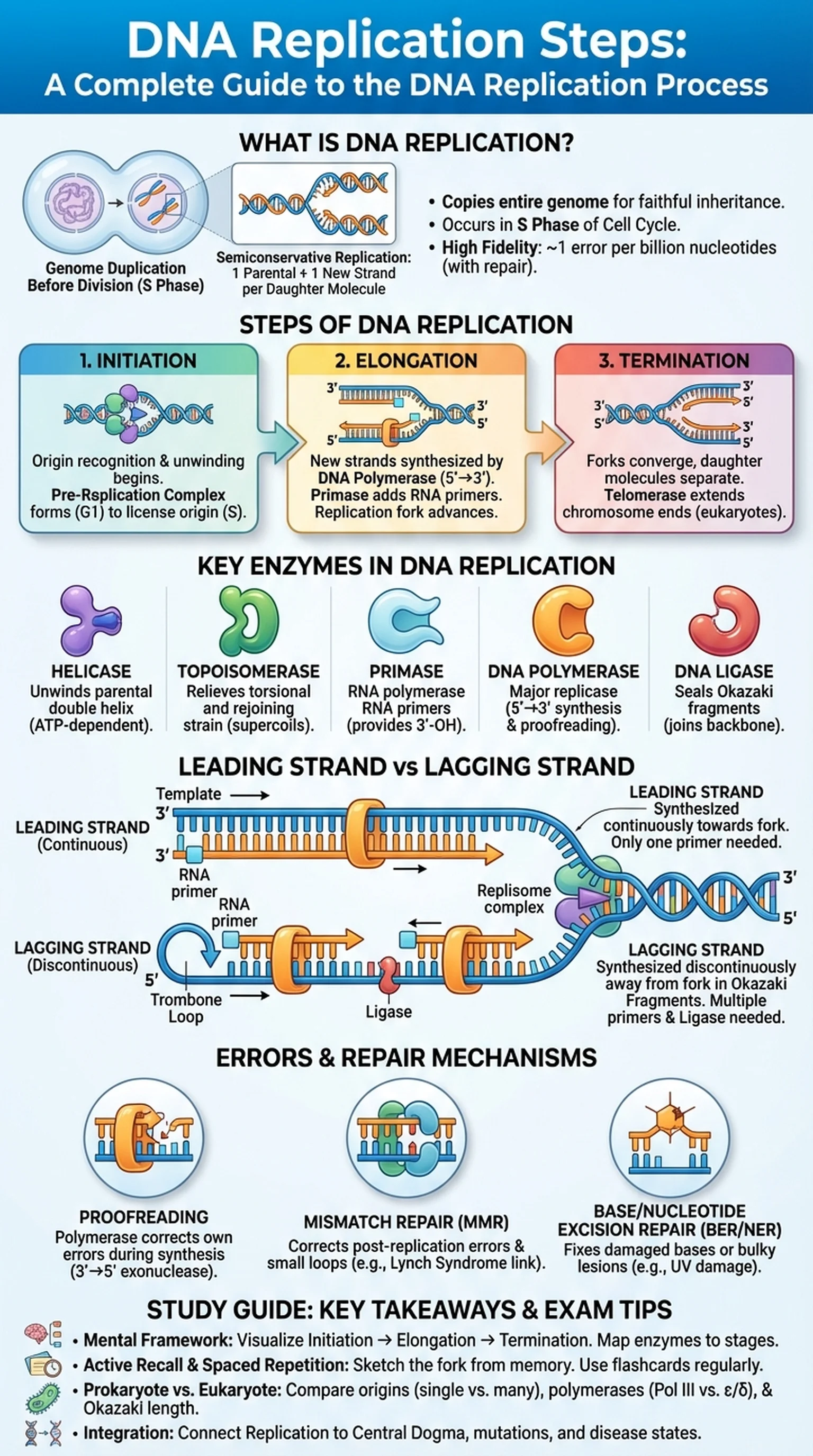
Visual overview of the complete DNA replication process from origin firing to daughter strand completion

Download
Infographic showing the DNA replication steps including initiation, elongation, and termination with key enzymes labeled

Interactive Study Short

Swipe through 5 slides about DNA Replication Steps: A Complete Guide to the DNA Replication Process

1 / 5

What Is DNA Replication?

DNA replication is the biological process by which a cell duplicates its entire genome before division, ensuring that each daughter cell receives a faithful copy of the genetic information. Because every cell in a multicellular organism carries the same DNA sequence, understanding the DNA replication process is foundational to molecular biology, genetics, and medicine.

At its core, DNA replication follows the principle of semiconservative replication, a model first demonstrated by the Meselson-Stahl experiment in 1958. In semiconservative replication, each of the two parental strands serves as a template for the synthesis of a new complementary strand. The result is two identical double-stranded DNA molecules, each consisting of one original (parental) strand and one newly synthesized strand. This elegant mechanism preserves genetic fidelity across generations of cell division.

DNA replication occurs during the S phase of the cell cycle, prior to mitosis or meiosis. In prokaryotes such as Escherichia coli, replication begins at a single origin of replication and proceeds bidirectionally around the circular chromosome. Eukaryotic genomes, being much larger and organized into linear chromosomes, contain thousands of replication origins that fire in a coordinated temporal program. Despite these organizational differences, the fundamental DNA replication steps are conserved across all domains of life.

The accuracy of DNA replication is remarkable. The error rate in human cells is approximately one mistake per billion nucleotides copied, thanks to the combined action of polymerase proofreading and post-replicative mismatch repair systems. When these safeguards fail, mutations accumulate and can lead to diseases including cancer. Understanding every stage of the DNA replication process therefore has direct clinical relevance, from pharmacology—many antibiotics and chemotherapeutics target replication enzymes—to genetic counseling and forensic science.

Key Terms

DNA Replication

The biological process by which a cell copies its entire DNA genome to produce two identical DNA molecules before cell division.

Semiconservative Replication

The mode of DNA replication in which each daughter molecule contains one parental strand and one newly synthesized strand.

Origin of Replication

A specific DNA sequence where replication is initiated, recognized by initiator proteins that separate the two strands.

S Phase

The phase of the cell cycle during which DNA synthesis (replication) occurs, situated between the G1 and G2 phases.

Steps of DNA Replication

The DNA replication steps can be organized into three major stages: initiation, elongation, and termination. Each stage involves a carefully orchestrated set of molecular events.

During initiation, initiator proteins recognize and bind to the origin of replication. In E. coli, the DnaA protein binds to specific 9-mer sequences within oriC, causing localized unwinding of adjacent AT-rich 13-mer repeats. In eukaryotes, the Origin Recognition Complex (ORC) marks replication origins, and licensing factors such as MCM2-7 helicases are loaded onto the DNA in the G1 phase—a process called pre-replication complex assembly. Activation of these licensed origins in S phase requires the kinase activities of CDK and DDK, which trigger the recruitment of additional factors and the onset of unwinding.

Elongation is the phase in which new DNA strands are actually synthesized. Once the double helix is unwound by helicase, single-strand binding proteins (SSB in prokaryotes, RPA in eukaryotes) stabilize the exposed single strands and prevent re-annealing or degradation. Primase synthesizes short RNA primers complementary to the template, providing the free 3′-OH group that DNA polymerase requires to begin adding deoxyribonucleotides. DNA polymerase III (prokaryotes) or DNA polymerase ε and δ (eukaryotes) then extend these primers in the 5′-to-3′ direction, reading the template strand from 3′ to 5′.

Termination varies between organisms. In circular bacterial chromosomes, the two replication forks converge at the terminus region, where Tus proteins bound to Ter sequences arrest fork progression. Topoisomerase IV then decatenates the interlinked daughter chromosomes. In eukaryotes, termination is less well defined—forks from adjacent replicons simply merge. A unique challenge arises at the ends of linear chromosomes, where the lagging strand cannot be fully replicated; this end-replication problem is solved by the enzyme telomerase, which extends the telomeric repeats.

Understanding these DNA replication steps in sequence is essential for medical students preparing for board exams and for researchers investigating how replication errors contribute to genomic instability.

Key Terms

Initiation

The first stage of DNA replication, during which proteins recognize the origin of replication and begin to unwind the double helix.

Elongation

The stage of DNA replication in which DNA polymerase synthesizes new strands by adding nucleotides complementary to the template.

Termination

The final stage of DNA replication, in which replication forks converge and the two daughter molecules are separated.

Pre-Replication Complex

A protein assembly loaded onto replication origins during G1 phase that licenses the origin for a single round of DNA replication in S phase.

Telomerase

A ribonucleoprotein enzyme that extends telomeric DNA repeats at chromosome ends, counteracting the end-replication problem.

Key Enzymes in DNA Replication

The DNA replication process depends on a coordinated team of enzymes and accessory proteins, each with a distinct biochemical function. Mastery of these enzymes is a high-yield topic for exams such as the MCAT, USMLE, and AP Biology.

Helicase is the motor protein that unwinds the parental double helix ahead of the replication fork. In E. coli, the DnaB helicase encircles the lagging-strand template and translocates in the 5′-to-3′ direction, using ATP hydrolysis to break the hydrogen bonds between complementary base pairs. Eukaryotic cells use the CMG complex (Cdc45-MCM-GINS), in which the MCM2-7 ring acts as the replicative helicase, moving 3′-to-5′ on the leading-strand template.

Topoisomerase relieves the torsional strain (positive supercoils) that accumulates ahead of the advancing helicase. Topoisomerase I makes transient single-strand breaks to relax supercoils, while Topoisomerase II (DNA gyrase in bacteria) introduces negative supercoils and can pass one duplex through another. Bacterial DNA gyrase is the target of fluoroquinolone antibiotics such as ciprofloxacin, which stabilize the enzyme-DNA complex and block the DNA replication process.

Primase is a specialized RNA polymerase that synthesizes short RNA primers (approximately 10 nucleotides in eukaryotes, 11–12 in prokaryotes) on the template strand. These primers are essential because no known DNA polymerase can initiate synthesis de novo; they all require a pre-existing 3′-OH.

DNA Polymerase is the central enzyme of replication. Prokaryotic DNA Pol III holoenzyme is the primary replicase, possessing 5′-to-3′ polymerase activity and 3′-to-5′ exonuclease proofreading activity. DNA Pol I removes RNA primers through its 5′-to-3′ exonuclease activity and fills the resulting gaps with DNA. In eukaryotes, Pol α/primase initiates synthesis, Pol ε replicates the leading strand, and Pol δ replicates the lagging strand.

DNA Ligase seals the phosphodiester backbone by joining Okazaki fragments on the lagging strand and closing any remaining nicks. The sliding clamp (beta clamp in prokaryotes, PCNA in eukaryotes) tethers the polymerase to the DNA, dramatically increasing processivity. Together, these enzymes ensure that each round of semiconservative replication is both rapid and accurate.

Key Terms

Helicase

An enzyme that uses ATP hydrolysis to unwind the double-stranded DNA at the replication fork, separating the two parental strands.

DNA Polymerase III

The primary replicative polymerase in prokaryotes, responsible for synthesizing new DNA in the 5′-to-3′ direction with proofreading capability.

DNA Ligase

An enzyme that catalyzes the formation of a phosphodiester bond to seal nicks in the DNA backbone, joining Okazaki fragments during replication.

Primase

An RNA polymerase that synthesizes short RNA primers on the DNA template, providing the 3′-OH required for DNA polymerase to begin synthesis.

Topoisomerase

An enzyme that relieves torsional strain in the DNA helix by cutting, rotating, and re-ligating the strand(s) ahead of the replication fork.

Leading Strand vs Lagging Strand in DNA Replication

One of the most conceptually challenging DNA replication steps involves understanding why the two new strands are synthesized differently. Because DNA polymerase can only add nucleotides in the 5′-to-3′ direction, the antiparallel nature of the double helix creates an asymmetry at each replication fork.

The leading strand is the strand whose template runs in the 3′-to-5′ direction relative to fork movement. DNA polymerase can synthesize this strand continuously in the same direction as the advancing helicase, requiring only a single RNA primer at the origin. As a result, leading-strand synthesis is faster and introduces fewer errors.

The lagging strand, by contrast, has a template that runs 5′-to-3′ relative to fork movement. Because polymerase cannot synthesize in the 3′-to-5′ direction, the lagging strand must be built in short, discontinuous segments called Okazaki fragments. Each fragment (1,000–2,000 nucleotides in prokaryotes; 100–200 nucleotides in eukaryotes) begins with an RNA primer laid down by primase and is then extended by DNA polymerase. Once a fragment reaches the 5′ end of the preceding fragment, DNA Pol I (prokaryotes) or RNase H plus FEN1 (eukaryotes) removes the RNA primer, fills the gap with DNA, and DNA ligase seals the nick to create a continuous strand.

The coordination between leading and lagging strand synthesis is achieved through the replisome, a multiprotein machine in which two polymerase cores are physically coupled. On the lagging strand, the template loops back on itself in a structure called a trombone loop, allowing both polymerases to move in the same overall direction despite synthesizing antiparallel strands. Clamp loader complexes repeatedly load new sliding clamps onto each Okazaki fragment primer to keep pace with the advancing fork.

This asymmetry has biological consequences. The lagging strand is inherently more vulnerable to mutagenesis because it spends more time in a single-stranded state, and the discontinuous synthesis involves more priming events, each of which is an opportunity for error. Certain mutational signatures in cancer genomes reflect this leading-versus-lagging strand bias, linking the mechanics of the DNA replication process directly to oncogenesis.

Key Terms

Leading Strand

The newly synthesized DNA strand that is extended continuously in the 5′-to-3′ direction toward the replication fork.

Lagging Strand

The newly synthesized DNA strand that is extended discontinuously in short Okazaki fragments, away from the replication fork.

Okazaki Fragments

Short segments of DNA (100–2,000 nucleotides) synthesized on the lagging strand, later joined by DNA ligase into a continuous strand.

Replisome

The multi-enzyme complex at the replication fork that coordinates simultaneous leading- and lagging-strand DNA synthesis.

DNA Replication Errors and Repair Mechanisms

Despite the high fidelity of the DNA replication process, errors do occur. Without correction, the intrinsic error rate of DNA polymerase would be roughly one mistake per 100,000 nucleotides. Multiple layers of quality control reduce this to approximately one error per billion base pairs in human cells.

The first line of defense is proofreading by DNA polymerase itself. When an incorrect nucleotide is incorporated, the geometry of the mismatched base pair distorts the polymerase active site, stalling further synthesis. The 3′-to-5′ exonuclease domain of the polymerase then excises the erroneous nucleotide, and synthesis resumes with the correct base. This proofreading activity improves accuracy by roughly 100-fold.

Mismatch repair (MMR) acts as a second proofreading system after the replication fork has passed. In E. coli, the MutS protein recognizes mismatches and small insertion/deletion loops, recruiting MutL and MutH to nick the newly synthesized (unmethylated) strand. An exonuclease degrades the error-containing segment, and DNA polymerase III resynthesizes the correct sequence. In humans, homologs MSH2, MSH6, MLH1, and PMS2 carry out equivalent functions. Defects in MMR genes cause Lynch syndrome (hereditary nonpolyposis colorectal cancer), directly illustrating how failures in the DNA replication steps lead to disease.

Base excision repair (BER) corrects small, non-helix-distorting lesions such as oxidized bases (e.g., 8-oxoguanine) and deaminated cytosines (uracil). A specific DNA glycosylase removes the damaged base, AP endonuclease cleaves the backbone, and Pol β fills the gap. Nucleotide excision repair (NER) handles bulky, helix-distorting adducts such as thymine dimers caused by UV radiation. NER excises a 24–32 nucleotide oligomer around the lesion, and the gap is filled by repair-associated polymerases and sealed by ligase. Defects in NER cause xeroderma pigmentosum, characterized by extreme UV sensitivity and high skin cancer risk.

For students studying DNA replication, understanding repair mechanisms is inseparable from understanding the replication process itself. Many pharmacological agents exploit these pathways—for example, PARP inhibitors used in BRCA-mutant cancers target the BER pathway, creating synthetic lethality with defective homologous recombination repair.

Key Terms

Proofreading

The 3′-to-5′ exonuclease activity of DNA polymerase that removes incorrectly incorporated nucleotides during replication.

Mismatch Repair (MMR)

A post-replicative repair system that detects and corrects base-pair mismatches and small insertion/deletion loops in newly synthesized DNA.

Base Excision Repair (BER)

A repair pathway that removes and replaces single damaged bases, such as oxidized or deaminated nucleotides, from the DNA.

Nucleotide Excision Repair (NER)

A repair pathway that removes bulky helix-distorting DNA lesions, such as UV-induced thymine dimers, by excising an oligonucleotide segment.

Lynch Syndrome

A hereditary cancer predisposition syndrome caused by germline mutations in mismatch repair genes, increasing risk of colorectal and other cancers.

DNA Replication Study Guide: Key Takeaways and Exam Tips

Mastering the DNA replication steps is essential for success on standardized exams including the MCAT, USMLE Step 1, AP Biology, and graduate-level molecular biology courses. This study guide summarizes the highest-yield concepts and offers strategies for retaining complex details.

First, build a mental framework around the three stages—initiation, elongation, and termination—and associate each enzyme with its specific stage. Create a table listing every major protein (helicase, SSB/RPA, primase, polymerases, clamp loader, sliding clamp, ligase, topoisomerase, telomerase) along with its function, directionality, and whether it acts on the leading strand, lagging strand, or both. This systematic approach prevents the common mistake of memorizing enzymes in isolation without understanding how they coordinate within the replisome.

Second, use active recall and spaced repetition to reinforce your understanding. After reading about the DNA replication process, close your notes and sketch the replication fork from memory, labeling every component. Tools like LectureScribe can transform your lecture recordings and notes into flashcard-style review materials, making spaced repetition more efficient.

Third, pay special attention to the comparison between prokaryotic and eukaryotic DNA replication. High-yield contrasts include: single versus multiple origins, DNA Pol III versus Pol ε/δ, beta clamp versus PCNA, DnaB versus CMG helicase, and Okazaki fragment length. Many exam questions present a scenario and ask you to identify which organism or system is being described.

Fourth, integrate DNA replication with related pathways. Semiconservative replication feeds into the central dogma of molecular biology—DNA is replicated, transcribed into RNA, and translated into protein. Errors in the DNA replication steps can produce mutations that alter gene expression, connecting replication to topics like oncogene activation, tumor suppressor loss, and pharmacogenomics.

Finally, practice problem-solving. Exam questions on DNA replication often present experimental scenarios—for example, asking you to predict the outcome if ligase is inhibited (accumulation of Okazaki fragments) or if telomerase is absent (progressive telomere shortening and replicative senescence). Working through these scenarios deepens conceptual understanding far more effectively than passive reading.

By following this structured study guide and leveraging AI-powered tools like LectureScribe to convert your lectures into comprehensive review materials, you can approach the DNA replication steps with confidence and precision.

Key Terms

Active Recall

A study technique in which learners actively retrieve information from memory rather than passively reviewing notes, shown to improve long-term retention.

Spaced Repetition

A learning strategy that schedules review sessions at increasing intervals, optimizing memory consolidation for complex material like DNA replication steps.

Replicative Senescence

The irreversible growth arrest of somatic cells after a finite number of divisions, driven by progressive telomere shortening in the absence of telomerase.

Frequently Asked Questions

What are the main DNA replication steps?

The main DNA replication steps are initiation (recognition and unwinding of the origin of replication), elongation (synthesis of new strands by DNA polymerase using the parental strands as templates), and termination (convergence of replication forks and separation of daughter molecules). Each step involves specific enzymes working in a coordinated sequence.

Why is DNA replication called semiconservative?

DNA replication is called semiconservative because each daughter DNA molecule retains (conserves) one of the two original parental strands and pairs it with one newly synthesized strand. This was demonstrated experimentally by Meselson and Stahl in 1958 using density-labeled DNA.

What is the role of helicase in the DNA replication process?

Helicase unwinds the double-stranded DNA at the replication fork by breaking the hydrogen bonds between complementary base pairs. It uses energy from ATP hydrolysis to translocate along the DNA, creating single-stranded templates that DNA polymerase can copy.

Why does the lagging strand require Okazaki fragments?

The lagging strand requires Okazaki fragments because DNA polymerase can only synthesize DNA in the 5-prime to 3-prime direction. Since the lagging strand template runs in the opposite orientation relative to fork movement, synthesis must occur in short, discontinuous segments that are later joined by DNA ligase.

How does proofreading reduce errors during DNA replication?

DNA polymerase has a built-in 3-prime to 5-prime exonuclease activity that acts as a proofreader. When an incorrect nucleotide is added, the polymerase detects the mismatch, reverses direction, removes the wrong base, and then resumes synthesis with the correct nucleotide. This reduces the error rate by approximately 100-fold.

What happens when DNA replication errors are not repaired?

Unrepaired DNA replication errors become permanent mutations in subsequent cell divisions. These mutations can alter protein function, disrupt gene regulation, or activate oncogenes. Deficiencies in repair pathways such as mismatch repair are associated with hereditary cancer syndromes like Lynch syndrome.

How do antibiotics and chemotherapy drugs target DNA replication?

Several drugs exploit the DNA replication process. Fluoroquinolone antibiotics inhibit bacterial DNA gyrase, blocking replication in bacteria without affecting human cells. Chemotherapy agents like cisplatin create DNA crosslinks that stall replication forks, while nucleoside analogs such as gemcitabine are incorporated into DNA and terminate chain elongation.

Study Biology Smarter

Upload your lecture notes and get AI-generated flashcards, quizzes, infographics, and study guides tailored to your curriculum.

Try LectureScribe Free

Create Study Materials

Transform your Biology lectures into flashcards, quizzes, and visual study guides with AI.

  • AI-generated flashcards & quizzes
  • Visual infographics from notes
  • Interactive study shorts
Start Studying Free

Quick Facts

SubjectBiology
Word Count2,500+
Slides5
InfographicIncluded
AuthorLectureScribe

Master Biology with LectureScribe

Upload your lecture notes and get AI-powered flashcards, quizzes, infographics, and study guides in minutes.