LectureScribe Logo
lecturescribe.io

LOCK IN VALENTINE PRICING BEFORE SALE ENDS!

Use code — New joiners get 40% OFF on annual plans

Plans will have higher prices after this sale ends

0days
:
0hours
:
0minutes
:
0seconds
Biology2,500+ words5 slides
🔬

Endoplasmic Reticulum: Rough vs Smooth ER Function

Learn about endoplasmic reticulum function, including the differences between rough ER and smooth ER. Understand how these organelles contribute to protein synthesis, lipid metabolism, and cellular homeostasis.

L
LectureScribeAI-Powered Study Platform

Study Infographic

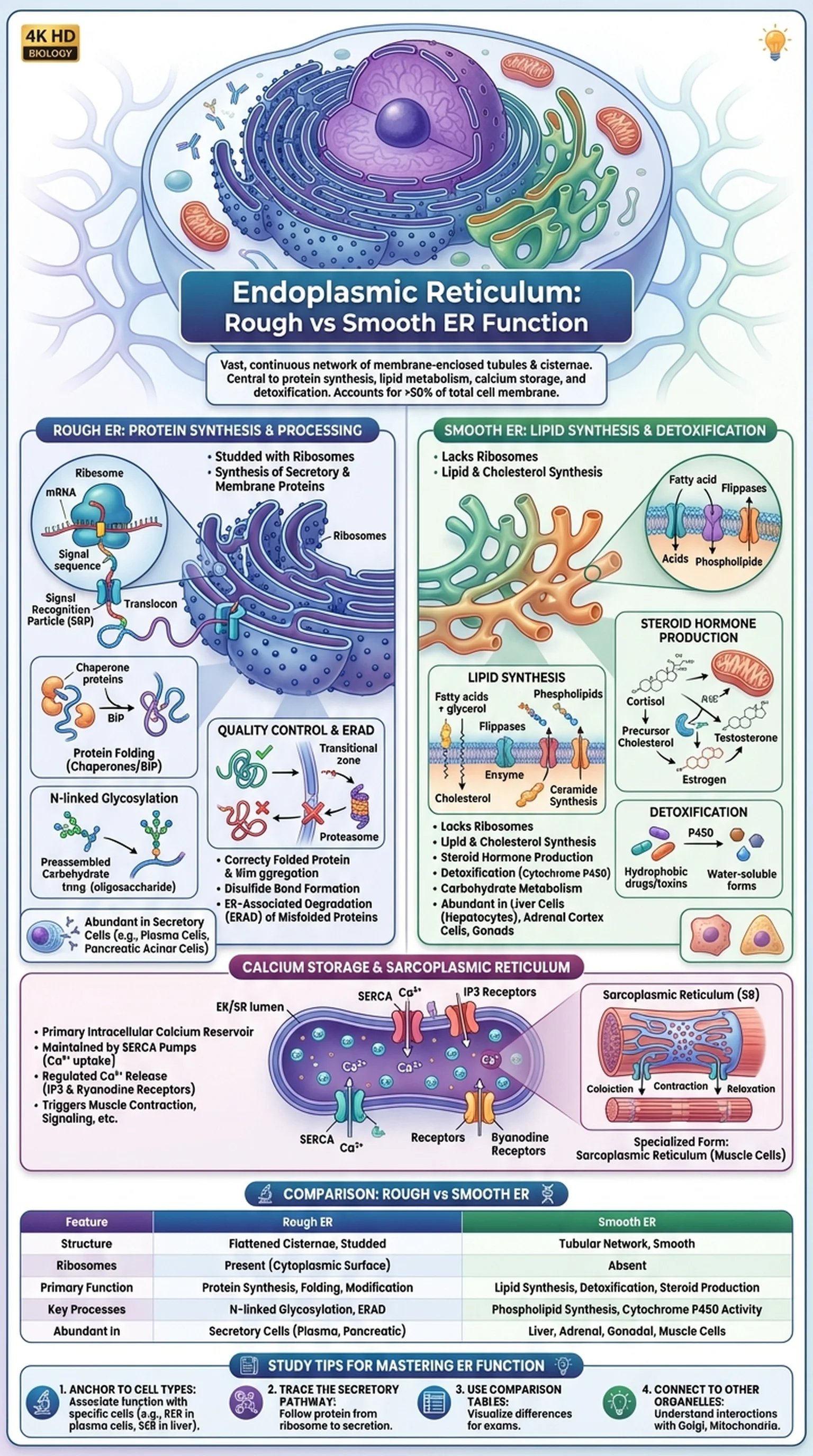
Complete endoplasmic reticulum diagram comparing rough ER protein synthesis and processing with smooth ER lipid synthesis and detoxification functions.

Download
Endoplasmic reticulum diagram showing rough ER with ribosomes and smooth ER tubules with their respective functions

Interactive Study Short

Swipe through 5 slides about Endoplasmic Reticulum: Rough vs Smooth ER Function

1 / 5

What Is the Endoplasmic Reticulum?

The endoplasmic reticulum is a vast, interconnected network of membrane-enclosed tubules and flattened sacs called cisternae that extends throughout the cytoplasm of eukaryotic cells. As one of the largest organelles by surface area, the endoplasmic reticulum plays central roles in protein synthesis, lipid metabolism, calcium storage, and detoxification. Understanding ER function is fundamental to cell biology and appears frequently on exams such as the MCAT, AP Biology, and USMLE.

The endoplasmic reticulum is physically continuous with the outer membrane of the nuclear envelope, creating a direct structural connection between the nucleus and the cytoplasmic membrane system. This continuity allows newly transcribed mRNA to be translated by ribosomes on the ER surface almost immediately after export from the nucleus. The organelle function of the endoplasmic reticulum is so central to cellular operations that it typically accounts for more than half of the total membrane in a eukaryotic cell.

The endoplasmic reticulum exists in two morphologically and functionally distinct forms: rough ER and smooth ER. Rough ER is studded with ribosomes on its cytoplasmic surface, giving it a granular appearance under the electron microscope. Smooth ER lacks ribosomes and has a more tubular morphology. Despite these differences, rough ER and smooth ER are continuous with each other and cooperate in numerous cellular processes. The relative proportion of each type varies depending on the cell's specialized function, reflecting the adaptability of this essential organelle.

Key Terms

Endoplasmic Reticulum

A large network of membrane-enclosed tubules and cisternae in eukaryotic cells that functions in protein synthesis, lipid metabolism, calcium storage, and detoxification.

Cisternae

Flattened, membrane-bound sacs that form the structural units of the endoplasmic reticulum and Golgi apparatus.

Organelle Function

The specific biological role performed by a membrane-bound compartment within a cell, such as the protein-processing function of the endoplasmic reticulum.

Nuclear Envelope

The double membrane surrounding the nucleus that is continuous with the rough endoplasmic reticulum.

Rough ER: Protein Synthesis and Processing

Rough ER derives its name from the ribosomes that are bound to its cytoplasmic surface, creating the studded appearance visible under electron microscopy. The primary organelle function of the rough ER is the synthesis, folding, and initial modification of proteins destined for secretion, membrane insertion, or delivery to other organelles. Cells that produce large quantities of secreted proteins, such as pancreatic acinar cells and plasma cells, have especially extensive rough ER networks.

Protein synthesis on the rough ER begins when a ribosome translating an mRNA molecule encounters a signal sequence at the N-terminus of the growing polypeptide chain. This signal sequence is recognized by the signal recognition particle (SRP), which docks the ribosome-mRNA complex onto an SRP receptor on the rough ER membrane. The polypeptide is then threaded through a protein channel called the translocon into the ER lumen, where the signal sequence is cleaved by signal peptidase.

Once inside the ER lumen, newly synthesized proteins undergo critical processing steps. Chaperone proteins such as BiP (binding immunoglobulin protein) assist in proper folding by preventing aggregation and facilitating the formation of correct three-dimensional structures. N-linked glycosylation, the attachment of a preassembled carbohydrate tree to asparagine residues, is one of the most important co-translational modifications and serves as a quality control tag. The rough ER also catalyzes the formation of disulfide bonds through the enzyme protein disulfide isomerase, which is essential for stabilizing the tertiary structure of many secreted proteins.

Proteins that fail to fold correctly are retained in the rough ER and eventually targeted for degradation through a process called ER-associated degradation (ERAD). Misfolded proteins are retrotranslocated back to the cytoplasm, ubiquitinated, and destroyed by the proteasome. This quality control mechanism ensures that only properly folded, functional proteins proceed through the secretory pathway from the endoplasmic reticulum to the Golgi apparatus and beyond.

Key Terms

Rough ER

The ribosome-studded region of the endoplasmic reticulum specialized for the synthesis, folding, and modification of secretory and membrane proteins.

Signal Recognition Particle (SRP)

A ribonucleoprotein complex that recognizes the signal sequence on a nascent polypeptide and directs the ribosome to the rough ER membrane.

N-linked Glycosylation

The co-translational attachment of a branched oligosaccharide to asparagine residues of proteins in the rough ER lumen, serving roles in folding and quality control.

ER-Associated Degradation (ERAD)

A quality control pathway in which misfolded proteins are retrotranslocated from the ER lumen to the cytoplasm for ubiquitin-mediated proteasomal degradation.

Chaperone Proteins

Proteins such as BiP that assist in the proper folding of newly synthesized polypeptides in the rough ER by preventing misfolding and aggregation.

Smooth ER: Lipid Synthesis and Detoxification

Smooth ER is the region of the endoplasmic reticulum that lacks ribosomes on its cytoplasmic surface. It has a more tubular, branching morphology compared to the flattened cisternae of rough ER. The organelle function of smooth ER is diverse and varies significantly between cell types, but its primary roles include lipid synthesis, steroid hormone production, carbohydrate metabolism, and detoxification of drugs and toxins.

Lipid synthesis is perhaps the most universal function of smooth ER across all cell types. The smooth ER is the principal site for the synthesis of phospholipids, which are the main structural components of all cellular membranes. Enzymes embedded in the smooth ER membrane catalyze the assembly of phospholipids from fatty acid and glycerol precursors. Flippases then transfer newly synthesized phospholipids from the cytoplasmic leaflet to the luminal leaflet of the ER membrane, maintaining proper membrane asymmetry. The smooth ER also synthesizes cholesterol and ceramide, precursors to a wide variety of membrane lipids and signaling molecules.

In endocrine cells such as those of the adrenal cortex and gonads, smooth ER is exceptionally abundant because it houses the enzymes required for steroid hormone synthesis. Cortisol, aldosterone, testosterone, and estrogen are all synthesized from cholesterol precursors through enzymatic reactions that occur partly in the smooth ER and partly in mitochondria. This ER function is critical for maintaining hormonal balance in the body.

The detoxification function of smooth ER is especially prominent in liver hepatocytes. The cytochrome P450 family of enzymes, located in the smooth ER membrane, oxidizes hydrophobic drugs, metabolic waste products, and environmental toxins, converting them into more water-soluble forms that can be excreted by the kidneys. Chronic exposure to drugs or alcohol causes the smooth ER in hepatocytes to proliferate dramatically, increasing the cell's detoxification capacity. This expansion of smooth ER explains the phenomenon of drug tolerance, where increasing doses are needed to achieve the same pharmacological effect.

Key Terms

Smooth ER

The ribosome-free region of the endoplasmic reticulum specialized for lipid synthesis, steroid hormone production, detoxification, and calcium storage.

Cytochrome P450

A large family of oxidase enzymes in the smooth ER membrane that catalyze the detoxification of drugs, toxins, and metabolic waste products.

Phospholipid Synthesis

The enzymatic assembly of phospholipids in the smooth ER membrane, providing the structural lipids needed for all cellular membranes.

Steroid Hormone Synthesis

The production of steroid hormones from cholesterol precursors, catalyzed by enzymes in the smooth ER and mitochondria of endocrine cells.

Calcium Storage and the Sarcoplasmic Reticulum

One of the most physiologically important functions of the endoplasmic reticulum is calcium ion storage and signaling. The ER lumen serves as the cell's primary intracellular calcium reservoir, maintaining calcium concentrations roughly 1,000 to 10,000 times higher than the surrounding cytoplasm. This enormous concentration gradient is established and maintained by SERCA pumps (sarco/endoplasmic reticulum calcium ATPase), which actively transport calcium ions from the cytoplasm into the ER lumen against their concentration gradient.

Calcium release from the endoplasmic reticulum is a tightly regulated signaling event that controls a wide range of cellular processes. Inositol trisphosphate (IP3) receptors and ryanodine receptors are calcium channels embedded in the ER membrane that open in response to specific signals, allowing calcium to flood into the cytoplasm. This rapid calcium release triggers muscle contraction, neurotransmitter release, fertilization, gene transcription, and apoptosis, depending on the cell type. The ER function of calcium signaling thus places the endoplasmic reticulum at the center of cellular communication networks.

In muscle cells, the endoplasmic reticulum takes on a specialized form called the sarcoplasmic reticulum (SR). The sarcoplasmic reticulum wraps around each myofibril and is exquisitely adapted for rapid calcium release and reuptake. When an action potential reaches a muscle cell, it triggers the release of calcium from the sarcoplasmic reticulum through ryanodine receptors, initiating the cross-bridge cycling that produces muscle contraction. After contraction, SERCA pumps rapidly sequester calcium back into the sarcoplasmic reticulum, allowing the muscle to relax. Disorders of sarcoplasmic reticulum calcium handling underlie conditions such as malignant hyperthermia and certain forms of heart failure.

The calcium storage organelle function of the endoplasmic reticulum also connects to the unfolded protein response (UPR). Many ER-resident chaperones require calcium for their activity, so depletion of ER calcium stores impairs protein folding and activates the UPR stress pathway. This link between calcium homeostasis and protein quality control underscores how intimately the various functions of the endoplasmic reticulum are interconnected.

Key Terms

SERCA Pump

Sarco/endoplasmic reticulum calcium ATPase; an active transporter that pumps calcium ions from the cytoplasm into the ER lumen to maintain the calcium gradient.

Sarcoplasmic Reticulum

A specialized form of the endoplasmic reticulum in muscle cells that stores and releases calcium ions to regulate muscle contraction and relaxation.

IP3 Receptor

A calcium channel on the ER membrane that opens in response to inositol trisphosphate signaling, releasing stored calcium into the cytoplasm.

Unfolded Protein Response (UPR)

A cellular stress response activated when misfolded proteins accumulate in the ER lumen, aiming to restore normal ER function or trigger apoptosis if stress is unresolved.

Rough ER vs Smooth ER: Structural and Functional Comparison

Comparing rough ER and smooth ER side by side clarifies how these two continuous regions of the endoplasmic reticulum divide the labor of cellular maintenance. While they share a common membrane system and many fundamental properties, their structural differences reflect their distinct organelle functions.

Structurally, rough ER consists of large, flattened cisternae arranged in parallel stacks, with the cytoplasmic surface densely studded with ribosomes. These ribosomes are not permanently attached; they bind to the rough ER only when they are translating mRNAs that encode proteins bearing a signal sequence. Smooth ER, by contrast, is composed of a branching network of tubules that are more irregular in shape and entirely devoid of ribosomes. In many cells, there is a transitional zone where rough ER gradually transitions into smooth ER, and transport vesicles bud from this region to carry cargo to the Golgi apparatus.

Functionally, rough ER is the primary site of synthesis for secreted proteins, membrane proteins, and lysosomal enzymes. It performs N-linked glycosylation, disulfide bond formation, and protein quality control. Smooth ER handles lipid and steroid synthesis, detoxification of xenobiotics, glycogen metabolism, and calcium storage. In hepatocytes, smooth ER is also responsible for the glucose-6-phosphatase reaction that releases free glucose into the blood during fasting, a function critical for blood sugar regulation.

The relative abundance of rough ER versus smooth ER in a given cell directly reflects that cell's primary function. Secretory cells like antibody-producing plasma cells are packed with rough ER. Steroid-producing cells in the adrenal glands and testes are rich in smooth ER. Hepatocytes, which perform both extensive protein secretion and detoxification, contain abundant quantities of both. This variation in ER composition across cell types is one of the most elegant examples of how organelle function is matched to cellular specialization.

Understanding the distinction between rough ER and smooth ER is not merely academic. Diseases such as alpha-1 antitrypsin deficiency, in which a misfolded protein accumulates in the rough ER of hepatocytes, and Niemann-Pick disease, which involves lipid processing defects related to smooth ER function, demonstrate the clinical relevance of endoplasmic reticulum biology.

Key Terms

Transitional ER

The region of the endoplasmic reticulum between rough ER and smooth ER from which transport vesicles bud to carry cargo to the Golgi apparatus.

Transport Vesicles

Small membrane-bound carriers that bud from the ER and fuse with the Golgi apparatus, shuttling proteins and lipids through the secretory pathway.

Glucose-6-Phosphatase

An enzyme in the smooth ER of hepatocytes that removes phosphate from glucose-6-phosphate, releasing free glucose into the bloodstream.

Secretory Pathway

The route by which proteins synthesized in the rough ER are transported through the Golgi apparatus and delivered to the cell surface or extracellular space.

Study Tips for Mastering ER Function

The endoplasmic reticulum is a high-yield topic on biology and medical exams, including the MCAT, AP Biology, USMLE Step 1, and undergraduate cell biology courses. Questions typically focus on distinguishing rough ER from smooth ER, understanding the secretory pathway, and connecting ER function to clinical diseases. Here are effective strategies for mastering this material.

First, anchor your understanding to cell types. Rather than memorizing ER function in the abstract, associate each ER function with the cell type that best exemplifies it. Rough ER dominates in plasma cells (antibody secretion) and pancreatic acinar cells (digestive enzyme secretion). Smooth ER dominates in adrenal cortex cells (steroid synthesis) and hepatocytes (detoxification). Sarcoplasmic reticulum dominates in skeletal and cardiac muscle cells (calcium-driven contraction). These associations make abstract concepts concrete and are frequently tested on exams.

Second, trace the life of a protein through the secretory pathway. Follow a protein from ribosome binding on the rough ER, through signal sequence cleavage, folding with chaperones, N-linked glycosylation, quality control, vesicle budding from the transitional ER, transport to the Golgi, further modification, and finally secretion or membrane insertion. This narrative approach helps you understand the sequential logic of the endoplasmic reticulum rather than seeing it as a collection of disconnected facts.

Third, compare rough ER and smooth ER in a structured table. Include rows for appearance, ribosomes, primary function, key enzymes, cell types where abundant, and associated diseases. Visual comparison tables are particularly effective for multiple-choice questions that ask you to classify organelle function or predict the consequences of ER dysfunction.

Fourth, connect the ER to other organelles. The endoplasmic reticulum communicates with the Golgi apparatus through transport vesicles, with mitochondria through calcium signaling and lipid transfer, and with the nucleus through the continuous nuclear envelope. Understanding these connections reveals the ER as a central hub rather than an isolated structure.

Finally, use active recall and spaced repetition to reinforce your knowledge. Platforms like LectureScribe can generate flashcards, slide decks, and practice questions directly from your lecture notes on the endoplasmic reticulum and other organelles, helping you test yourself regularly and retain the material for exams.

Key Terms

Active Recall

A study technique in which learners actively retrieve information from memory rather than passively reviewing notes, proven to enhance long-term retention.

Spaced Repetition

A learning strategy that involves reviewing material at increasing intervals to strengthen long-term memory retention.

MCAT

The Medical College Admission Test; a standardized exam required for admission to medical schools in the United States and Canada.

Frequently Asked Questions

What is the function of the endoplasmic reticulum?

The endoplasmic reticulum performs multiple essential functions including protein synthesis and processing (rough ER), lipid and steroid synthesis (smooth ER), detoxification of drugs and toxins (smooth ER), calcium storage and signaling, and carbohydrate metabolism. Its specific ER function varies by cell type.

What is the difference between rough ER and smooth ER?

Rough ER has ribosomes attached to its cytoplasmic surface and specializes in protein synthesis, folding, and modification. Smooth ER lacks ribosomes and specializes in lipid synthesis, steroid hormone production, detoxification, and calcium storage. Both are continuous regions of the endoplasmic reticulum.

Why does rough ER have ribosomes?

Rough ER has ribosomes because they are needed to synthesize proteins that enter the secretory pathway. Ribosomes bind to the rough ER when they translate mRNAs encoding proteins with signal sequences, threading the growing polypeptide into the ER lumen for folding, modification, and transport.

What organelle function does smooth ER serve in liver cells?

In liver cells (hepatocytes), smooth ER performs detoxification of drugs and toxins via cytochrome P450 enzymes, synthesis of phospholipids and cholesterol, glycogen metabolism, and the release of free glucose into the blood via glucose-6-phosphatase. The smooth ER proliferates in response to chronic drug exposure.

How does the endoplasmic reticulum relate to the Golgi apparatus?

The endoplasmic reticulum sends proteins and lipids to the Golgi apparatus via transport vesicles that bud from the transitional ER. The Golgi further processes, sorts, and packages these molecules for delivery to their final destinations, including the cell surface, lysosomes, and the extracellular space.

What is the sarcoplasmic reticulum?

The sarcoplasmic reticulum is a specialized form of the endoplasmic reticulum found in muscle cells. It stores calcium ions and releases them in response to nerve signals to trigger muscle contraction. SERCA pumps then recapture calcium to allow muscle relaxation.

What happens when the endoplasmic reticulum is stressed?

When misfolded proteins accumulate in the ER lumen, the cell activates the unfolded protein response (UPR). The UPR reduces protein synthesis, increases production of chaperones, and enhances ER-associated degradation. If stress is not resolved, the UPR triggers apoptosis. ER stress is implicated in neurodegenerative diseases and diabetes.

Study Biology Smarter

Upload your lecture notes and get AI-generated flashcards, quizzes, infographics, and study guides tailored to your curriculum.

Try LectureScribe Free

Create Study Materials

Transform your Biology lectures into flashcards, quizzes, and visual study guides with AI.

  • AI-generated flashcards & quizzes
  • Visual infographics from notes
  • Interactive study shorts
Start Studying Free

Quick Facts

SubjectBiology
Word Count2,500+
Slides5
InfographicIncluded
AuthorLectureScribe

Master Biology with LectureScribe

Upload your lecture notes and get AI-powered flashcards, quizzes, infographics, and study guides in minutes.