LectureScribe Logo
lecturescribe.io

LOCK IN VALENTINE PRICING BEFORE SALE ENDS!

Use code — New joiners get 40% OFF on annual plans

Plans will have higher prices after this sale ends

0days
:
0hours
:
0minutes
:
0seconds
Biochemistry2,500+ words5 slides
🧪

Enzyme Inhibition: Competitive, Noncompetitive, and Uncompetitive

Learn the types of enzyme inhibition including competitive, noncompetitive, and uncompetitive inhibition. Understand how enzyme inhibitors work and their effects on kinetics.

L
LectureScribeAI-Powered Study Platform

Study Infographic

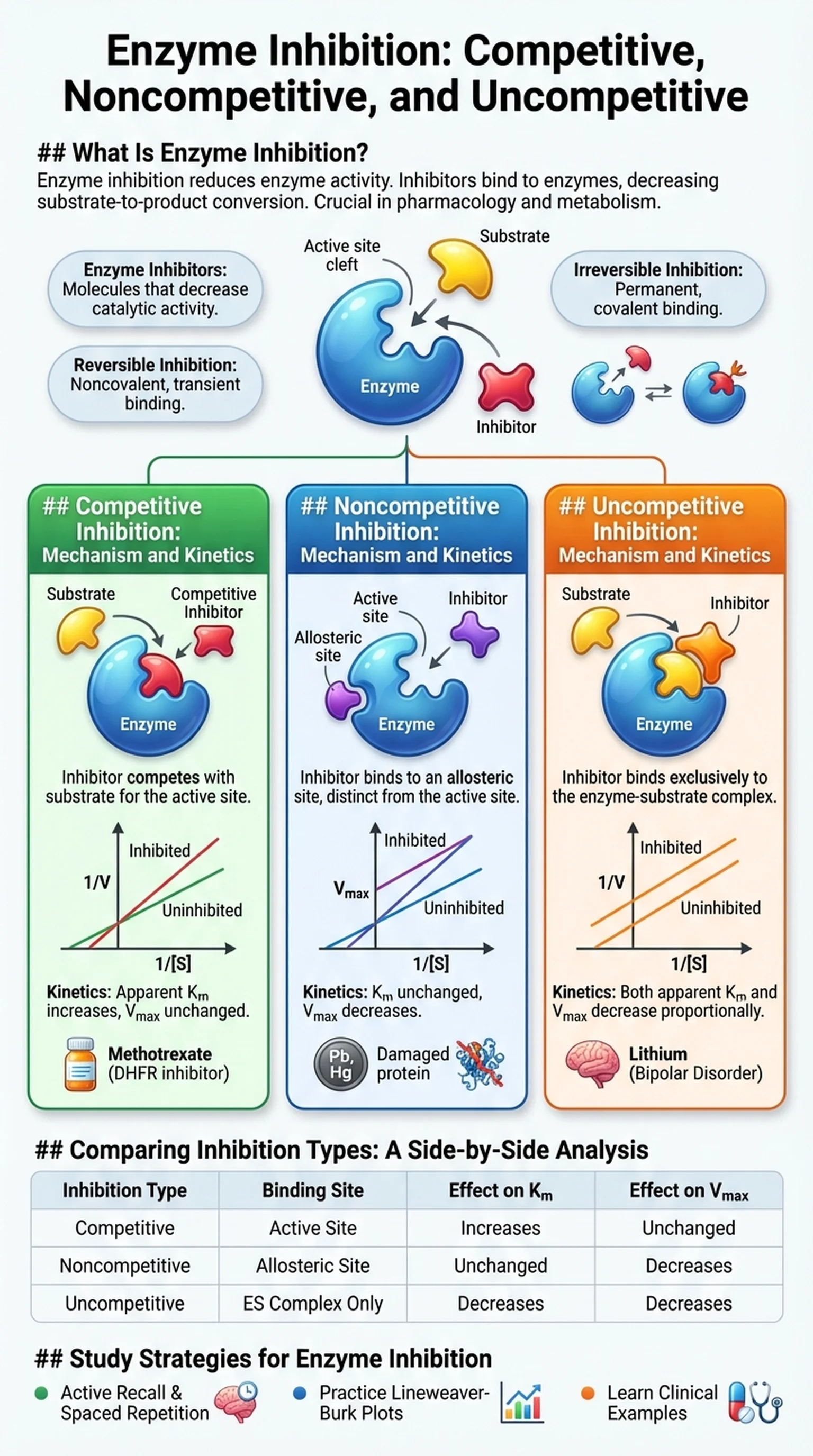
Side-by-side comparison of the three major types of enzyme inhibition showing binding sites, kinetic effects, and Lineweaver-Burk plot signatures.

Download
Enzyme inhibition comparison diagram showing competitive, noncompetitive, and uncompetitive inhibition with Lineweaver-Burk plot patterns

Interactive Study Short

Swipe through 5 slides about Enzyme Inhibition: Competitive, Noncompetitive, and Uncompetitive

1 / 5

What Is Enzyme Inhibition?

Enzyme inhibition is the process by which specific molecules reduce or eliminate the catalytic activity of enzymes. Enzyme inhibitors are substances that bind to enzymes and decrease their ability to convert substrates into products. This phenomenon is fundamental to biochemistry and has far-reaching implications in pharmacology, metabolism, and disease. Nearly half of all FDA-approved drugs work by acting as enzyme inhibitors, targeting specific enzymes involved in disease pathways to restore normal physiological function.

Enzyme inhibition can be broadly divided into two categories: reversible and irreversible. Reversible inhibitors bind to enzymes through noncovalent interactions such as hydrogen bonds, hydrophobic contacts, and ionic attractions. Because these interactions are weak and transient, the enzyme can regain full activity once the inhibitor dissociates. Irreversible inhibitors, by contrast, form covalent bonds with amino acid residues in or near the active site, permanently inactivating the enzyme. Aspirin, for example, irreversibly acetylates cyclooxygenase (COX), blocking prostaglandin synthesis and reducing inflammation.

Within the category of reversible inhibition, there are three classical types: competitive inhibition, noncompetitive inhibition, and uncompetitive inhibition. Each type is defined by where the inhibitor binds relative to the substrate and how it affects the kinetic parameters Km and Vmax. Understanding these distinctions is essential for interpreting enzyme kinetic data, designing effective drugs, and answering exam questions on standardized tests like the MCAT and USMLE. The sections that follow provide a detailed analysis of each inhibition type, complete with molecular mechanisms, kinetic consequences, and real-world examples.

Key Terms

Enzyme Inhibition

The reduction or elimination of enzyme catalytic activity by molecules (inhibitors) that bind to the enzyme and interfere with its function.

Enzyme Inhibitors

Molecules that bind to enzymes and decrease their catalytic activity, classified as reversible or irreversible depending on their binding mechanism.

Reversible Inhibition

Inhibition in which the inhibitor binds noncovalently to the enzyme and can dissociate, allowing the enzyme to regain activity.

Irreversible Inhibition

Inhibition in which the inhibitor forms a permanent covalent bond with the enzyme, leading to permanent loss of catalytic function.

Competitive Inhibition: Mechanism and Kinetics

Competitive inhibition occurs when an inhibitor molecule competes directly with the substrate for binding to the enzyme's active site. The competitive inhibitor typically resembles the substrate in shape or charge, allowing it to fit into the active site and block substrate access. Importantly, competitive inhibition is mutually exclusive with substrate binding: the enzyme can bind either the substrate or the inhibitor, but not both simultaneously.

The kinetic hallmark of competitive inhibition is an increase in the apparent Km with no change in Vmax. Because the inhibitor and substrate compete for the same binding site, adding more substrate can outcompete the inhibitor and eventually saturate the enzyme. At sufficiently high substrate concentrations, the reaction reaches the same Vmax as in the absence of the inhibitor. However, the substrate concentration needed to reach half of Vmax increases, which is reflected in the higher apparent Km. On a Lineweaver-Burk plot, competitive inhibition produces lines that intersect at the same y-intercept (1/Vmax unchanged) but have different slopes and x-intercepts.

Classic examples of competitive inhibition abound in pharmacology. Methotrexate is a competitive inhibitor of dihydrofolate reductase (DHFR) that mimics the substrate dihydrofolate. By blocking DHFR, methotrexate inhibits nucleotide synthesis and is used to treat cancer and autoimmune diseases. Statins such as atorvastatin competitively inhibit HMG-CoA reductase, the rate-limiting enzyme in cholesterol biosynthesis, by resembling the substrate HMG-CoA. Malonate is a classic competitive inhibitor of succinate dehydrogenase in the Krebs cycle, structurally similar to the natural substrate succinate. These examples illustrate how competitive inhibition is harnessed therapeutically to modulate enzyme activity in human disease.

Key Terms

Competitive Inhibition

A form of reversible enzyme inhibition in which the inhibitor competes with the substrate for the active site, increasing apparent Km without affecting Vmax.

Active Site Competition

The molecular basis of competitive inhibition, where inhibitor and substrate vie for the same binding pocket on the enzyme.

Apparent Km

The observed Michaelis constant in the presence of a competitive inhibitor; higher than the true Km because more substrate is needed to overcome inhibition.

Methotrexate

A competitive inhibitor of dihydrofolate reductase used as a chemotherapeutic agent and immunosuppressant.

Noncompetitive Inhibition: Mechanism and Kinetics

Noncompetitive inhibition is a form of reversible enzyme inhibition in which the inhibitor binds to a site on the enzyme that is distinct from the active site, known as an allosteric site. Unlike competitive inhibition, the noncompetitive inhibitor can bind to both the free enzyme and the enzyme-substrate complex with equal affinity. This means that substrate binding and inhibitor binding are not mutually exclusive; both can occupy the enzyme simultaneously. However, the resulting enzyme-substrate-inhibitor complex is catalytically inactive.

The kinetic signature of noncompetitive inhibition is a decrease in Vmax with no change in Km. Because the inhibitor does not interfere with substrate binding, the enzyme's affinity for its substrate remains the same. However, a fraction of enzyme molecules are rendered nonfunctional by the inhibitor, reducing the total catalytic capacity. Increasing substrate concentration cannot overcome noncompetitive inhibition because the inhibitor does not compete with substrate for the active site. On a Lineweaver-Burk plot, noncompetitive inhibition produces lines that intersect on the x-axis (same Km) but have different y-intercepts (decreased Vmax) and steeper slopes.

A well-known example of noncompetitive inhibition is the effect of heavy metal ions such as lead and mercury on various enzymes. These metals bind to sulfhydryl groups on enzyme surfaces, causing conformational changes that reduce catalytic activity without blocking the active site. Another example is the drug doxycycline, which acts as a noncompetitive inhibitor of matrix metalloproteinases. In metabolic regulation, certain feedback inhibitors function through noncompetitive mechanisms, binding to regulatory subunits of allosteric enzymes to modulate pathway flux in response to cellular needs. Understanding noncompetitive inhibition is critical for appreciating how enzyme inhibitors can affect enzyme function through mechanisms entirely independent of the substrate binding site.

Key Terms

Noncompetitive Inhibition

Reversible enzyme inhibition where the inhibitor binds an allosteric site on either the free enzyme or the enzyme-substrate complex, decreasing Vmax without affecting Km.

Allosteric Site

A binding site on an enzyme distinct from the active site where regulatory molecules or noncompetitive inhibitors can bind and alter enzyme activity.

Enzyme-Substrate-Inhibitor Complex

A ternary complex formed when a noncompetitive inhibitor binds to an enzyme that already has substrate bound; this complex is catalytically inactive.

Heavy Metal Inhibition

Noncompetitive enzyme inhibition caused by heavy metals like lead and mercury that bind to cysteine sulfhydryl groups and distort enzyme conformation.

Uncompetitive Inhibition: Mechanism and Kinetics

Uncompetitive inhibition is the third major type of reversible enzyme inhibition and is perhaps the most counterintuitive for students encountering it for the first time. In uncompetitive inhibition, the inhibitor binds exclusively to the enzyme-substrate complex, not to the free enzyme. This means the inhibitor can only attach after the substrate has already bound, locking the complex in an inactive state and preventing catalysis.

The kinetic consequences of uncompetitive inhibition are distinctive: both Km and Vmax decrease by the same factor. The decrease in Vmax occurs because the enzyme-substrate-inhibitor complex cannot release product. The decrease in apparent Km is a subtler effect: by trapping the enzyme-substrate complex, the inhibitor effectively removes free enzyme from the equilibrium, pulling the binding reaction forward and making it appear as though the enzyme has higher affinity for the substrate. On a Lineweaver-Burk plot, uncompetitive inhibition produces a characteristic pattern of parallel lines, where the inhibited line is shifted upward with the same slope as the uninhibited line but different x- and y-intercepts.

Uncompetitive inhibition is relatively rare for single-substrate enzymes but is more commonly observed in multi-substrate reactions and in reactions catalyzed by enzymes that follow ordered sequential mechanisms. Lithium, used in the treatment of bipolar disorder, acts as an uncompetitive inhibitor of inositol monophosphatase, reducing the recycling of inositol and dampening phosphoinositide signaling. Some herbicides and antibiotics also employ uncompetitive inhibition mechanisms. Although uncompetitive inhibition is less commonly tested than competitive or noncompetitive inhibition on standardized exams, understanding it completes the picture of how enzyme inhibitors modulate enzyme activity and is necessary for a comprehensive mastery of enzyme kinetics.

Key Terms

Uncompetitive Inhibition

Reversible enzyme inhibition where the inhibitor binds only to the enzyme-substrate complex, decreasing both apparent Km and Vmax proportionally.

Parallel Lines (Lineweaver-Burk)

The diagnostic pattern on a Lineweaver-Burk plot for uncompetitive inhibition, where inhibited and uninhibited lines have the same slope but different intercepts.

Enzyme-Substrate Complex Trapping

The mechanism of uncompetitive inhibition in which the inhibitor locks the ES complex in a nonproductive state, preventing product release.

Lithium

A mood stabilizer used for bipolar disorder that acts as an uncompetitive inhibitor of inositol monophosphatase.

Comparing Inhibition Types: A Side-by-Side Analysis

Having examined competitive inhibition, noncompetitive inhibition, and uncompetitive inhibition individually, it is essential to compare them side by side. This comparison reveals the logical framework underlying enzyme inhibition and enables students to quickly identify inhibition types from experimental data.

The most important distinguishing features relate to how each type of enzyme inhibition affects the kinetic parameters Km and Vmax. In competitive inhibition, Km increases while Vmax remains unchanged. In noncompetitive inhibition, Km stays the same while Vmax decreases. In uncompetitive inhibition, both Km and Vmax decrease proportionally. These differences arise directly from the binding behavior of each class of enzyme inhibitors. Competitive inhibitors block substrate access to the active site and can be overcome by excess substrate. Noncompetitive inhibitors reduce the number of functional enzyme molecules regardless of substrate concentration. Uncompetitive inhibitors trap the enzyme-substrate complex and remove it from the catalytic cycle.

On a Lineweaver-Burk plot, the three types produce unmistakable patterns. Competitive inhibition yields lines converging at the y-axis. Noncompetitive inhibition yields lines converging on the x-axis. Uncompetitive inhibition yields parallel lines. Students should practice drawing these three patterns from memory and linking each graphical signature to the corresponding molecular mechanism.

Mixed inhibition, a related but distinct phenomenon, occurs when an inhibitor can bind to both the free enzyme and the enzyme-substrate complex but with different affinities. Mixed inhibition changes both Km and Vmax, but unlike uncompetitive inhibition, the lines on a Lineweaver-Burk plot are neither parallel nor convergent on either axis. Recognizing mixed inhibition as a hybrid of competitive and noncompetitive behaviors deepens the understanding of reversible enzyme inhibition as a spectrum rather than a set of discrete categories.

Key Terms

Mixed Inhibition

A type of reversible inhibition where the inhibitor binds both the free enzyme and enzyme-substrate complex with different affinities, altering both Km and Vmax.

Lineweaver-Burk Patterns

The characteristic line arrangements on a double reciprocal plot that distinguish competitive (converge at y-axis), noncompetitive (converge at x-axis), and uncompetitive (parallel) inhibition.

Kinetic Parameters

Quantitative values (Km, Vmax, kcat) derived from enzyme kinetic experiments that describe enzyme behavior and are altered in predictable ways by different inhibitor types.

Study Strategies for Enzyme Inhibition

Enzyme inhibition is one of the highest-yield topics in biochemistry for standardized exams including the MCAT, USMLE Step 1, and DAT. The key to mastering it lies in building a structured mental model that connects molecular mechanisms to kinetic outcomes and graphical representations.

First, create a comparison table with four columns: inhibition type, binding site, effect on Km, and effect on Vmax. Fill in the entries for competitive inhibition (active site, Km increases, Vmax unchanged), noncompetitive inhibition (allosteric site, Km unchanged, Vmax decreases), and uncompetitive inhibition (enzyme-substrate complex, Km decreases, Vmax decreases). This table should become so familiar that you can reproduce it instantly during an exam. Second, practice with Lineweaver-Burk plots. Sketch the uninhibited line first, then draw each inhibition type. Label the x-intercept, y-intercept, and slope for each case. Understanding why each parameter changes is more valuable than rote memorization.

Third, learn clinical examples for each type. Competitive inhibition examples include statins and methotrexate. Noncompetitive inhibition examples include heavy metal poisoning and certain allosteric regulators. Uncompetitive inhibition examples include lithium. Associating each inhibition type with a memorable pharmacological example anchors abstract concepts in real-world applications. Fourth, practice with enzyme inhibitors in multi-step problems. Exam questions often combine inhibition analysis with Michaelis-Menten calculations, asking you to predict how an inhibitor affects reaction velocity at a specific substrate concentration.

Finally, use technology to reinforce your learning. AI-powered platforms like LectureScribe can generate practice problems, flashcards, and summary slides from your lecture notes on enzyme inhibition, allowing you to quiz yourself using active recall and spaced repetition for durable long-term retention of these critical concepts.

Key Terms

Active Recall

A study strategy in which learners actively retrieve information from memory, strengthening neural pathways and improving long-term retention.

Spaced Repetition

A learning technique that schedules review sessions at increasing intervals to combat forgetting and build durable memory.

MCAT

The Medical College Admission Test; enzyme inhibition is one of the most frequently tested biochemistry topics on this exam.

Frequently Asked Questions

What is enzyme inhibition?

Enzyme inhibition is the process by which molecules called enzyme inhibitors reduce or block the catalytic activity of enzymes. It can be reversible (competitive, noncompetitive, uncompetitive) or irreversible, and plays a critical role in drug design, metabolic regulation, and toxicology.

What is the difference between competitive and noncompetitive inhibition?

In competitive inhibition, the inhibitor binds to the enzyme's active site and competes with substrate, increasing Km but not changing Vmax. In noncompetitive inhibition, the inhibitor binds to an allosteric site and reduces Vmax without affecting Km. Competitive inhibition can be overcome by excess substrate; noncompetitive inhibition cannot.

How does uncompetitive inhibition differ from the other types?

Uncompetitive inhibition is unique because the inhibitor binds only to the enzyme-substrate complex, not the free enzyme. It decreases both Km and Vmax proportionally and produces parallel lines on a Lineweaver-Burk plot, unlike competitive or noncompetitive inhibition.

What are examples of enzyme inhibitors used as drugs?

Common drug examples include statins (competitive inhibitors of HMG-CoA reductase), methotrexate (competitive inhibitor of dihydrofolate reductase), aspirin (irreversible inhibitor of cyclooxygenase), and lithium (uncompetitive inhibitor of inositol monophosphatase).

How do you identify inhibition type from a Lineweaver-Burk plot?

On a Lineweaver-Burk plot: competitive inhibition shows lines converging at the y-axis (same Vmax, different Km); noncompetitive inhibition shows lines converging on the x-axis (same Km, different Vmax); uncompetitive inhibition shows parallel lines (both Km and Vmax change proportionally).

Can competitive inhibition be overcome?

Yes, competitive inhibition can be overcome by increasing substrate concentration. Since the inhibitor competes with substrate for the active site, sufficiently high substrate levels will outcompete the inhibitor and allow the enzyme to reach its normal Vmax.

What is mixed inhibition?

Mixed inhibition occurs when an inhibitor can bind to both the free enzyme and the enzyme-substrate complex but with different affinities. It alters both Km and Vmax and produces lines on a Lineweaver-Burk plot that intersect in the second or third quadrant, distinct from pure noncompetitive inhibition.

Study Biochemistry Smarter

Upload your lecture notes and get AI-generated flashcards, quizzes, infographics, and study guides tailored to your curriculum.

Try LectureScribe Free

Create Study Materials

Transform your Biochemistry lectures into flashcards, quizzes, and visual study guides with AI.

  • AI-generated flashcards & quizzes
  • Visual infographics from notes
  • Interactive study shorts
Start Studying Free

Quick Facts

SubjectBiochemistry
Word Count2,500+
Slides5
InfographicIncluded
AuthorLectureScribe

Master Biochemistry with LectureScribe

Upload your lecture notes and get AI-powered flashcards, quizzes, infographics, and study guides in minutes.