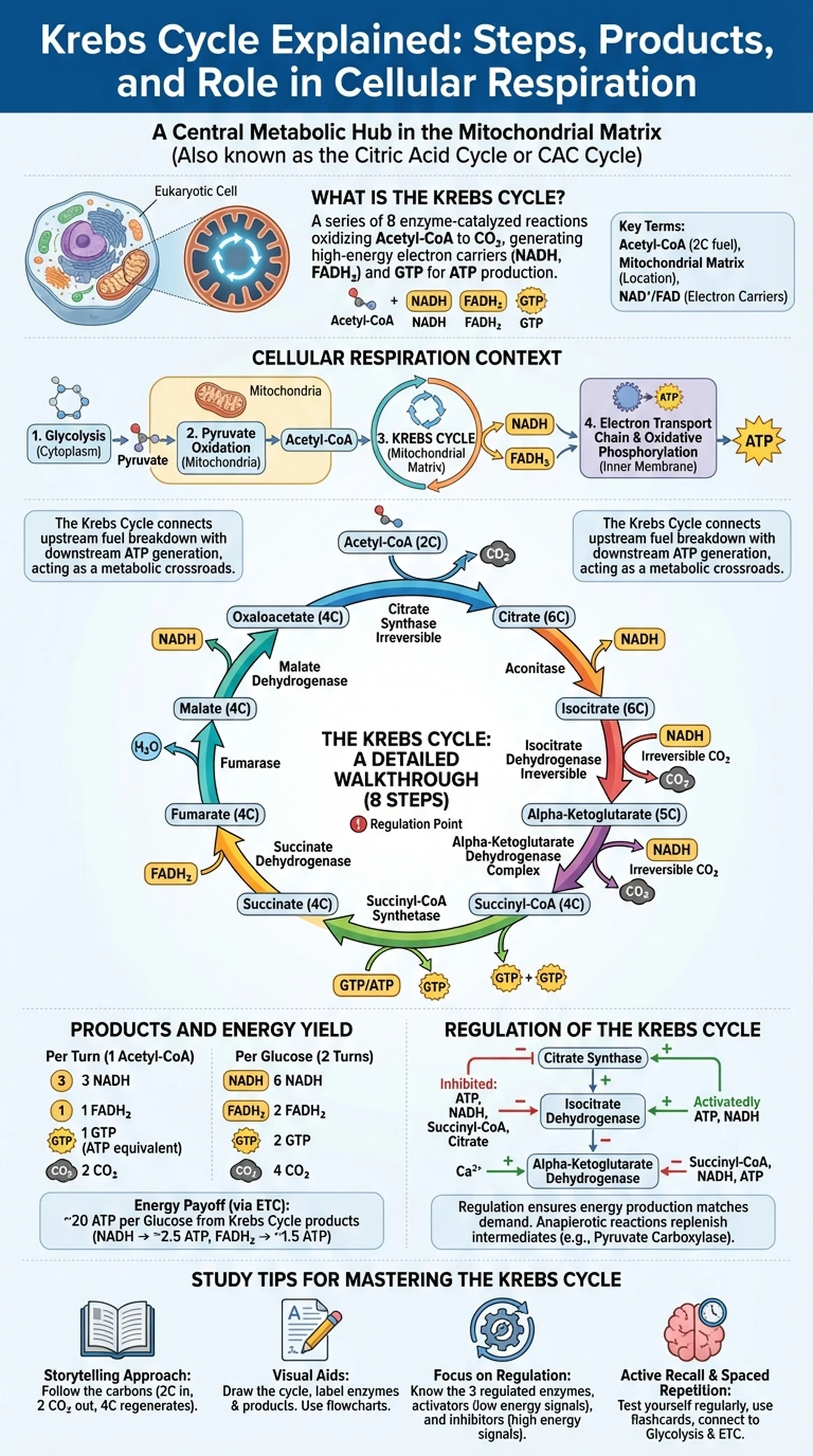
What Is the Krebs Cycle?
The Krebs cycle is a series of enzyme-catalyzed chemical reactions that form a central part of aerobic metabolism in nearly all living organisms. Named after Sir Hans Krebs, who first described the pathway in 1937, the Krebs cycle takes place in the mitochondrial matrix of eukaryotic cells. It is also widely known as the citric acid cycle because its first intermediate product is citrate, a form of citric acid. In many textbooks, you will also see it abbreviated as the CAC cycle or referred to as the citrate cycle, reflecting the pivotal role that citrate plays in the opening reaction.
The primary purpose of the Krebs cycle is to oxidize acetyl-CoA, a two-carbon molecule derived from the breakdown of carbohydrates, fats, and proteins. Through a series of eight sequential reactions, the cycle strips high-energy electrons from carbon-based substrates and transfers them to the electron carriers NAD+ and FAD. These reduced coenzymes, NADH and FADH2, then shuttle the electrons to the electron transport chain, where the majority of ATP is ultimately generated.
Understanding the Krebs cycle is foundational for students studying biochemistry, cell biology, and medical sciences. It represents a metabolic hub where catabolic and anabolic pathways converge. Intermediates of the citric acid cycle serve as precursors for amino acid synthesis, gluconeogenesis, and fatty acid production. This dual nature makes the Krebs cycle indispensable not only for energy extraction but also for biosynthetic processes throughout the cell.
Key Terms
A cyclic series of eight enzymatic reactions in the mitochondrial matrix that oxidizes acetyl-CoA to CO2, generating NADH, FADH2, and GTP.
An alternative name for the Krebs cycle, derived from the first product of the pathway, citrate (citric acid).
A two-carbon acetyl group attached to coenzyme A; the primary fuel that enters the Krebs cycle.
The innermost compartment of the mitochondrion where the Krebs cycle reactions occur.
Oxidized electron carriers that accept high-energy electrons during the Krebs cycle to form NADH and FADH2.