LectureScribe Logo
lecturescribe.io

LOCK IN VALENTINE PRICING BEFORE SALE ENDS!

Use code — New joiners get 40% OFF on annual plans

Plans will have higher prices after this sale ends

0days
:
0hours
:
0minutes
:
0seconds
Anatomy2,500+ words5 slides
❤️

Heart Anatomy: Chambers, Valves, and Blood Flow Pathway

Master heart anatomy including the four heart chambers, heart valves, and the complete blood flow through heart pathway. Essential guide for anatomy students preparing for the MCAT and medical exams.

L
LectureScribeAI-Powered Study Platform

Study Infographic

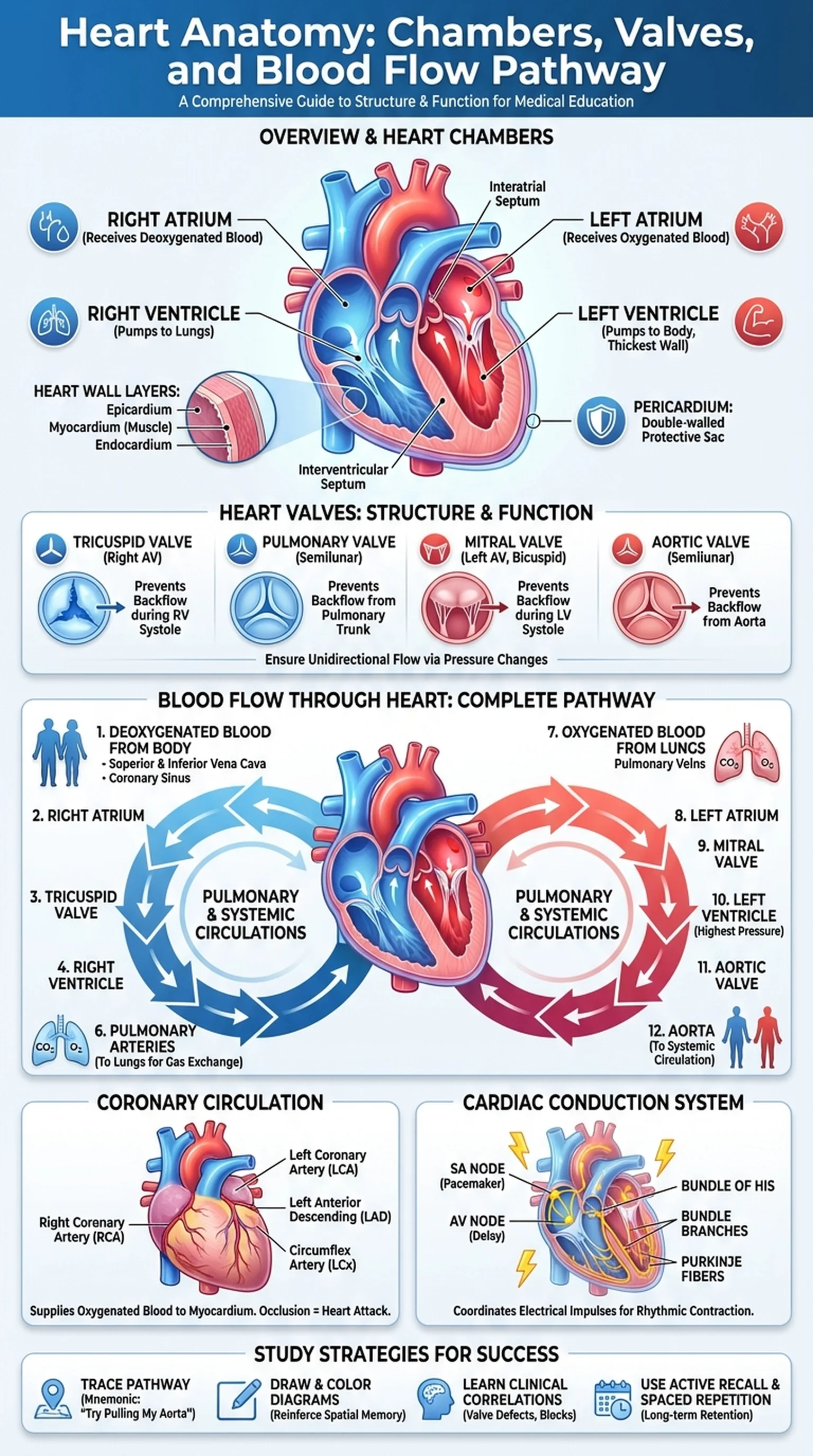
Complete heart anatomy illustration labeling all four chambers, valves, great vessels, coronary arteries, and the directional blood flow through the heart.

Download
Heart anatomy diagram showing four heart chambers, four heart valves, coronary arteries, and the complete blood flow pathway through pulmonary and systemic circulation

Interactive Study Short

Swipe through 5 slides about Heart Anatomy: Chambers, Valves, and Blood Flow Pathway

1 / 5

Overview of Heart Anatomy

Heart anatomy is one of the most fundamental topics in human biology and medical education. The heart is a muscular organ approximately the size of a closed fist, located in the mediastinum of the thoracic cavity, slightly left of the midline. It is enclosed in a double-walled sac called the pericardium and functions as the central pump of the cardiovascular system, responsible for circulating blood to every tissue in the body. Understanding cardiac anatomy is prerequisite knowledge for courses in physiology, pathology, and clinical medicine.

The heart wall consists of three layers: the epicardium (outer layer), the myocardium (thick muscular middle layer), and the endocardium (smooth inner lining). The myocardium is composed of specialized cardiac muscle cells (cardiomyocytes) that are capable of rhythmic, involuntary contraction. The thickness of the myocardium varies by chamber, reflecting the workload of each region. The left ventricle, which pumps blood to the entire systemic circulation, has the thickest myocardium, while the atria, which merely push blood into the ventricles below them, have much thinner walls.

A thorough understanding of heart anatomy requires knowledge of the four heart chambers, the four heart valves, the great vessels, the coronary circulation, and the cardiac conduction system. Together, these structures ensure that blood flow through heart follows a precise unidirectional pathway: deoxygenated blood enters the right side, is pumped to the lungs for gas exchange, returns to the left side, and is then ejected into the systemic circulation. This dual-circuit arrangement, the pulmonary and systemic circulations, is one of the hallmarks of cardiac anatomy in mammals and is central to understanding cardiovascular physiology and disease.

Key Terms

Heart Anatomy

The structural organization of the heart including its chambers, valves, wall layers, great vessels, and conduction system.

Cardiac Anatomy

The study of the heart's physical structure, encompassing both gross and microscopic features essential for understanding cardiovascular function.

Pericardium

A double-walled fibroserous sac enclosing the heart, consisting of a fibrous outer layer and a serous inner layer that reduces friction during heartbeats.

Myocardium

The thick muscular middle layer of the heart wall composed of cardiomyocytes, responsible for generating the contractile force that pumps blood.

The Four Heart Chambers

The human heart is divided into four heart chambers: two upper atria and two lower ventricles. The right and left sides of the heart are separated by the interatrial septum (between the atria) and the interventricular septum (between the ventricles), preventing the mixing of oxygenated and deoxygenated blood. Each chamber has distinct structural features that reflect its specific role in the circulatory pathway.

The right atrium receives deoxygenated blood from the body through three vessels: the superior vena cava (draining the upper body), the inferior vena cava (draining the lower body), and the coronary sinus (draining the heart muscle itself). The right atrium has a smooth posterior wall (the sinus venarum) and a roughened anterior wall with muscular ridges called pectinate muscles. A remnant of the fetal foramen ovale, called the fossa ovalis, is visible on the interatrial septum. The right atrium contracts to push blood through the tricuspid valve into the right ventricle.

The right ventricle receives blood from the right atrium and pumps it through the pulmonary valve into the pulmonary trunk, which bifurcates into the left and right pulmonary arteries leading to the lungs. The interior of the right ventricle features irregular muscular columns called trabeculae carneae and papillary muscles that anchor the tricuspid valve cusps via chordae tendineae. The left atrium receives oxygenated blood from the lungs via four pulmonary veins and sends it through the mitral (bicuspid) valve into the left ventricle. The left ventricle, the most muscular of the four heart chambers, pumps oxygenated blood through the aortic valve into the ascending aorta for distribution to the entire body. Its wall is approximately three times thicker than that of the right ventricle, reflecting the higher pressure required for systemic circulation.

Key Terms

Heart Chambers

The four compartments of the heart: right atrium, right ventricle, left atrium, and left ventricle, each with a specific role in receiving or pumping blood.

Right Atrium

The upper right chamber that receives deoxygenated blood from the body via the superior vena cava, inferior vena cava, and coronary sinus.

Left Ventricle

The lower left chamber with the thickest myocardium that pumps oxygenated blood into the aorta for systemic circulation.

Interventricular Septum

The muscular and membranous wall separating the right and left ventricles, preventing mixing of oxygenated and deoxygenated blood.

Heart Valves: Structure and Function

Heart valves are essential structures that ensure unidirectional blood flow through the heart by opening and closing in response to pressure changes during the cardiac cycle. The human heart has four heart valves, classified into two functional categories: the two atrioventricular (AV) valves and the two semilunar valves. Dysfunction of any valve, whether through stenosis (narrowing) or regurgitation (leaking), can significantly impair cardiac output and produce characteristic heart murmurs detectable with a stethoscope.

The atrioventricular valves are located between the atria and ventricles. The tricuspid valve, positioned between the right atrium and right ventricle, has three leaflets (cusps). The mitral valve (also called the bicuspid valve), positioned between the left atrium and left ventricle, has two leaflets. Both AV valves are anchored to papillary muscles on the ventricular walls by fibrous cords called chordae tendineae. When the ventricles contract during systole, the rising pressure forces the AV valve leaflets closed. The papillary muscles simultaneously contract and pull on the chordae tendineae to prevent the valve leaflets from prolapsing (everting) into the atria.

The semilunar valves guard the exits from the ventricles into the great arteries. The pulmonary valve lies between the right ventricle and the pulmonary trunk, and the aortic valve lies between the left ventricle and the aorta. Each semilunar valve has three crescent-shaped cusps that open during ventricular ejection and snap shut when the ventricles relax, preventing backflow. The aortic valve is of particular clinical importance because the right and left coronary arteries originate from small outpouchings (sinuses of Valsalva) just above two of its cusps. Understanding the anatomy and function of all four heart valves is critical for interpreting cardiac auscultation findings, echocardiography reports, and for managing valvular heart disease in clinical practice.

Key Terms

Heart Valves

Four fibrous structures (tricuspid, mitral, pulmonary, aortic) that enforce unidirectional blood flow through the heart by opening and closing with pressure changes.

Tricuspid Valve

The three-leaflet atrioventricular valve between the right atrium and right ventricle that prevents backflow during right ventricular systole.

Mitral Valve

The two-leaflet (bicuspid) atrioventricular valve between the left atrium and left ventricle, the most commonly affected valve in rheumatic heart disease.

Chordae Tendineae

Fibrous cords connecting the AV valve leaflets to papillary muscles, preventing valve prolapse during ventricular contraction.

Semilunar Valves

The pulmonary and aortic valves, each with three crescent-shaped cusps, that prevent backflow from the great arteries into the ventricles during diastole.

Blood Flow Through Heart: The Complete Pathway

Understanding blood flow through heart is essential for any student of cardiac anatomy and physiology. The pathway traces a figure-eight circuit through the pulmonary and systemic circulations, with the heart serving as the dual pump at the center. Here is the complete sequence of blood flow through all four heart chambers and four heart valves.

Deoxygenated blood from the body returns to the right atrium via the superior vena cava, inferior vena cava, and coronary sinus. When the right atrium contracts, blood passes through the tricuspid valve into the right ventricle. The right ventricle then contracts, closing the tricuspid valve and opening the pulmonary valve, sending blood into the pulmonary trunk. The pulmonary trunk divides into the right and left pulmonary arteries, which carry deoxygenated blood to the respective lungs. In the pulmonary capillary beds, carbon dioxide diffuses from the blood into the alveoli, and oxygen diffuses from the alveoli into the blood, oxygenating the hemoglobin in red blood cells.

Oxygenated blood returns from the lungs to the left atrium via four pulmonary veins (two from each lung). When the left atrium contracts, blood flows through the mitral valve into the left ventricle. The left ventricle, with its thick muscular wall, generates the highest pressures in the heart during contraction. Ventricular systole closes the mitral valve and opens the aortic valve, ejecting oxygenated blood into the ascending aorta. From the aorta, blood is distributed through the arterial tree to every organ and tissue in the body. After delivering oxygen and collecting carbon dioxide and metabolic waste in the systemic capillaries, blood returns through the venous system to the right atrium, completing the circuit. This continuous, unidirectional blood flow through heart depends entirely on the coordinated action of the four heart chambers and the proper function of all four heart valves.

Key Terms

Blood Flow Through Heart

The sequential pathway of blood through the four chambers and four valves: right atrium, tricuspid valve, right ventricle, pulmonary valve, lungs, left atrium, mitral valve, left ventricle, aortic valve, and systemic circulation.

Pulmonary Circulation

The circuit that carries deoxygenated blood from the right ventricle to the lungs and returns oxygenated blood to the left atrium.

Systemic Circulation

The circuit that carries oxygenated blood from the left ventricle to the body's tissues and returns deoxygenated blood to the right atrium.

Pulmonary Veins

Four vessels that carry oxygenated blood from the lungs to the left atrium; they are the only veins in the body that carry oxygen-rich blood.

Coronary Circulation and the Cardiac Conduction System

The heart muscle itself requires a constant supply of oxygenated blood to sustain its unceasing contractions. The coronary circulation provides this supply through two main arteries that originate from the ascending aorta just above the aortic valve. The left coronary artery (LCA) branches into the left anterior descending artery (LAD), which supplies the anterior wall and the anterior portion of the interventricular septum, and the left circumflex artery (LCx), which supplies the lateral and posterior walls of the left ventricle. The right coronary artery (RCA) supplies the right ventricle and, in most individuals, gives rise to the posterior descending artery (PDA), which supplies the posterior interventricular septum and the inferior wall of the left ventricle.

Occlusion of a coronary artery, typically by an atherosclerotic plaque or thrombus, deprives the downstream myocardium of oxygen, resulting in myocardial infarction (heart attack). The LAD is the most commonly occluded vessel and is sometimes called the "widow maker" because its blockage can be rapidly fatal. Understanding coronary anatomy within the broader context of heart anatomy is therefore directly relevant to clinical cardiology.

The cardiac conduction system is the specialized network of cells that generates and propagates the electrical impulses controlling the heartbeat. The sinoatrial (SA) node, located in the right atrium near the superior vena cava, serves as the natural pacemaker, initiating each heartbeat at a rate of 60 to 100 beats per minute. The electrical signal spreads through both atria to the atrioventricular (AV) node, located in the interatrial septum near the tricuspid valve. After a brief delay that allows atrial contraction to complete, the impulse travels down the bundle of His, through the right and left bundle branches, and into the Purkinje fibers, which rapidly distribute the signal to the ventricular myocardium. This coordinated conduction ensures that the heart chambers contract in the correct sequence to maintain efficient blood flow through heart and into the great vessels.

Key Terms

Coronary Arteries

The left and right coronary arteries that branch from the ascending aorta to supply oxygenated blood to the myocardium.

Sinoatrial (SA) Node

The heart's natural pacemaker, a cluster of specialized cells in the right atrium that spontaneously generates electrical impulses to initiate each heartbeat.

Atrioventricular (AV) Node

A cluster of conduction cells in the interatrial septum that delays the electrical impulse briefly before transmitting it to the ventricles via the bundle of His.

Purkinje Fibers

Specialized conduction fibers that rapidly distribute electrical impulses throughout the ventricular myocardium, ensuring coordinated ventricular contraction.

Study Strategies for Heart Anatomy

Heart anatomy is a cornerstone topic on anatomy examinations, the MCAT, USMLE Step 1, and clinical rotations. The volume of structural detail can be overwhelming, but a systematic approach will help you build a strong and lasting understanding of cardiac anatomy, the four heart chambers, the heart valves, and the blood flow through heart pathway.

First, trace the blood flow pathway repeatedly until you can recite it from memory. Start at the superior vena cava and follow the blood through every chamber and valve: right atrium, tricuspid valve, right ventricle, pulmonary valve, pulmonary arteries, lungs, pulmonary veins, left atrium, mitral valve, left ventricle, aortic valve, and aorta. Use the mnemonic "Try Pulling My Aorta" (Tricuspid, Pulmonary, Mitral, Aortic) to remember the valve order from right to left. This simple exercise reinforces the unidirectional nature of blood flow through heart and the function of each heart valve.

Second, use diagrams and models extensively. Drawing the heart from memory and labeling all four heart chambers, valves, great vessels, and coronary arteries is one of the most effective study techniques for cardiac anatomy. Color-code oxygenated blood (red) and deoxygenated blood (blue) to reinforce the separation between pulmonary and systemic circuits. Label the SA node, AV node, bundle of His, and Purkinje fibers to integrate the conduction system into your spatial understanding.

Third, learn clinical correlations alongside the anatomy. For each structure, know what happens when it fails: mitral valve prolapse, aortic stenosis, AV block, LAD occlusion. Exam questions frequently present clinical vignettes that require you to identify which anatomical structure is affected. Finally, use active recall and spaced repetition to lock this material into long-term memory. Platforms like LectureScribe can generate flashcards and interactive quizzes from your lecture notes on heart anatomy, ensuring you practice retrieval at the optimal intervals for durable retention.

Key Terms

Active Recall

A study technique that involves actively retrieving information from memory rather than passively reviewing, proven to enhance long-term retention.

Spaced Repetition

A learning strategy that spaces review sessions at increasing intervals, optimizing memory consolidation for complex anatomical material.

MCAT

The Medical College Admission Test, a standardized examination that tests anatomy and physiology concepts including heart anatomy and cardiovascular function.

Frequently Asked Questions

What are the four heart chambers?

The four heart chambers are the right atrium, right ventricle, left atrium, and left ventricle. The right side handles deoxygenated blood heading to the lungs, while the left side handles oxygenated blood being pumped to the body.

What are the four heart valves and their functions?

The four heart valves are the tricuspid (right AV), pulmonary (right semilunar), mitral/bicuspid (left AV), and aortic (left semilunar). They ensure unidirectional blood flow by opening and closing in response to pressure changes during the cardiac cycle.

What is the pathway of blood flow through heart?

Blood flow through heart follows this path: deoxygenated blood enters the right atrium, passes through the tricuspid valve into the right ventricle, is pumped through the pulmonary valve to the lungs, returns oxygenated to the left atrium, passes through the mitral valve into the left ventricle, and is ejected through the aortic valve into the aorta.

Why is the left ventricle thicker than the right ventricle?

The left ventricle has a thicker myocardium because it must generate enough pressure to pump blood through the entire systemic circulation, which has much higher resistance than the pulmonary circulation served by the right ventricle.

What is cardiac anatomy most important for in clinical medicine?

Cardiac anatomy is essential for understanding valvular heart disease, coronary artery disease, heart failure, arrhythmias, and congenital heart defects. Knowledge of heart anatomy underpins the interpretation of echocardiograms, ECGs, and cardiac catheterization findings.

What prevents the heart valves from flipping inside out?

The atrioventricular valves (tricuspid and mitral) are prevented from prolapsing by the chordae tendineae, fibrous cords that tether the valve leaflets to papillary muscles on the ventricular walls. When the ventricles contract, the papillary muscles tense the chordae, holding the leaflets in place.

What is the function of the coronary arteries?

The coronary arteries (left and right) branch from the ascending aorta to supply oxygenated blood to the heart muscle itself. Blockage of a coronary artery leads to myocardial infarction (heart attack) due to oxygen deprivation of the downstream cardiac tissue.

Study Anatomy Smarter

Upload your lecture notes and get AI-generated flashcards, quizzes, infographics, and study guides tailored to your curriculum.

Try LectureScribe Free

Create Study Materials

Transform your Anatomy lectures into flashcards, quizzes, and visual study guides with AI.

  • AI-generated flashcards & quizzes
  • Visual infographics from notes
  • Interactive study shorts
Start Studying Free

Quick Facts

SubjectAnatomy
Word Count2,500+
Slides5
InfographicIncluded
AuthorLectureScribe

Master Anatomy with LectureScribe

Upload your lecture notes and get AI-powered flashcards, quizzes, infographics, and study guides in minutes.