LectureScribe Logo
lecturescribe.io

LOCK IN VALENTINE PRICING BEFORE SALE ENDS!

Use code — New joiners get 40% OFF on annual plans

Plans will have higher prices after this sale ends

0days
:
0hours
:
0minutes
:
0seconds
Mathematics2,500+ words5 slides
📐

Integration by Parts Examples: Formula, LIATE Rule, and Practice Problems

Master integration by parts with worked examples, the LIATE rule, and the integration by parts formula. Step-by-step guide for integral calculus students.

L
LectureScribeAI-Powered Study Platform

Study Infographic

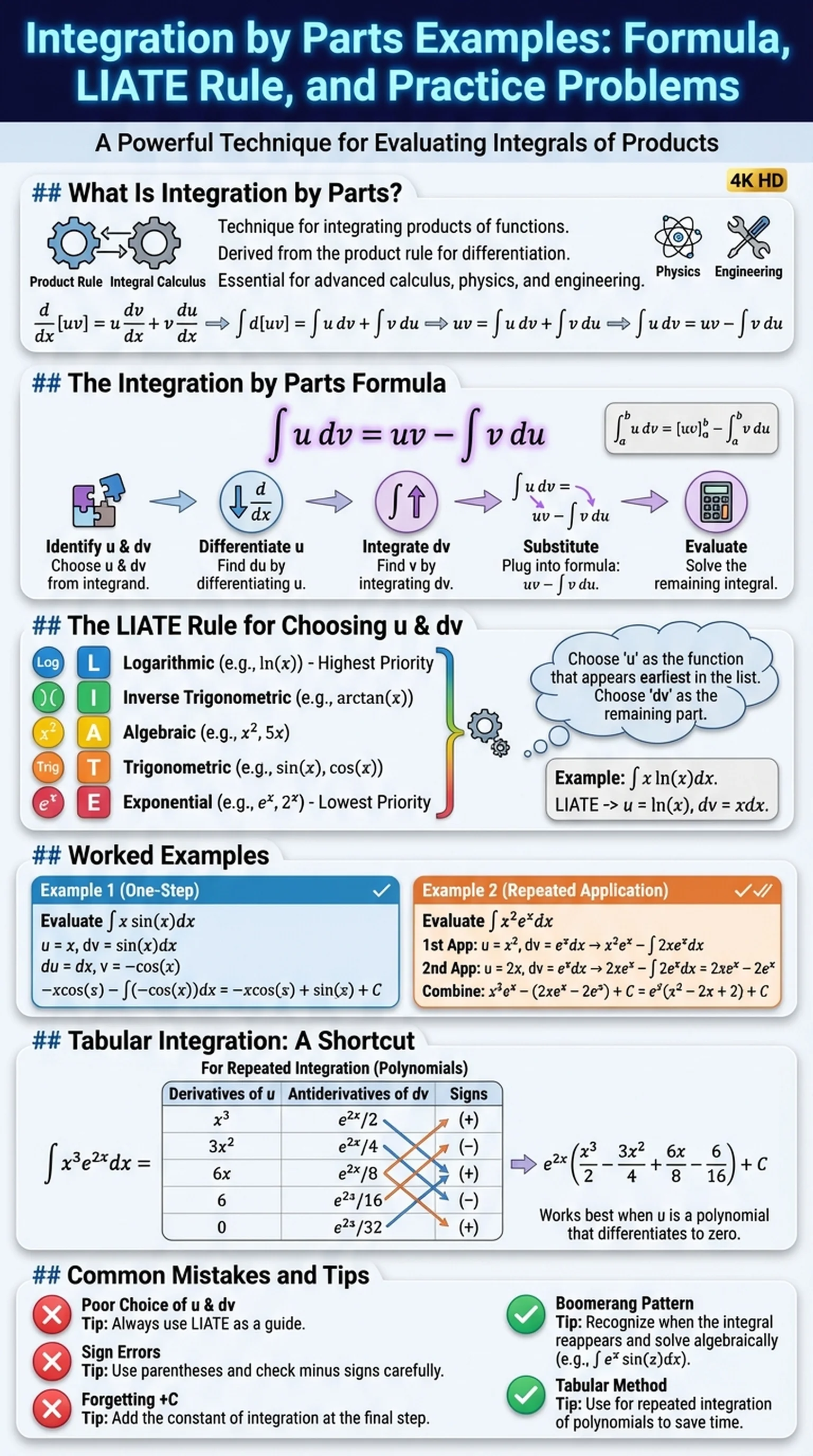
Visual guide to the integration by parts formula, LIATE rule, and tabular integration method

Download
Integration by parts formula and LIATE rule infographic with worked examples for integral calculus

Interactive Study Short

Swipe through 5 slides about Integration by Parts Examples: Formula, LIATE Rule, and Practice Problems

1 / 5

What Is Integration by Parts?

Integration by parts is one of the most important techniques in integral calculus, used to evaluate integrals of products of functions that cannot be solved by simple substitution or direct antidifferentiation. It is the integration counterpart of the product rule from differential calculus and is essential for any student studying calculus at the college level, preparing for the AP Calculus BC exam, or working through engineering mathematics courses.

The core idea behind integration by parts is to transform a difficult integral into a simpler one by strategically choosing which part of the integrand to differentiate and which part to integrate. When you encounter an ∫ of the form integral of f(x)g(x)dx that does not yield to u-substitution, integration by parts is typically the next technique to try. Common examples include integrals like ∫ of x*e^x dx, ∫ of x*sin(x) dx, and ∫ of ln(x) dx.

Historically, integration by parts derives from the product rule for differentiation. Since the derivative of a product u*v equals u*dv + v*du, integrating both sides and rearranging yields the integration by parts formula. This derivation is not just a mathematical curiosity — understanding it helps you see why the technique works and builds intuition for choosing u and dv effectively.

Integration by parts appears throughout mathematics, physics, and engineering. It is used to derive many important formulas, including reduction formulas for powers of trigonometric functions, the Laplace transform of derivatives, and solutions to differential equations. In probability and statistics, it appears in the derivation of expected values and moment-generating functions. Mastering integration by parts examples across these diverse applications is essential for building a deep and flexible understanding of integral calculus.

Key Terms

Integration by Parts

A technique for evaluating integrals of products of functions by transforming the integral using the formula: integral of u dv = uv - integral of v du.

Integral Calculus

The branch of calculus concerned with finding antiderivatives and evaluating definite and indefinite integrals.

Product Rule

The differentiation rule stating that d/dx[u*v] = u*dv/dx + v*du/dx, from which integration by parts is derived.

Antidifferentiation

The process of finding a function whose derivative equals a given function, also known as finding the indefinite integral.

u-Substitution

An integration technique that reverses the chain rule by substituting a new variable for part of the integrand.

The Integration by Parts Formula

The integration by parts formula is the central tool of this technique. In its most common form, it is written as: ∫ of u dv = u*v - ∫ of v du. Here, u and dv are chosen from the original integrand, du is the derivative of u, and v is the antiderivative of dv. The success of the method depends entirely on making a good choice of u and dv.

To apply the integration by parts formula, follow these steps. First, identify two factors in the integrand and assign one as u and the other as dv. Second, differentiate u to find du. Third, integrate dv to find v (do not include the constant of integration at this stage). Fourth, substitute into the formula: ∫ of u dv = u*v - ∫ of v du. Fifth, evaluate the new integral on the right side, which should be simpler than the original.

Let us illustrate with a classic integration by parts example: evaluate the ∫ of x*e^x dx. Let u = x, so du = dx. Let dv = e^x dx, so v = e^x. Substituting into the integration by parts formula: ∫ of x*e^x dx = x*e^x - ∫ of e^x dx = x*e^x - e^x + C. The original ∫ of a product has been reduced to a straightforward antiderivative.

For definite integrals, the formula becomes: ∫ from a to b of u dv = [u*v] evaluated from a to b minus ∫ from a to b of v du. The boundary term [u*v] must be evaluated at both limits before subtracting the remaining integral. This version is used extensively in applications to physics and engineering, where definite integrals represent physical quantities like work, charge, and probability.

It is important to recognize that the integration by parts formula may need to be applied more than once. Some integrals, such as ∫ of x^2*e^x dx, require two applications. Others, like ∫ of e^x*sin(x) dx, require two applications followed by solving an algebraic equation for the original integral. These multi-step integration by parts examples are common on exams and require careful bookkeeping to avoid sign errors.

Key Terms

Integration by Parts Formula

The equation integral of u dv = u*v - integral of v du, used to transform integrals of products into simpler forms.

u

The factor chosen from the integrand to be differentiated in the integration by parts formula.

dv

The factor chosen from the integrand to be integrated in the integration by parts formula.

Definite Integral

An integral evaluated between two specific bounds, yielding a numerical value rather than a function plus a constant.

Constant of Integration

An arbitrary constant C added to an indefinite integral to represent the family of all antiderivatives.

The LIATE Rule for Choosing u and dv

Choosing the correct u and dv is the most critical decision when applying integration by parts, and the LIATE rule provides a reliable heuristic for making this choice. LIATE stands for Logarithmic, Inverse trigonometric, Algebraic, Trigonometric, and Exponential. The rule states that you should choose u as the function that appears earliest in the LIATE list, because these functions become simpler when differentiated.

The logic behind the LIATE rule is straightforward. Logarithmic functions like ln(x) are difficult to integrate but easy to differentiate (d/dx[ln(x)] = 1/x). Similarly, inverse trigonometric functions like arctan(x) have complex integrals but simple derivatives. Algebraic functions like x^n reduce their power when differentiated. Trigonometric and exponential functions, on the other hand, remain essentially the same complexity when either differentiated or integrated, so they are better candidates for dv.

Consider the ∫ of x*ln(x) dx. According to the LIATE rule, ln(x) is logarithmic and x is algebraic. Since L comes before A, choose u = ln(x). Then dv = x dx, v = x^2/2, and du = (1/x)dx. Applying the integration by parts formula: ∫ of x*ln(x) dx = (x^2/2)*ln(x) - ∫ of (x^2/2)*(1/x) dx = (x^2/2)*ln(x) - ∫ of x/2 dx = (x^2/2)*ln(x) - x^2/4 + C.

For the ∫ of arctan(x) dx, there appears to be only one function. Treat this as arctan(x)*1 dx. The LIATE rule says inverse trigonometric (I) comes before algebraic (A), but here 1 is the algebraic part. Let u = arctan(x), dv = dx, v = x, du = 1/(1+x^2) dx. Then: ∫ of arctan(x) dx = x*arctan(x) - ∫ of x/(1+x^2) dx. The remaining integral is solvable by u-substitution, giving x*arctan(x) - (1/2)*ln(1+x^2) + C.

While the LIATE rule works in the vast majority of cases, it is a guideline rather than an absolute law. Occasionally, the non-LIATE choice leads to a simpler result, particularly in integration by parts examples involving products of exponentials and trigonometric functions. Experience and practice will help you recognize these exceptions. The LIATE rule is nevertheless the best starting point for any integration by parts problem and is the strategy recommended by most integral calculus textbooks and instructors.

Key Terms

LIATE Rule

A heuristic for choosing u in integration by parts: Logarithmic, Inverse trigonometric, Algebraic, Trigonometric, Exponential — choose u from the earliest category.

Logarithmic Function

A function of the form ln(x) or log_b(x) that appears first in the LIATE priority and is typically chosen as u.

Inverse Trigonometric Function

Functions like arcsin(x), arccos(x), arctan(x) that are the inverses of trigonometric functions and are prioritized as u in LIATE.

Algebraic Function

Polynomial or rational functions like x^n that reduce in degree when differentiated, making them good candidates for u.

Heuristic

A practical rule of thumb that provides a good solution in most cases, though not guaranteed to be optimal in every situation.

Worked Examples of Integration by Parts

The best way to develop fluency with integration by parts is through careful study of worked examples that cover the range of problem types you will encounter in integral calculus courses and on standardized exams. Below are several integration by parts examples with detailed solutions.

Example 1: Evaluate the ∫ of x*sin(x) dx. By the LIATE rule, let u = x (algebraic) and dv = sin(x) dx. Then du = dx and v = -cos(x). Applying the integration by parts formula: ∫ of x*sin(x) dx = -x*cos(x) - ∫ of -cos(x) dx = -x*cos(x) + sin(x) + C. This example demonstrates the standard one-step application where the resulting integral is immediately solvable.

Example 2: Evaluate the ∫ of x^2*e^x dx. This requires two applications of integration by parts. First: let u = x^2, dv = e^x dx, so du = 2x dx, v = e^x. Result: x^2*e^x - ∫ of 2x*e^x dx. Now apply integration by parts again to the remaining integral: let u = 2x, dv = e^x dx, so du = 2 dx, v = e^x. Result: 2x*e^x - ∫ of 2*e^x dx = 2x*e^x - 2e^x. Combining: ∫ of x^2*e^x dx = x^2*e^x - 2x*e^x + 2e^x + C = e^x(x^2 - 2x + 2) + C.

Example 3: Evaluate the ∫ of e^x*cos(x) dx. Let u = e^x, dv = cos(x) dx. Then du = e^x dx, v = sin(x). Result: e^x*sin(x) - ∫ of e^x*sin(x) dx. Apply integration by parts again: let u = e^x, dv = sin(x) dx, du = e^x dx, v = -cos(x). Result: -e^x*cos(x) + ∫ of e^x*cos(x) dx. Substituting back: ∫ of e^x*cos(x) dx = e^x*sin(x) - [-e^x*cos(x) + ∫ of e^x*cos(x) dx]. Let I = ∫ of e^x*cos(x) dx. Then I = e^x*sin(x) + e^x*cos(x) - I, so 2I = e^x(sin(x) + cos(x)), giving I = (e^x/2)(sin(x) + cos(x)) + C. This boomerang technique is a classic integration by parts pattern.

Example 4: Evaluate the ∫ of ln(x) dx. Let u = ln(x), dv = dx, du = (1/x) dx, v = x. Result: x*ln(x) - ∫ of x*(1/x) dx = x*ln(x) - x + C. This example shows that integration by parts can be applied even when the integrand appears to be a single function rather than a product.

These integration by parts examples represent the core problem types. Practice each pattern until you can identify the appropriate strategy within seconds of seeing the integral.

Key Terms

Boomerang Technique

A pattern in integration by parts where after two applications, the original integral reappears on the right side, allowing it to be solved algebraically.

Reduction Formula

A formula that expresses an integral involving a parameter n in terms of a similar integral with a smaller value of n, often derived using integration by parts.

Repeated Integration by Parts

The application of integration by parts two or more times in succession to fully evaluate an integral, such as integral of x^n*e^x dx.

Natural Logarithm Integral

The integral of ln(x) dx = x*ln(x) - x + C, a standard result derived using integration by parts with u = ln(x) and dv = dx.

Tabular Integration: A Shortcut for Repeated Integration by Parts

Tabular integration, also known as the tabular method or the tic-tac-toe method, is a streamlined technique for evaluating integrals that require multiple applications of integration by parts. It is especially useful when one factor of the integrand is a polynomial, because polynomials eventually differentiate to zero. This method eliminates the need to rewrite the integration by parts formula at each step, reducing bookkeeping and the risk of sign errors.

To use tabular integration, create a table with three columns. The first column lists successive derivatives of u (the function you would normally differentiate repeatedly). The second column lists successive antiderivatives of dv (the function you would normally integrate repeatedly). The third column tracks alternating signs, starting with positive.

Let us apply tabular integration to the ∫ of x^3*e^(2x) dx. In the derivatives column, list the successive derivatives of x^3: x^3, 3x^2, 6x, 6, 0. In the antiderivatives column, list the successive antiderivatives of e^(2x): e^(2x)/2, e^(2x)/4, e^(2x)/8, e^(2x)/16. The signs alternate: +, -, +, -. Now multiply diagonally (each derivative with the next antiderivative down) and apply the sign: +(x^3)(e^(2x)/2) - (3x^2)(e^(2x)/4) + (6x)(e^(2x)/8) - (6)(e^(2x)/16) + C. Simplify to obtain: e^(2x)[(x^3/2) - (3x^2/4) + (6x/8) - (6/16)] + C = e^(2x)[(x^3/2) - (3x^2/4) + (3x/4) - (3/8)] + C.

Tabular integration works whenever one function eventually differentiates to zero, which is the case for any polynomial. It saves substantial time compared to performing three or four separate applications of the integration by parts formula. For this reason, it is a favorite shortcut among students taking integral calculus exams where time is limited.

However, tabular integration has limitations. It does not apply when neither function differentiates to zero, such as in the ∫ of e^x*sin(x) dx, which requires the boomerang technique instead. It also requires careful attention to the alternating signs — a single sign error will propagate through the entire answer. Despite these caveats, tabular integration is an invaluable tool that every calculus student should have in their toolkit, and it is frequently tested in integration by parts examples on AP Calculus and college exams.

When combined with the LIATE rule for choosing the function to differentiate, tabular integration makes even complex polynomial-exponential or polynomial-trigonometric integrals manageable. Practice with several examples to build speed and confidence with this powerful shortcut.

Key Terms

Tabular Integration

A shortcut method for repeated integration by parts that uses a table of successive derivatives and antiderivatives with alternating signs.

Tic-Tac-Toe Method

An informal name for tabular integration, referring to the grid-like table used to organize the calculation.

Alternating Signs

The pattern of +, -, +, - applied to successive terms in tabular integration, derived from repeated application of the integration by parts formula.

Polynomial Termination

The property that any polynomial will differentiate to zero after a finite number of steps, which is the condition required for tabular integration to work.

Common Mistakes and Tips for Integration by Parts

Even students who understand the integration by parts formula conceptually often make errors in execution. Being aware of the most common pitfalls and applying targeted study strategies can significantly improve your accuracy and speed on integration by parts problems.

The most frequent mistake is choosing u and dv poorly. If you choose a u that becomes more complex when differentiated, or a dv that you cannot integrate, the technique fails. Always apply the LIATE rule as a first check. If the resulting integral is more complicated than the original, try swapping your choice of u and dv. With experience, you will develop intuition for the optimal partition.

Sign errors are the second most common problem. Every application of the integration by parts formula introduces a subtraction: ∫ of u dv = uv MINUS ∫ of v du. When multiple applications are chained together, a single misplaced negative sign can corrupt the entire answer. To mitigate this, write each step clearly, use parentheses around negative terms, and consider using tabular integration when applicable to reduce the number of manual sign operations.

Forgetting the constant of integration in indefinite integrals is a frequent but easily avoidable error. While the constant does not affect the mechanics of integration by parts, omitting it costs points on exams. Add + C only at the final step, after all integration is complete.

Another mistake is failing to recognize when the boomerang technique applies. In integrals like ∫ of e^x*sin(x) dx and ∫ of e^x*cos(x) dx, two applications of integration by parts produce an equation where the original integral appears on both sides. Instead of continuing to apply integration by parts indefinitely (which would loop forever), you must solve the resulting algebraic equation for the integral. Recognizing this pattern is a critical skill in integral calculus.

Finally, students sometimes attempt integration by parts when a simpler method would suffice. Always check for u-substitution first, as it is usually faster. Integration by parts should be your tool when the integrand is a product of two distinct types of functions that does not simplify by substitution.

To build mastery, work through a variety of integration by parts examples daily, starting with single-step problems and progressing to multi-step and boomerang cases. Use LectureScribe's AI-generated practice sets to get instant feedback and track your progress. Consistent practice with targeted review of errors is the most efficient path to integral calculus fluency.

Key Terms

Poor Choice of u

Selecting a function for u that becomes more complex when differentiated, making the resulting integral harder rather than easier.

Sign Error

A mistake in the sign (positive or negative) of a term, commonly occurring in the subtraction step of the integration by parts formula.

Boomerang Pattern

A situation where two applications of integration by parts regenerate the original integral, requiring algebraic solution rather than further integration.

Integral Calculus Fluency

The ability to quickly identify appropriate integration techniques and execute them accurately, developed through deliberate and varied practice.

Frequently Asked Questions

What is the integration by parts formula?

The integration by parts formula is: integral of u dv = u*v - integral of v du. It transforms the integral of a product of functions into a boundary term (u*v) minus a new, ideally simpler, integral.

What is the LIATE rule in integration by parts?

The LIATE rule is a heuristic for choosing u: prioritize Logarithmic, Inverse trigonometric, Algebraic, Trigonometric, then Exponential functions. Choose u as the function earliest in this list, since it simplifies most when differentiated.

When should I use integration by parts?

Use integration by parts when the integrand is a product of two distinct function types that cannot be simplified by u-substitution. Common cases include products of polynomials with exponentials, trigonometric functions, or logarithms.

What is tabular integration?

Tabular integration is a shortcut for repeated integration by parts. You create a table of successive derivatives and antiderivatives with alternating signs, then multiply diagonally. It works when one function eventually differentiates to zero.

How do you handle integration by parts when the original integral reappears?

This is the boomerang technique. After two applications of integration by parts, if the original integral appears on the right side, assign it a variable (I), write the equation in terms of I, and solve algebraically. This commonly occurs with e^x*sin(x) and e^x*cos(x).

Can integration by parts be applied to definite integrals?

Yes. For definite integrals, the formula becomes: integral from a to b of u dv = [u*v] from a to b minus integral from a to b of v du. The boundary term u*v must be evaluated at both limits before subtracting the remaining integral.

What are the most common mistakes in integration by parts?

The most common mistakes are poor choice of u and dv, sign errors in the subtraction step, forgetting the constant of integration, failing to recognize the boomerang pattern, and using integration by parts when u-substitution would be simpler and faster.

Study Mathematics Smarter

Upload your lecture notes and get AI-generated flashcards, quizzes, infographics, and study guides tailored to your curriculum.

Try LectureScribe Free

Create Study Materials

Transform your Mathematics lectures into flashcards, quizzes, and visual study guides with AI.

  • AI-generated flashcards & quizzes
  • Visual infographics from notes
  • Interactive study shorts
Start Studying Free

Quick Facts

SubjectMathematics
Word Count2,500+
Slides5
InfographicIncluded
AuthorLectureScribe

Master Mathematics with LectureScribe

Upload your lecture notes and get AI-powered flashcards, quizzes, infographics, and study guides in minutes.