LectureScribe Logo
lecturescribe.io

LOCK IN VALENTINE PRICING BEFORE SALE ENDS!

Use code — New joiners get 40% OFF on annual plans

Plans will have higher prices after this sale ends

0days
:
0hours
:
0minutes
:
0seconds
Biology2,500+ words5 slides
🔬

PCR Steps Explained: Polymerase Chain Reaction Guide

Learn the PCR steps in detail. This guide explains the polymerase chain reaction technique, DNA amplification process, and how each PCR step works in molecular biology.

L
LectureScribeAI-Powered Study Platform

Study Infographic

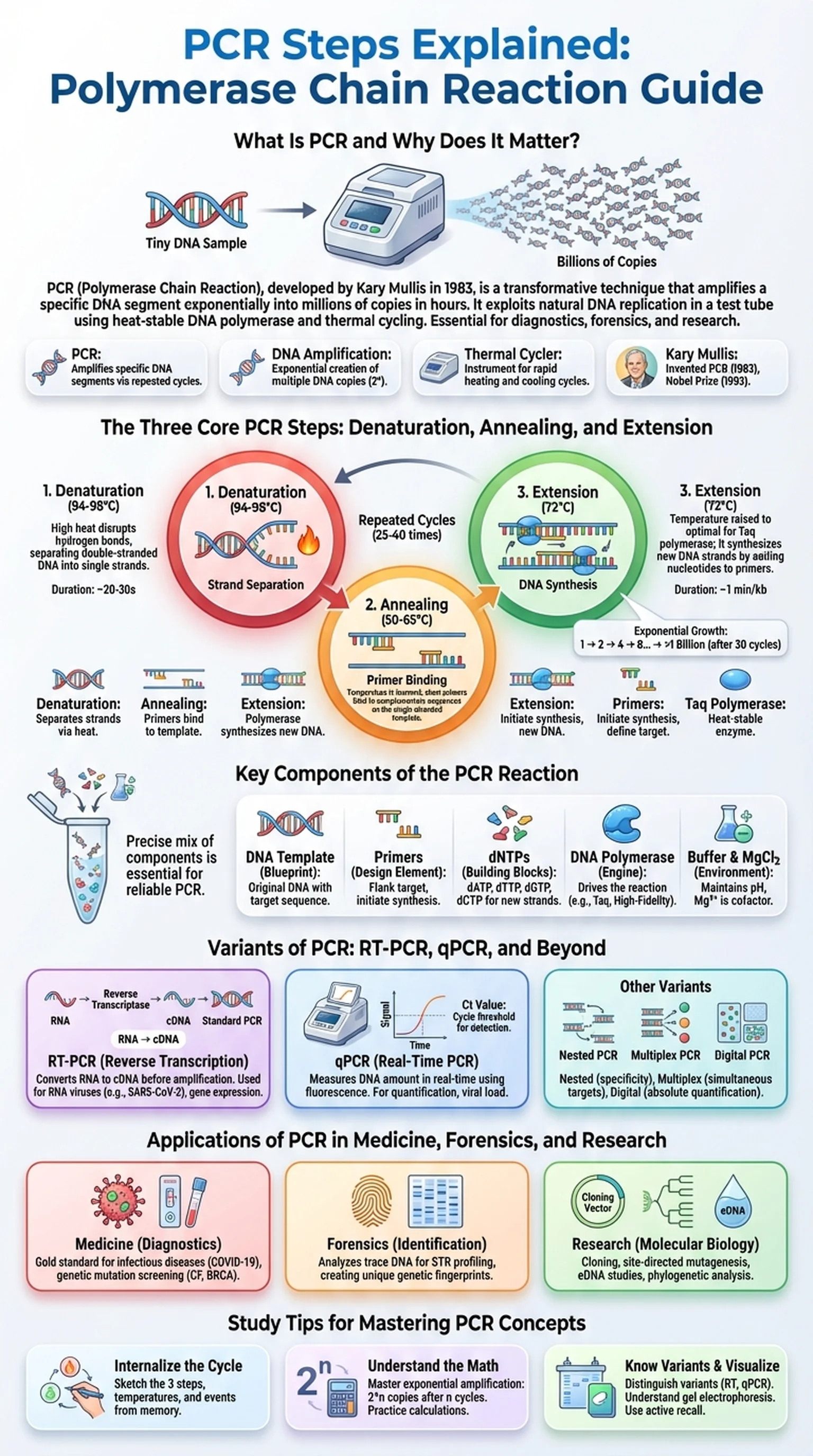
Complete PCR diagram illustrating the three core steps of the polymerase chain reaction and exponential DNA amplification across multiple cycles.

Download
PCR steps diagram showing the three phases of the polymerase chain reaction: denaturation, annealing, and extension with DNA amplification

Interactive Study Short

Swipe through 5 slides about PCR Steps Explained: Polymerase Chain Reaction Guide

1 / 5

What Is PCR and Why Does It Matter?

PCR, or the polymerase chain reaction, is one of the most transformative techniques in modern molecular biology. Developed by Kary Mullis in 1983, PCR allows scientists to take a tiny sample of DNA and amplify it into millions or even billions of copies within just a few hours. This DNA amplification capability revolutionized fields ranging from forensic science and medical diagnostics to evolutionary biology and genetic engineering.

At its core, the PCR technique exploits the natural mechanism of DNA replication. In a living cell, enzymes unwind the double helix and synthesize new complementary strands. PCR mimics this process in a test tube by using a heat-stable DNA polymerase, short DNA primers, free nucleotides, and a thermal cycler that rapidly changes temperature. The elegance of the polymerase chain reaction lies in its exponential nature: each cycle doubles the number of target DNA molecules, so after 30 cycles a single molecule can theoretically become over one billion copies.

The importance of PCR cannot be overstated. Before its invention, obtaining enough DNA for analysis required laborious cloning procedures that took weeks. Today, the PCR technique is used in COVID-19 testing, paternity analysis, cancer mutation screening, and species identification from environmental samples. Understanding the PCR steps is essential for any student of biology, biochemistry, or medical sciences, as this foundational method appears on exams like the MCAT, GRE Biology, and AP Biology with remarkable frequency.

Key Terms

PCR

Polymerase chain reaction; a laboratory technique used to amplify specific segments of DNA through repeated cycles of denaturation, annealing, and extension.

DNA Amplification

The process of creating multiple copies of a specific DNA sequence, achieved exponentially through the polymerase chain reaction.

Thermal Cycler

A laboratory instrument that rapidly heats and cools samples to the precise temperatures required for each step of the PCR technique.

Kary Mullis

The American biochemist who invented PCR in 1983 and was awarded the Nobel Prize in Chemistry in 1993 for this work.

The Three Core PCR Steps: Denaturation, Annealing, and Extension

The polymerase chain reaction proceeds through three fundamental PCR steps that are repeated in cycles, typically 25 to 40 times. Each cycle consists of denaturation, annealing, and extension, and understanding these steps in detail is critical for mastering the PCR technique.

Denaturation is the first step and occurs at approximately 94 to 98 degrees Celsius. At this high temperature, the hydrogen bonds holding the two strands of the double-stranded DNA template together are disrupted, causing the strands to separate completely. This strand separation is essential because the DNA polymerase enzyme needs single-stranded DNA as a template for synthesizing new strands. The denaturation step typically lasts 20 to 30 seconds per cycle, and the initial denaturation at the start of the reaction may be extended to several minutes to ensure complete separation of complex genomic DNA.

Annealing is the second step, and the temperature is lowered to between 50 and 65 degrees Celsius, depending on the melting temperature of the primers. During annealing, short synthetic oligonucleotide primers bind to their complementary sequences on the now-single-stranded DNA template. The primers define the boundaries of the region to be amplified and provide the free 3-prime hydroxyl group that DNA polymerase requires to begin synthesis. Primer design is one of the most critical aspects of a successful PCR technique, as primers that are too short or too nonspecific will lead to off-target amplification.

Extension, also called elongation, is the third step. The temperature is raised to approximately 72 degrees Celsius, the optimal working temperature for Taq polymerase. During extension, the polymerase reads the template strand and adds complementary nucleotides to the 3-prime end of each primer, synthesizing a new DNA strand. The duration of the extension step depends on the length of the target sequence, with a general rule of one minute per kilobase of DNA. At the end of one complete cycle of these three PCR steps, the amount of target DNA has doubled, setting the stage for exponential DNA amplification.

Key Terms

Denaturation

The first PCR step in which high heat separates double-stranded DNA into two single strands by breaking hydrogen bonds.

Annealing

The second PCR step in which primers bind to complementary sequences on single-stranded DNA template at a reduced temperature.

Extension

The third PCR step in which DNA polymerase synthesizes new DNA strands by adding nucleotides to the primers at 72 degrees Celsius.

Primers

Short single-stranded DNA sequences (typically 18-25 nucleotides) that bind to complementary template regions and initiate DNA synthesis during PCR.

Taq Polymerase

A heat-stable DNA polymerase isolated from Thermus aquaticus, the enzyme most commonly used in the PCR technique due to its ability to withstand denaturation temperatures.

Key Components of the PCR Reaction

A successful polymerase chain reaction depends on the precise combination of several essential components. Each reagent plays a specific role, and understanding their functions helps explain why the PCR technique is so reliable and reproducible when optimized correctly.

The DNA template is the starting material that contains the target sequence to be amplified. The template can come from a wide variety of sources, including purified genomic DNA, cDNA, plasmid DNA, or even crude cell lysates. The quality and purity of the template significantly affect the efficiency of DNA amplification. Contaminants such as proteins, salts, or organic solvents can inhibit the polymerase and reduce yield.

Primers are arguably the most important design element in any PCR experiment. A standard reaction uses a forward primer and a reverse primer that flank the target region. The primers must be complementary to sequences on opposite strands of the template, and they should have similar melting temperatures to ensure they anneal efficiently at the same temperature. Primer length, GC content, and the absence of secondary structures like hairpins all influence the specificity of the PCR technique.

Deoxynucleotide triphosphates (dNTPs) are the building blocks that the polymerase incorporates into the growing DNA strand. An equimolar mixture of dATP, dTTP, dGTP, and dCTP is added to the reaction, and an imbalance in dNTP concentrations can increase the error rate of the polymerase. The buffer solution maintains an optimal pH and ionic environment for enzyme activity, and magnesium chloride is a critical cofactor for Taq polymerase. The concentration of magnesium must be carefully optimized because too little reduces enzyme activity while too much promotes nonspecific amplification.

Finally, the DNA polymerase itself drives the entire reaction. Taq polymerase remains the workhorse of standard PCR, but high-fidelity polymerases such as Pfu and Phusion are used when accuracy is paramount, for example in cloning or sequencing applications. These proofreading polymerases have 3-prime to 5-prime exonuclease activity, which allows them to correct misincorporated nucleotides during DNA amplification.

Key Terms

dNTPs

Deoxynucleotide triphosphates; the four nucleotide building blocks (dATP, dTTP, dGTP, dCTP) used by DNA polymerase to synthesize new strands during PCR.

Magnesium Chloride (MgCl2)

An essential cofactor for Taq polymerase activity; its concentration must be optimized for each PCR reaction to balance specificity and yield.

High-Fidelity Polymerase

A DNA polymerase with proofreading (3' to 5' exonuclease) activity that produces fewer errors during DNA amplification compared to standard Taq polymerase.

DNA Template

The original DNA molecule containing the target sequence that serves as the blueprint for amplification during the polymerase chain reaction.

Variants of PCR: RT-PCR, qPCR, and Beyond

Since its invention, the basic polymerase chain reaction has been adapted into numerous specialized variants, each designed to address specific experimental needs. These PCR variants extend the utility of DNA amplification far beyond simple copying of a target sequence.

Reverse transcription PCR (RT-PCR) is used to amplify RNA rather than DNA. In this two-step process, an enzyme called reverse transcriptase first converts an RNA template into complementary DNA (cDNA), and then standard PCR steps amplify the cDNA. RT-PCR is indispensable in virology, as it forms the basis of diagnostic tests for RNA viruses such as SARS-CoV-2. It is also widely used in gene expression studies to detect and measure mRNA levels in cells and tissues.

Quantitative PCR (qPCR), also called real-time PCR, allows researchers to measure the amount of DNA being amplified in real time during the reaction. Fluorescent dyes or probes bind to the newly synthesized DNA, and a detector in the thermal cycler measures the fluorescence intensity after each cycle. The cycle at which the fluorescence crosses a threshold (the Ct value) is inversely proportional to the initial amount of target DNA. This makes qPCR a powerful tool for gene expression quantification, pathogen load determination, and viral titer measurement. The PCR technique of qPCR combines the specificity of the polymerase chain reaction with the sensitivity of fluorescence detection.

Other notable variants include nested PCR, which uses two sequential rounds of amplification with different primer sets to increase specificity; multiplex PCR, which amplifies multiple target sequences simultaneously in a single reaction; and digital PCR (dPCR), which partitions the sample into thousands of individual micro-reactions for absolute quantification without a standard curve. Each variant builds upon the core PCR steps of denaturation, annealing, and extension while adding modifications that solve particular challenges in DNA amplification and molecular diagnostics.

Key Terms

RT-PCR

Reverse transcription PCR; a variant that first converts RNA to cDNA using reverse transcriptase before amplifying the cDNA with standard PCR steps.

qPCR (Real-Time PCR)

Quantitative PCR; a technique that measures DNA amplification in real time using fluorescent reporters, enabling quantification of initial template amounts.

Ct Value

The cycle threshold; the PCR cycle number at which fluorescence intensity exceeds a defined threshold, indicating detectable amplification.

Multiplex PCR

A PCR variant that uses multiple primer pairs to amplify several different target sequences simultaneously in a single reaction tube.

Applications of PCR in Medicine, Forensics, and Research

The polymerase chain reaction has become an indispensable tool across an extraordinary range of disciplines. Its ability to detect and amplify minute quantities of DNA has transformed medicine, criminal justice, agriculture, and basic biological research.

In clinical medicine, the PCR technique is the gold standard for diagnosing infectious diseases. PCR-based tests can detect bacterial, viral, and fungal pathogens with unparalleled sensitivity and specificity, often identifying infections before symptoms appear. The COVID-19 pandemic brought RT-PCR testing into the global spotlight, demonstrating how DNA amplification technology can be deployed at massive scale to track and contain a novel pathogen. Beyond infectious disease, PCR is used to screen for genetic mutations associated with hereditary conditions such as cystic fibrosis, sickle cell anemia, and BRCA-related breast cancer.

In forensic science, PCR enables the analysis of DNA from crime scenes where only trace amounts of biological material are available. A few cells from a hair follicle, a drop of blood, or a saliva-stained envelope can yield enough amplified DNA for short tandem repeat (STR) profiling, which produces a unique genetic fingerprint for each individual. The sensitivity of the PCR technique means that cold cases from decades ago can now be solved using degraded DNA samples that would have been useless with older methods.

In research laboratories, the polymerase chain reaction underpins virtually every area of molecular biology. Cloning experiments begin with PCR amplification of the gene of interest. Site-directed mutagenesis uses modified PCR steps to introduce specific mutations into a gene. Environmental DNA (eDNA) studies use PCR to detect species from water or soil samples without ever capturing an organism. Phylogenetic studies amplify conserved gene regions to compare evolutionary relationships among species. The versatility of DNA amplification ensures that PCR will remain a cornerstone technique for decades to come.

Key Terms

STR Profiling

Short tandem repeat profiling; a forensic DNA analysis method that amplifies highly variable repeat regions using PCR to create a unique genetic fingerprint.

eDNA

Environmental DNA; genetic material shed by organisms into their surroundings, detectable through PCR amplification of water or soil samples.

Site-Directed Mutagenesis

A technique that uses modified PCR to introduce specific, targeted mutations into a DNA sequence for functional studies.

Genetic Screening

The use of PCR-based assays to detect mutations associated with inherited diseases or predispositions in an individual's DNA.

Study Tips for Mastering PCR Concepts

The polymerase chain reaction is a high-yield topic for standardized exams including the MCAT, GRE Biology, AP Biology, and USMLE Step 1. Understanding the core PCR steps and their biochemical logic will prepare you for both multiple-choice and passage-based questions.

First, internalize the three-step cycle. Sketch the PCR steps from memory: denaturation at high heat separates strands, annealing at a lower temperature allows primers to bind, and extension at 72 degrees Celsius lets Taq polymerase synthesize new DNA. Practice drawing this cycle and labeling the temperature, duration, and molecular events at each step. Visualizing the process helps you answer questions about what would happen if a specific step were modified or omitted.

Second, understand the math of exponential DNA amplification. After n cycles, the theoretical number of copies is 2 to the power of n. After 10 cycles, a single molecule becomes roughly 1,024 copies; after 20 cycles, over one million; after 30 cycles, over one billion. Exam questions often ask students to calculate the number of copies after a given number of cycles, or to determine how many cycles are needed to reach a target number.

Third, know the key variants and their applications. Be able to distinguish between standard PCR, RT-PCR, and qPCR. Understand that RT-PCR starts with RNA, that qPCR provides quantitative data in real time, and that both rely on the same fundamental PCR technique. Also be familiar with gel electrophoresis as the standard method for visualizing PCR products by size.

Finally, use active recall and spaced repetition to reinforce your knowledge. Platforms like LectureScribe can generate flashcards, slide decks, and practice questions directly from your lecture notes on the polymerase chain reaction and other molecular biology techniques. Testing yourself regularly ensures long-term retention and exam readiness.

Key Terms

Exponential Amplification

The doubling of target DNA with each PCR cycle, described mathematically as 2^n copies after n cycles of the polymerase chain reaction.

Gel Electrophoresis

A laboratory technique that separates DNA fragments by size through an agarose or polyacrylamide gel, used to visualize and verify PCR products.

Active Recall

A study technique in which learners actively retrieve information from memory rather than passively reviewing notes.

Frequently Asked Questions

What are the three main PCR steps?

The three main PCR steps are denaturation (heating to 94-98 degrees Celsius to separate DNA strands), annealing (cooling to 50-65 degrees Celsius to allow primers to bind), and extension (heating to 72 degrees Celsius for Taq polymerase to synthesize new DNA strands). These steps are repeated 25-40 times for exponential DNA amplification.

What is the polymerase chain reaction used for?

The polymerase chain reaction is used for DNA amplification in a wide range of applications including medical diagnostics, forensic DNA profiling, genetic screening, gene cloning, pathogen detection, and research. It is the gold standard technique for detecting and copying specific DNA sequences from minute samples.

Why is Taq polymerase used in PCR?

Taq polymerase is used in PCR because it is heat-stable and can withstand the high temperatures (94-98 degrees Celsius) required during the denaturation step. Isolated from the thermophilic bacterium Thermus aquaticus, Taq polymerase retains its enzymatic activity through repeated heating cycles, making it ideal for the PCR technique.

How does DNA amplification work in PCR?

DNA amplification in PCR works through exponential copying. Each cycle of the three PCR steps doubles the number of target DNA molecules. After 30 cycles, a single DNA molecule can theoretically be amplified to over one billion copies. This exponential growth is what makes the polymerase chain reaction so powerful for detecting trace amounts of DNA.

What is the difference between PCR and RT-PCR?

Standard PCR amplifies DNA templates, while RT-PCR (reverse transcription PCR) first converts RNA into complementary DNA (cDNA) using reverse transcriptase before performing the standard PCR steps. RT-PCR is used when the starting material is RNA, such as in the detection of RNA viruses or the measurement of gene expression.

What is the PCR technique of qPCR?

qPCR, or quantitative PCR, is a PCR technique that measures DNA amplification in real time using fluorescent reporters. Unlike standard PCR that only shows end-point results, qPCR monitors the accumulation of product after each cycle, allowing researchers to quantify the initial amount of target DNA or RNA in a sample.

How many copies of DNA are produced after 30 PCR cycles?

After 30 PCR cycles, a single target DNA molecule can theoretically produce approximately 1.07 billion copies (2 to the power of 30). In practice, the actual yield may be somewhat lower due to reagent depletion and enzyme efficiency, but the exponential nature of the polymerase chain reaction still generates enormous quantities of amplified DNA.

Study Biology Smarter

Upload your lecture notes and get AI-generated flashcards, quizzes, infographics, and study guides tailored to your curriculum.

Try LectureScribe Free

Create Study Materials

Transform your Biology lectures into flashcards, quizzes, and visual study guides with AI.

  • AI-generated flashcards & quizzes
  • Visual infographics from notes
  • Interactive study shorts
Start Studying Free

Quick Facts

SubjectBiology
Word Count2,500+
Slides5
InfographicIncluded
AuthorLectureScribe

Master Biology with LectureScribe

Upload your lecture notes and get AI-powered flashcards, quizzes, infographics, and study guides in minutes.