LectureScribe Logo
lecturescribe.io

LOCK IN VALENTINE PRICING BEFORE SALE ENDS!

Use code — New joiners get 40% OFF on annual plans

Plans will have higher prices after this sale ends

0days
:
0hours
:
0minutes
:
0seconds
Biology2,500+ words5 slides
🧮

Punnett Square Problems: Genetics Practice with Solutions

Practice Punnett square problems with step-by-step solutions. Master monohybrid cross, dihybrid cross, and genetics problems with clear explanations and examples.

L
LectureScribeAI-Powered Study Platform

Study Infographic

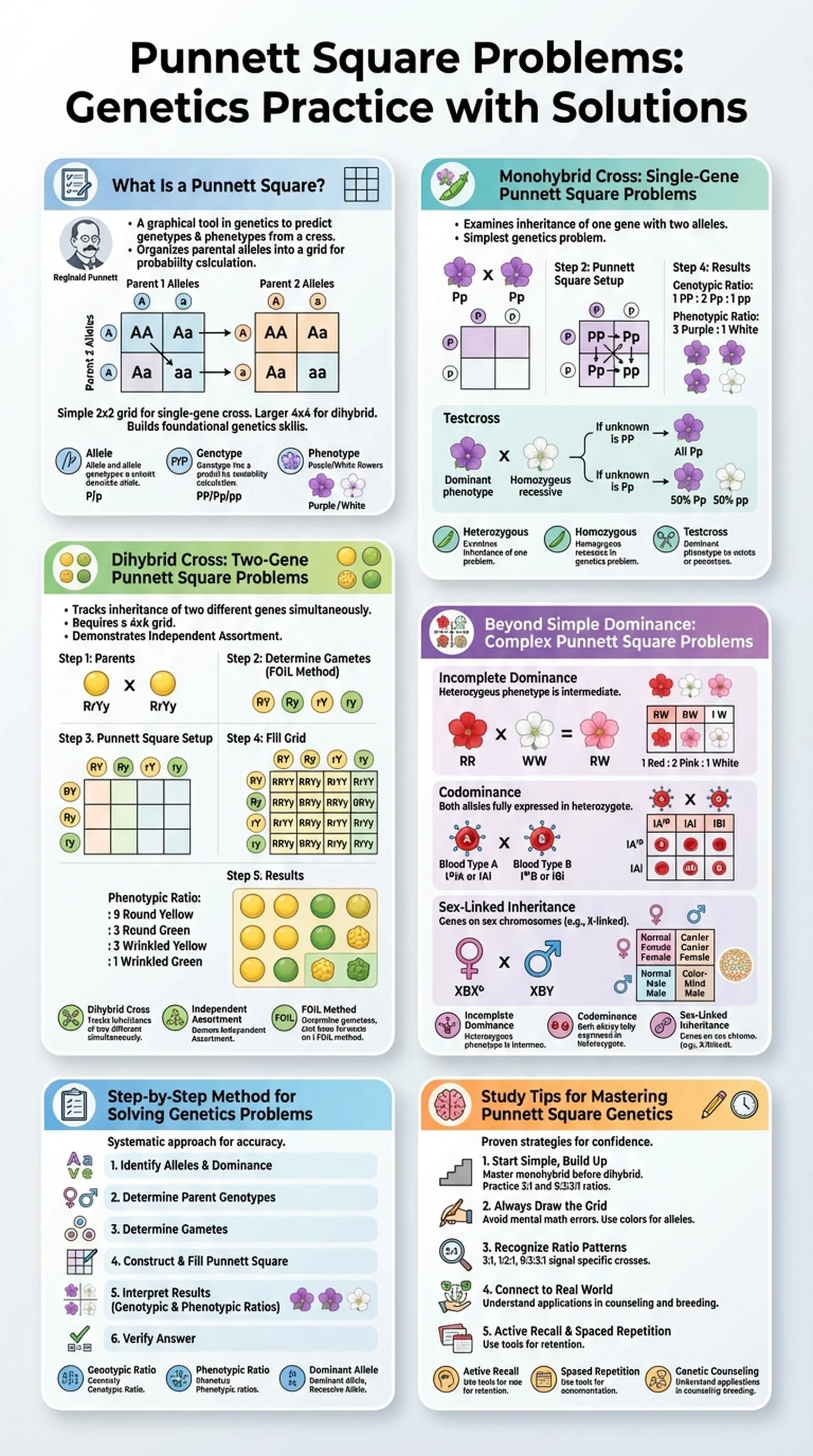
Complete Punnett square guide illustrating monohybrid cross (2x2) and dihybrid cross (4x4) setups with expected offspring ratios.

Download
Punnett square examples showing monohybrid cross and dihybrid cross with genotypic and phenotypic ratios

Interactive Study Short

Swipe through 5 slides about Punnett Square Problems: Genetics Practice with Solutions

1 / 5

What Is a Punnett Square?

A Punnett square is a simple graphical tool used in genetics to predict the possible genotypes and phenotypes of offspring from a particular cross. Named after the British geneticist Reginald Punnett, who popularized the method in the early twentieth century, the Punnett square organizes all possible combinations of parental alleles into a grid format. This makes it straightforward to calculate the probability of each genetic outcome in a given cross.

The basic structure of a Punnett square involves placing one parent's alleles along the top of the grid and the other parent's alleles along the side. Each cell within the grid is then filled in by combining the corresponding row and column alleles. For a single-gene cross, the Punnett square is a simple 2x2 grid, while a dihybrid cross involving two genes requires a larger 4x4 grid with sixteen possible combinations.

Punnett square practice is a cornerstone of introductory genetics courses because it builds the foundational skills needed to solve more complex genetics problems. By working through Punnett square examples, students learn to distinguish between dominant and recessive alleles, interpret genotypic and phenotypic ratios, and understand basic principles of Mendelian inheritance. Whether you are studying for AP Biology, the MCAT, or a college genetics course, mastering the Punnett square is essential for success in genetics. The technique applies not only to simple dominant-recessive traits but also to incomplete dominance, codominance, and sex-linked inheritance patterns.

Key Terms

Punnett Square

A grid diagram used to predict the genotypic and phenotypic ratios of offspring from a genetic cross.

Allele

One of two or more alternative forms of a gene that arise by mutation and are found at the same locus on a chromosome.

Genotype

The genetic makeup of an organism, represented by the combination of alleles it carries for a particular trait.

Phenotype

The observable physical or biochemical characteristics of an organism, determined by its genotype and environmental influences.

Monohybrid Cross: Single-Gene Punnett Square Problems

A monohybrid cross examines the inheritance of a single gene with two alleles. This is the simplest type of genetics problem and the ideal starting point for Punnett square practice. In a typical monohybrid cross, we track one trait, such as flower color in pea plants, where the dominant allele (P) produces purple flowers and the recessive allele (p) produces white flowers.

Consider a cross between two heterozygous parents (Pp x Pp). Setting up the Punnett square, we place the alleles of one parent (P and p) along the top and the alleles of the other parent (P and p) along the side. Filling in the four cells gives us: PP, Pp, Pp, and pp. This yields a genotypic ratio of 1 PP : 2 Pp : 1 pp. Since both PP and Pp individuals express the dominant phenotype (purple flowers), the phenotypic ratio is 3 purple : 1 white, the classic 3:1 ratio that Gregor Mendel observed in his pea plant experiments.

Now consider a testcross, one of the most important genetics problems in practice. A testcross involves crossing an organism with a dominant phenotype but unknown genotype against a homozygous recessive organism (pp). If the unknown parent is homozygous dominant (PP), all offspring will be Pp and express the dominant phenotype. If the unknown parent is heterozygous (Pp), the offspring will be 50% Pp and 50% pp, producing a 1:1 phenotypic ratio. This simple Punnett square analysis allows geneticists to determine the genotype of the dominant parent based on the offspring ratios.

Monohybrid cross problems form the basis for understanding more complex inheritance patterns. Once you can confidently solve single-gene Punnett square problems, you are prepared to tackle dihybrid crosses and multi-gene inheritance scenarios that appear frequently on exams.

Key Terms

Monohybrid Cross

A genetic cross examining the inheritance of a single trait controlled by one gene with two alleles.

Heterozygous

Having two different alleles for a particular gene (e.g., Pp), one dominant and one recessive.

Testcross

A cross between an organism with a dominant phenotype and one with a homozygous recessive genotype, used to determine the dominant organism's genotype.

Homozygous

Having two identical alleles for a particular gene, either homozygous dominant (PP) or homozygous recessive (pp).

Dihybrid Cross: Two-Gene Punnett Square Problems

A dihybrid cross is a genetics problem that tracks the inheritance of two different genes simultaneously. This type of cross requires a 4x4 Punnett square with sixteen cells, representing all possible combinations of alleles from both parents. The dihybrid cross was central to Mendel's discovery of the law of independent assortment, which states that alleles of different genes are distributed independently during gamete formation, provided the genes are on different chromosomes.

Consider a cross involving pea plants that differ in two traits: seed shape (R = round, r = wrinkled) and seed color (Y = yellow, y = green). If both parents are heterozygous for both traits (RrYy x RrYy), each parent can produce four types of gametes: RY, Ry, rY, and ry. Setting up the 4x4 Punnett square and filling in all sixteen cells reveals the classic 9:3:3:1 phenotypic ratio: 9 round yellow, 3 round green, 3 wrinkled yellow, and 1 wrinkled green.

Solving dihybrid cross problems requires careful organization. First, determine the gamete types each parent can produce. For a parent with genotype RrYy, use the FOIL method: combine each allele of the first gene with each allele of the second gene to get RY, Ry, rY, and ry. Then place one parent's gametes along the top and the other's along the side of the Punnett square. Fill in each cell by combining the gamete alleles.

The dihybrid cross is a frequent source of genetics problems on AP Biology and MCAT exams. Students should practice identifying genotypic and phenotypic ratios, recognizing deviations from the expected 9:3:3:1 ratio (which may indicate linked genes or epistasis), and applying the Punnett square to real-world scenarios such as predicting trait combinations in breeding experiments. Mastering the dihybrid cross is a clear sign that you understand the mechanics of Mendelian inheritance.

Key Terms

Dihybrid Cross

A genetic cross that tracks two traits controlled by two different genes, requiring a 4x4 Punnett square.

Independent Assortment

Mendel's law stating that alleles of different genes segregate independently during gamete formation.

FOIL Method

A technique for determining all possible gamete combinations from a dihybrid parent by pairing each allele of one gene with each allele of another.

9:3:3:1 Ratio

The expected phenotypic ratio from a dihybrid cross between two heterozygous parents, assuming independent assortment and complete dominance.

Beyond Simple Dominance: Complex Punnett Square Problems

While basic Punnett square practice focuses on complete dominance, many genetics problems involve more complex inheritance patterns. Understanding these patterns is critical for solving the full range of genetics problems you will encounter in coursework and on standardized exams.

Incomplete dominance occurs when the heterozygous phenotype is intermediate between the two homozygous phenotypes. For example, crossing a red-flowered plant (RR) with a white-flowered plant (WW) in a species exhibiting incomplete dominance produces all pink-flowered offspring (RW). A Punnett square cross of two pink heterozygotes (RW x RW) yields a 1:2:1 phenotypic ratio of red, pink, and white, rather than the 3:1 ratio seen in complete dominance.

Codominance is a related but distinct pattern in which both alleles are fully expressed in the heterozygote. The classic example is the ABO blood type system, where the IA and IB alleles are codominant with each other but both dominant over the i allele. A Punnett square can predict the possible blood types of offspring when parental genotypes are known. For instance, crossing an IAIB parent with an IAi parent produces offspring with blood types A, AB, and B in predictable ratios.

Sex-linked inheritance adds another layer of complexity to Punnett square problems. Genes located on the X chromosome follow different inheritance patterns in males and females because males have only one X chromosome. Color blindness, for example, is an X-linked recessive trait. A Punnett square for a cross between a carrier female (XBXb) and a normal male (XBY) shows that 50% of sons will be color-blind while all daughters will have normal vision, though half will be carriers.

These complex genetics problems require the same Punnett square framework but demand careful attention to how alleles interact and how sex chromosomes influence inheritance. Regular Punnett square practice with these variations builds the flexibility needed to handle any genetics problem.

Key Terms

Incomplete Dominance

A pattern of inheritance in which the heterozygous phenotype is intermediate between the two homozygous phenotypes.

Codominance

A pattern of inheritance in which both alleles are fully and simultaneously expressed in the heterozygote.

Sex-Linked Inheritance

The inheritance pattern of genes located on the sex chromosomes, particularly the X chromosome.

Carrier

An individual who is heterozygous for a recessive allele and does not express the trait but can pass it to offspring.

Step-by-Step Method for Solving Genetics Problems

Developing a systematic approach to solving genetics problems is the key to accuracy and speed on exams. The following step-by-step method applies to any Punnett square problem, from simple monohybrid crosses to complex multi-gene scenarios.

Step 1: Identify the alleles and their dominance relationships. Determine which allele is dominant and which is recessive, and assign letter symbols accordingly. By convention, the uppercase letter represents the dominant allele and the lowercase letter represents the recessive allele. Step 2: Determine the genotypes of the parents. Use the information given in the problem, such as phenotypes, family history, or previous cross results, to establish each parent's genotype. If a parent shows the dominant phenotype but the genotype is unknown, consider using a testcross approach.

Step 3: Determine the possible gametes for each parent. For a monohybrid cross, each parent produces two types of gametes. For a dihybrid cross, each parent can produce up to four types of gametes. List all gamete types carefully before constructing the Punnett square. Step 4: Construct and fill in the Punnett square. Place one parent's gametes along the top and the other's along the side, then combine alleles in each cell.

Step 5: Interpret the results. Count the genotypes in the grid and determine both the genotypic ratio and the phenotypic ratio. Express ratios in their simplest form. Step 6: Verify your answer. Confirm that the total number of genotypic combinations equals the expected number of cells (4 for a monohybrid cross, 16 for a dihybrid cross). Check that phenotypic ratios make sense given the dominance pattern.

This methodical approach ensures consistency when working through genetics problems. Punnett square practice using this framework will build confidence for tackling increasingly difficult problems on AP Biology, genetics coursework, and the MCAT.

Key Terms

Genotypic Ratio

The ratio of different genotypes produced in a genetic cross, expressed in its simplest whole-number form.

Phenotypic Ratio

The ratio of different observable traits (phenotypes) produced in a genetic cross.

Dominant Allele

An allele that is expressed in the phenotype when present in either the homozygous or heterozygous state.

Recessive Allele

An allele that is only expressed in the phenotype when present in the homozygous state.

Study Tips for Mastering Punnett Square Genetics

Punnett square problems are among the most frequently tested topics in biology, appearing on AP Biology exams, the MCAT, and college genetics courses. Here are proven strategies for mastering genetics problems and achieving confidence with the Punnett square.

First, start with monohybrid cross problems and build up to dihybrid cross problems. Trying to tackle complex genetics problems before mastering the basics often leads to confusion. Work through at least ten monohybrid cross examples before moving to dihybrid crosses. Once you are comfortable with the standard 3:1 and 9:3:3:1 ratios, introduce problems involving incomplete dominance, codominance, and sex-linked traits.

Second, always draw the Punnett square rather than trying to solve problems mentally. Even experienced genetics students make errors when they skip the grid. The visual layout prevents allele-combination mistakes and makes ratio counting straightforward. Use different colors or symbols to distinguish between alleles if you find yourself mixing them up.

Third, practice recognizing common ratio patterns. A 3:1 phenotypic ratio signals a monohybrid cross between two heterozygotes. A 1:2:1 ratio indicates incomplete dominance. A 1:1 ratio suggests a testcross. A 9:3:3:1 ratio signals a dihybrid cross between two heterozygotes. Knowing these patterns helps you quickly identify what type of cross produced a given set of offspring, which is a common exam question format.

Fourth, connect Punnett square practice to real-world applications. Genetic counseling uses Punnett square analysis to advise parents about the probability of inherited conditions. Agricultural breeding programs use crosses to select for desirable traits. Understanding these applications deepens your grasp of why genetics problems matter beyond the classroom.

Finally, use active recall and spaced repetition to retain what you learn. Platforms like LectureScribe generate practice questions and flashcards from your notes, helping you review Punnett square concepts consistently over time. Consistent practice is the single most effective strategy for mastering genetics problems.

Key Terms

Active Recall

A study technique in which learners actively retrieve information from memory rather than passively reviewing notes.

Spaced Repetition

A learning strategy that involves reviewing material at increasing intervals to strengthen long-term memory retention.

Genetic Counseling

A healthcare service that uses genetic analysis, including Punnett squares, to advise individuals about inherited conditions and reproductive risks.

Frequently Asked Questions

What is a Punnett square used for?

A Punnett square is used to predict the possible genotypes and phenotypes of offspring from a genetic cross. It organizes all possible allele combinations from two parents into a grid, making it easy to calculate the probability of each genetic outcome.

How do you solve a monohybrid cross Punnett square?

To solve a monohybrid cross, determine each parent's genotype, list their possible gametes, place gametes along the top and side of a 2x2 grid, and fill in each cell by combining the row and column alleles. Then count genotypes and phenotypes to determine the offspring ratios.

What is a dihybrid cross and what ratio does it produce?

A dihybrid cross tracks two traits simultaneously using a 4x4 Punnett square. When both parents are heterozygous for both traits, the expected phenotypic ratio is 9:3:3:1, assuming complete dominance and independent assortment of the two genes.

What is the difference between genotype and phenotype?

Genotype refers to the genetic makeup of an organism, the specific alleles it carries. Phenotype refers to the observable characteristics expressed by those alleles. Two organisms can have different genotypes (such as PP and Pp) but the same phenotype if the trait shows complete dominance.

How do you set up a Punnett square for genetics problems?

First identify the parental genotypes and determine the possible gametes each parent can produce. Place one parent's gametes across the top of the grid and the other's along the side. Fill in each cell by combining the corresponding gamete alleles, then analyze the resulting genotypic and phenotypic ratios.

What does Punnett square practice help you learn?

Punnett square practice helps you understand how alleles are inherited, calculate offspring probabilities, distinguish between dominant and recessive traits, and recognize standard genetic ratios. It builds the skills needed for more advanced genetics problems involving multiple genes and complex inheritance patterns.

Can Punnett squares predict real-world outcomes?

Punnett squares predict probabilities, not guaranteed outcomes. They show the expected ratios of genotypes and phenotypes in offspring based on parental genotypes. Actual results may deviate from predictions due to small sample sizes, but large populations tend to match predicted ratios closely.

Study Biology Smarter

Upload your lecture notes and get AI-generated flashcards, quizzes, infographics, and study guides tailored to your curriculum.

Try LectureScribe Free

Create Study Materials

Transform your Biology lectures into flashcards, quizzes, and visual study guides with AI.

  • AI-generated flashcards & quizzes
  • Visual infographics from notes
  • Interactive study shorts
Start Studying Free

Quick Facts

SubjectBiology
Word Count2,500+
Slides5
InfographicIncluded
AuthorLectureScribe

Master Biology with LectureScribe

Upload your lecture notes and get AI-powered flashcards, quizzes, infographics, and study guides in minutes.