LectureScribe Logo
lecturescribe.io

LOCK IN VALENTINE PRICING BEFORE SALE ENDS!

Use code — New joiners get 40% OFF on annual plans

Plans will have higher prices after this sale ends

0days
:
0hours
:
0minutes
:
0seconds
Biology2,500+ words5 slides
🧬

Types of Mutations in Biology: Point, Frameshift & Chromosomal

Learn the types of mutations in biology including point mutations, frameshift mutations, and chromosomal mutations. Understand how each mutation type affects genes and proteins.

L
LectureScribeAI-Powered Study Platform

Study Infographic

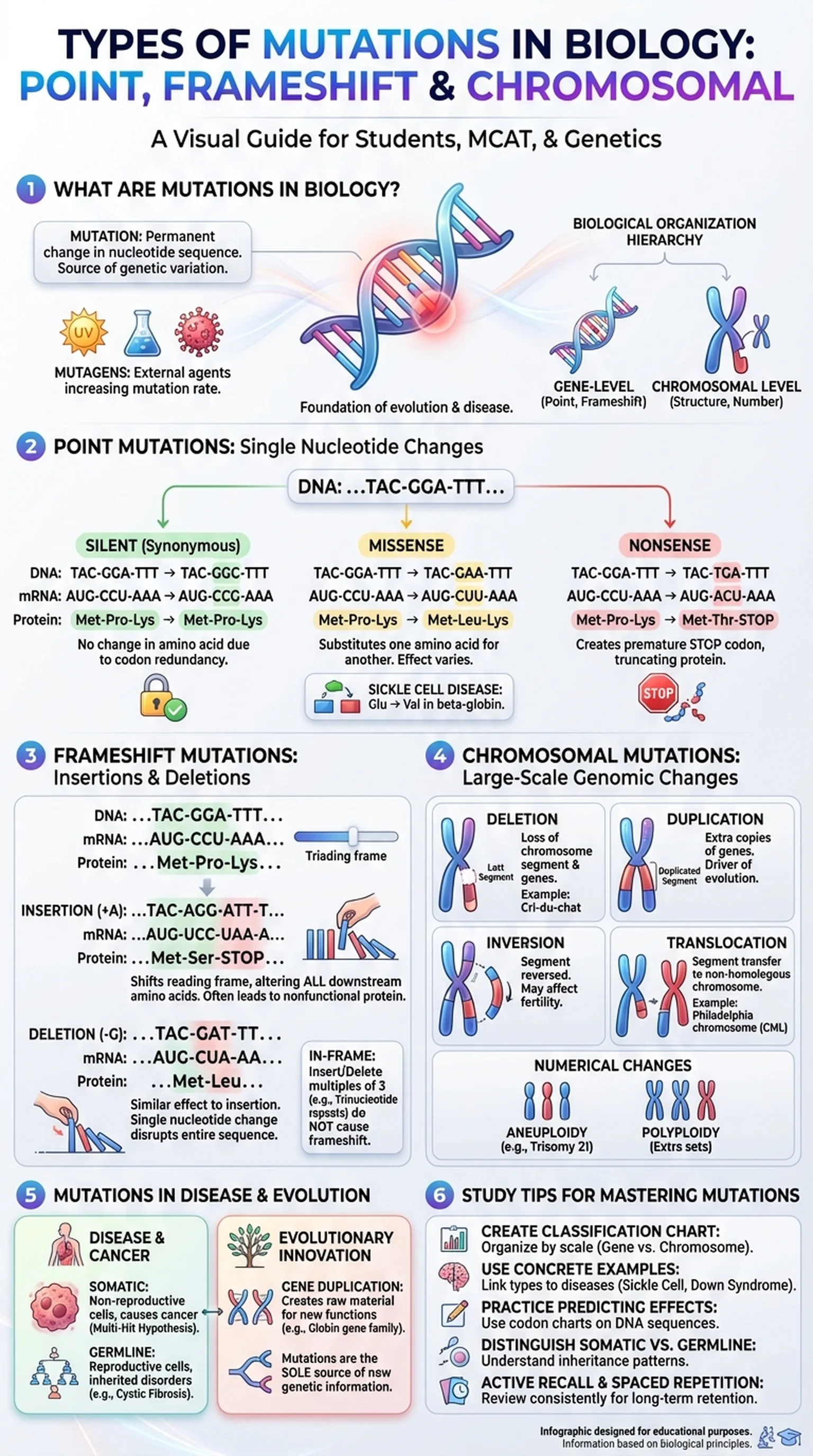
Complete guide to the types of mutations in biology, illustrating point mutations, frameshift mutations, and chromosomal mutations with disease examples.

Download
Types of mutations diagram showing point mutations, frameshift mutations, and chromosomal mutations with examples of each category

Interactive Study Short

Swipe through 5 slides about Types of Mutations in Biology: Point, Frameshift & Chromosomal

1 / 5

What Are Mutations in Biology?

In mutation biology, a mutation is defined as any permanent change in the nucleotide sequence of an organism's DNA. Mutations are the ultimate source of all genetic variation, providing the raw material upon which natural selection and evolution act. Without mutations, populations would lack the genetic diversity needed to adapt to changing environments. However, most mutations are neutral or harmful, and only a small fraction confer a selective advantage.

The types of mutations can be classified at multiple levels of biological organization. At the smallest scale, changes affecting one or a few nucleotides are called gene-level mutations, which include point mutations and frameshift mutations. At the largest scale, changes affecting the structure or number of entire chromosomes are called chromosomal mutations. Understanding this hierarchy is essential for studying genetics, molecular biology, and medicine, since different types of mutations produce vastly different effects on an organism's phenotype.

Mutations can arise spontaneously during DNA replication when the cell's proofreading machinery fails to correct an error, or they can be induced by external agents called mutagens. Chemical mutagens, such as benzene and nitrous acid, alter the chemical structure of DNA bases. Physical mutagens, such as ultraviolet light and ionizing radiation, cause direct damage to the DNA backbone or promote the formation of abnormal base pairs. Biological mutagens, including certain viruses and transposable elements, can insert foreign DNA sequences into the genome. Regardless of their origin, mutations are the foundation of mutation biology and a core concept in every genetics course.

Key Terms

Mutation

A permanent change in the nucleotide sequence of DNA that may affect gene function and be passed to offspring.

Mutagen

An external agent (chemical, physical, or biological) that increases the rate of mutation in DNA.

Types of Mutations

The classification of mutations based on scale and mechanism, including point mutations, frameshift mutations, and chromosomal mutations.

Genetic Variation

Differences in DNA sequences among individuals in a population, ultimately generated by mutations.

Point Mutations: Single Nucleotide Changes

A point mutation is a change in a single nucleotide base pair within the DNA sequence. Point mutations are the most common type of gene-level mutation and can be further classified into three categories based on their effect on the protein product: silent mutations, missense mutations, and nonsense mutations.

A silent (synonymous) mutation changes a nucleotide but does not alter the amino acid encoded by the codon, thanks to the degeneracy of the genetic code. For example, both GCU and GCC code for alanine, so a U-to-C change in the third position of the codon has no effect on the protein. A missense mutation, by contrast, changes a nucleotide in a way that substitutes one amino acid for another. The phenotypic impact of a missense point mutation depends on the chemical properties of the new amino acid relative to the original. A conservative substitution (replacing one hydrophobic amino acid with another) may have little effect, whereas a radical substitution (replacing a charged amino acid with a nonpolar one) can dramatically alter protein structure and function. Sickle cell disease is a classic example: a single point mutation in the beta-globin gene replaces glutamic acid with valine, causing hemoglobin molecules to polymerize under low-oxygen conditions.

A nonsense mutation changes a codon that specifies an amino acid into a premature stop codon, truncating the protein. Truncated proteins are usually nonfunctional and are often degraded by cellular quality-control mechanisms such as nonsense-mediated mRNA decay. Nonsense mutations are frequently associated with severe genetic disorders because they eliminate the protein entirely.

Point mutations can also occur in non-coding regions of the genome, including promoters, enhancers, and splice sites. A point mutation in a splice site can cause exon skipping or intron retention, dramatically altering the mRNA and the resulting protein. Understanding the subtleties of point mutation effects is a critical component of mutation biology and is heavily tested in genetics and biochemistry courses.

Key Terms

Point Mutation

A mutation that changes a single nucleotide base pair in the DNA sequence, including silent, missense, and nonsense mutations.

Missense Mutation

A point mutation that changes one amino acid to another in the protein product.

Nonsense Mutation

A point mutation that converts an amino acid codon into a premature stop codon, truncating the protein.

Silent Mutation

A point mutation that changes a nucleotide but does not alter the amino acid encoded, due to the redundancy of the genetic code.

Sickle Cell Disease

A genetic disorder caused by a single point mutation in the beta-globin gene, resulting in abnormal hemoglobin that distorts red blood cells.

Frameshift Mutations: Insertions and Deletions

A frameshift mutation occurs when one or more nucleotides are inserted into or deleted from the DNA sequence in a number that is not a multiple of three. Because the genetic code is read in triplets (codons), inserting or deleting nucleotides shifts the reading frame of the mRNA downstream of the mutation. This frameshift changes every codon and every amino acid from the point of the mutation onward, almost always producing a nonfunctional protein.

Insertions add extra nucleotides to the sequence. For example, if the original DNA sequence reads TAC-GGA-TTT, inserting a single adenine after the first codon shifts the reading frame to TAC-AGG-ATT-T..., completely changing the downstream amino acid sequence. Deletions remove nucleotides and produce the same reading-frame disruption. A single-nucleotide deletion causes a frameshift mutation just as effectively as a single insertion.

Frameshift mutations are generally more damaging than point mutations because they alter the entire downstream protein sequence rather than a single amino acid. They frequently introduce premature stop codons, resulting in truncated and nonfunctional proteins. The severity of a frameshift mutation depends on its location within the gene. A frameshift near the beginning of the coding sequence affects nearly the entire protein, while one near the end may leave most of the protein intact.

Notably, insertions or deletions of exactly three nucleotides (or multiples of three) do not cause a frameshift. Instead, they add or remove whole amino acids without disrupting the reading frame. These in-frame insertions and deletions are considered a separate category within the types of mutations. Diseases associated with trinucleotide repeat expansions, such as Huntington disease and Fragile X syndrome, involve the in-frame insertion of repeated three-nucleotide sequences that expand over generations. The distinction between frameshift and in-frame mutations is a key topic in mutation biology and is essential for understanding genetic disease mechanisms.

Key Terms

Frameshift Mutation

A mutation caused by the insertion or deletion of nucleotides in a number not divisible by three, shifting the mRNA reading frame and altering all downstream codons.

Insertion

A type of mutation in which one or more extra nucleotides are added to the DNA sequence.

Deletion

A type of mutation in which one or more nucleotides are removed from the DNA sequence.

Reading Frame

The grouping of nucleotides into consecutive, non-overlapping triplets (codons) that determines how the mRNA sequence is translated.

Trinucleotide Repeat Expansion

A type of mutation in which a three-nucleotide sequence is abnormally repeated many times, often worsening over generations.

Chromosomal Mutations: Large-Scale Genomic Changes

Chromosomal mutations are large-scale alterations that affect the structure or number of entire chromosomes. Unlike point mutations and frameshift mutations, which involve changes to individual nucleotides, chromosomal mutations can rearrange, duplicate, or eliminate thousands to millions of base pairs at once. These mutations are among the most consequential types of mutations because they often affect multiple genes simultaneously.

Structural chromosomal mutations include four major categories. Deletions occur when a segment of a chromosome is lost, removing one or more genes. Cri-du-chat syndrome, for example, results from a deletion on the short arm of chromosome 5. Duplications arise when a chromosome segment is copied, resulting in extra copies of the genes in that region. Gene duplications are an important driver of evolution because the extra copy can accumulate mutations and potentially acquire new functions. Inversions occur when a chromosome segment breaks at two points and is reinserted in the reverse orientation. Inversions usually do not cause phenotypic effects unless a breakpoint disrupts a gene, but they can affect fertility by interfering with recombination during meiosis. Translocations involve the transfer of a chromosome segment to a non-homologous chromosome. The Philadelphia chromosome, a translocation between chromosomes 9 and 22, is associated with chronic myelogenous leukemia.

Numerical chromosomal mutations involve changes in the total number of chromosomes. Aneuploidy is the condition of having one or more extra or missing chromosomes. The most common human aneuploidy is trisomy 21 (Down syndrome), in which an individual has three copies of chromosome 21. Polyploidy, having entire extra sets of chromosomes, is common in plants and is an important mechanism of speciation but is almost always lethal in animals.

Chromosomal mutations can be detected using karyotyping, fluorescence in situ hybridization (FISH), and chromosomal microarray analysis. Understanding these large-scale mutations is critical for clinical genetics, cancer biology, and evolutionary biology, and they represent an essential category within mutation biology.

Key Terms

Chromosomal Mutations

Large-scale mutations that alter the structure or number of chromosomes, potentially affecting many genes at once.

Deletion (Chromosomal)

A structural chromosomal mutation in which a segment of a chromosome is lost, removing one or more genes.

Translocation

A chromosomal mutation in which a segment of one chromosome is transferred to a non-homologous chromosome.

Aneuploidy

A condition in which an organism has an abnormal number of chromosomes, such as trisomy (one extra) or monosomy (one missing).

Inversion

A chromosomal mutation in which a segment is reversed end-to-end within the chromosome.

Mutations and Their Role in Disease and Evolution

The types of mutations described in this guide have profound implications for both human disease and the evolution of life on Earth. In medicine, mutations are the root cause of thousands of genetic disorders. Point mutations cause diseases such as sickle cell anemia and cystic fibrosis. Frameshift mutations underlie conditions like Tay-Sachs disease, where a four-nucleotide insertion in the HEXA gene disrupts the reading frame and produces a nonfunctional enzyme. Chromosomal mutations are responsible for syndromes such as Down syndrome, Turner syndrome, and various cancers driven by translocations and deletions.

Somatic mutations, which occur in non-reproductive cells, are the primary drivers of cancer. When a point mutation, frameshift mutation, or chromosomal mutation activates an oncogene or inactivates a tumor suppressor gene, the affected cell may begin to divide uncontrollably. Most cancers result from the accumulation of multiple mutations over a person's lifetime, a concept known as the multi-hit hypothesis.

From an evolutionary perspective, mutations are the sole source of new genetic information. Without mutations, natural selection would have no variation to act upon, and populations could not adapt to new environments. Gene duplications, a form of chromosomal mutation, have been particularly important in evolution because duplicate genes can diverge and acquire novel functions through subsequent point mutations. The globin gene family, which includes hemoglobin and myoglobin, evolved through a series of gene duplications followed by sequence divergence.

Understanding how different types of mutations affect organisms connects mutation biology to disciplines ranging from genetic counseling to pharmacogenomics. For students, recognizing the clinical and evolutionary significance of mutations provides context that transforms abstract molecular concepts into tangible, real-world knowledge.

Key Terms

Somatic Mutation

A mutation occurring in a non-reproductive cell that is not passed to offspring but can contribute to cancer and other diseases.

Germline Mutation

A mutation occurring in reproductive cells (eggs or sperm) that can be transmitted to offspring.

Multi-Hit Hypothesis

The concept that cancer typically results from the accumulation of multiple mutations in oncogenes and tumor suppressor genes over time.

Gene Duplication

A chromosomal mutation that creates an extra copy of a gene, providing raw material for evolutionary innovation.

Study Tips for Mastering Types of Mutations

The types of mutations are a core topic in AP Biology, the MCAT, genetics courses, and molecular biology programs. Here are effective strategies for building mastery of mutation biology and performing well on exams.

First, create a classification chart that organizes all types of mutations by scale. At the gene level, list point mutations (silent, missense, nonsense) and frameshift mutations (insertions and deletions). At the chromosome level, list structural mutations (deletions, duplications, inversions, translocations) and numerical mutations (aneuploidy, polyploidy). This hierarchical view helps you see how the different types relate to one another and ensures you do not confuse gene-level and chromosome-level events.

Second, use concrete examples to anchor each mutation type. Associate point mutation with sickle cell disease, frameshift mutation with Tay-Sachs disease, and chromosomal mutations with Down syndrome and the Philadelphia chromosome. These clinical anchors make abstract concepts memorable and are frequently tested on exams.

Third, practice predicting the effects of mutations on proteins. Given a DNA sequence, introduce a point mutation and determine whether it is silent, missense, or nonsense by consulting a codon chart. Then introduce an insertion or deletion and trace the resulting frameshift through several codons. This hands-on approach develops the analytical skills needed for exam questions that present novel mutations and ask you to predict their consequences.

Fourth, understand the distinction between somatic and germline mutations. Somatic mutations affect only the individual and can cause cancer, while germline mutations are passed to offspring and can cause inherited disorders. This distinction is important for both clinical medicine and evolutionary biology.

Finally, use active recall and spaced repetition to review mutation biology consistently. Platforms like LectureScribe can generate flashcards, quiz questions, and slide decks from your notes on the types of mutations, helping you retain the details of each mutation type through regular, structured review.

Key Terms

Active Recall

A study technique in which learners actively retrieve information from memory rather than passively reviewing notes.

Spaced Repetition

A learning strategy that involves reviewing material at increasing intervals to strengthen long-term memory retention.

MCAT

The Medical College Admission Test; a standardized exam required for admission to medical schools in the United States and Canada.

Frequently Asked Questions

What are the main types of mutations in biology?

The main types of mutations are point mutations (changes to single nucleotides), frameshift mutations (insertions or deletions that shift the reading frame), and chromosomal mutations (large-scale changes to chromosome structure or number). Each type affects genes and proteins differently.

What is a point mutation and what are its subtypes?

A point mutation is a change in a single nucleotide base pair. Its three subtypes are silent mutations (no amino acid change), missense mutations (one amino acid substituted for another), and nonsense mutations (premature stop codon created). The effect on the organism depends on the subtype.

How does a frameshift mutation differ from a point mutation?

A frameshift mutation involves the insertion or deletion of nucleotides in a number not divisible by three, shifting the entire reading frame and changing all downstream amino acids. A point mutation changes only a single nucleotide and typically affects just one amino acid.

What are chromosomal mutations and why are they significant?

Chromosomal mutations are large-scale changes affecting whole chromosome segments or chromosome numbers. They include deletions, duplications, inversions, translocations, and aneuploidy. They are significant because they can affect many genes at once and cause major disorders like Down syndrome.

What is the difference between somatic and germline mutations?

Somatic mutations occur in non-reproductive body cells and are not passed to offspring but can cause conditions like cancer. Germline mutations occur in egg or sperm cells and are heritable, meaning they can be transmitted to the next generation and cause inherited genetic disorders.

How do mutations contribute to evolution?

Mutations are the sole source of new genetic variation in populations. While most mutations are neutral or harmful, some confer advantages that are favored by natural selection. Over many generations, beneficial mutations accumulate, driving adaptation and the evolution of new species.

What causes mutations in DNA?

Mutations can arise spontaneously from errors during DNA replication or be induced by external mutagens. Chemical mutagens alter base structure, physical mutagens like UV radiation damage DNA, and biological mutagens such as viruses can insert foreign sequences into the genome.

Study Biology Smarter

Upload your lecture notes and get AI-generated flashcards, quizzes, infographics, and study guides tailored to your curriculum.

Try LectureScribe Free

Create Study Materials

Transform your Biology lectures into flashcards, quizzes, and visual study guides with AI.

  • AI-generated flashcards & quizzes
  • Visual infographics from notes
  • Interactive study shorts
Start Studying Free

Quick Facts

SubjectBiology
Word Count2,500+
Slides5
InfographicIncluded
AuthorLectureScribe

Master Biology with LectureScribe

Upload your lecture notes and get AI-powered flashcards, quizzes, infographics, and study guides in minutes.