LectureScribe Logo
lecturescribe.io

LOCK IN VALENTINE PRICING BEFORE SALE ENDS!

Use code — New joiners get 40% OFF on annual plans

Plans will have higher prices after this sale ends

0days
:
0hours
:
0minutes
:
0seconds
Biochemistry2,500+ words5 slides
🔄

Urea Cycle Steps: Nitrogen Metabolism and Ammonia Detoxification

Learn the urea cycle steps in detail, from nitrogen metabolism to ammonia detoxification. Understand urea cycle disorders, enzyme deficiencies, and clinical significance for MCAT and USMLE preparation.

L
LectureScribeAI-Powered Study Platform

Study Infographic

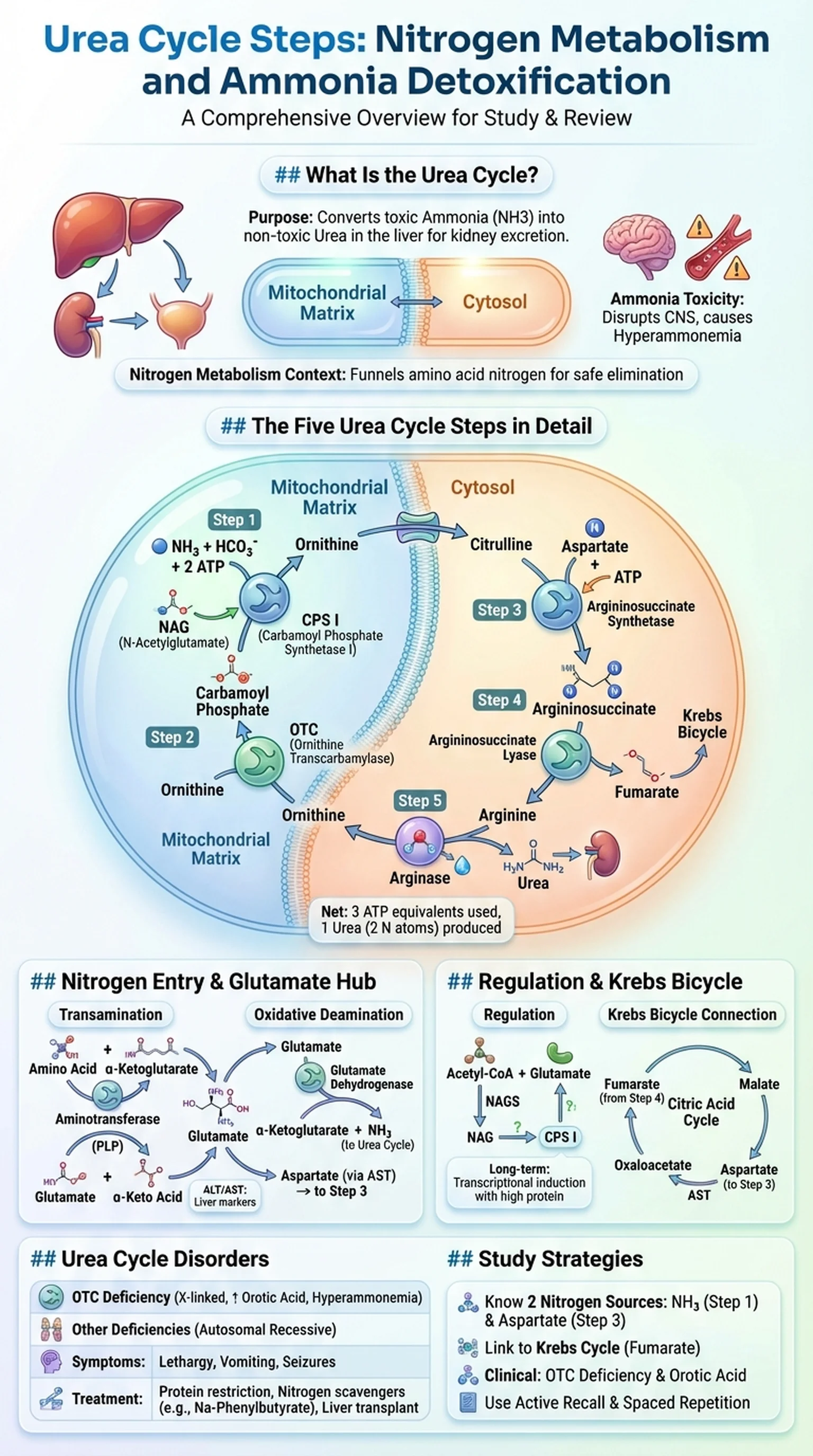
Complete urea cycle pathway illustrating the five urea cycle steps, nitrogen entry points, ATP requirements, and the metabolic link to the citric acid cycle.

Download
Urea cycle diagram showing all five enzymatic steps, mitochondrial and cytosolic compartments, and the connection to the citric acid cycle via fumarate

Interactive Study Short

Swipe through 5 slides about Urea Cycle Steps: Nitrogen Metabolism and Ammonia Detoxification

1 / 5

What Is the Urea Cycle?

The urea cycle is a metabolic pathway that converts toxic ammonia into urea, a water-soluble and relatively non-toxic molecule that is excreted by the kidneys in urine. Also known as the ornithine cycle, it was the first cyclic metabolic pathway to be discovered, described by Hans Krebs and Kurt Henseleit in 1932. The urea cycle takes place primarily in the liver, with the first two reactions occurring in the mitochondrial matrix and the remaining three reactions occurring in the cytosol of hepatocytes.

The urea cycle is essential for ammonia detoxification in humans and other ureotelic organisms. Ammonia is produced continuously through the normal catabolism of amino acids, which occurs when proteins are broken down for energy or when excess dietary amino acids are deaminated. Free ammonia is extremely toxic to the central nervous system because it disrupts the glutamate-glutamine balance in astrocytes, depletes alpha-ketoglutarate from the citric acid cycle, and impairs oxidative energy metabolism in neurons. Even modest elevations in blood ammonia can cause confusion, lethargy, and cerebral edema, while severe hyperammonemia can be fatal.

Nitrogen metabolism is the broader biochemical context in which the urea cycle operates. When amino acids are catabolized, their amino groups must be safely collected, transported, and eliminated. The processes of transamination and oxidative deamination funnel nitrogen from various amino acids into glutamate and then into ammonia or aspartate, the two nitrogen donors of the urea cycle. Each molecule of urea contains two nitrogen atoms: one derived from free ammonia and one from aspartate. Understanding the urea cycle is therefore foundational for students studying nitrogen metabolism, amino acid catabolism, and the clinical consequences of metabolic liver disease.

Key Terms

Urea Cycle

A cyclic metabolic pathway in the liver that converts toxic ammonia and aspartate-derived nitrogen into urea for excretion by the kidneys.

Ammonia Detoxification

The biological process of converting toxic free ammonia (NH3/NH4+) into the non-toxic, water-soluble waste product urea through the urea cycle.

Nitrogen Metabolism

The collective biochemical processes involved in the assimilation, interconversion, and elimination of nitrogen-containing compounds, including amino acid catabolism and the urea cycle.

Hyperammonemia

An abnormally elevated concentration of ammonia in the blood, often caused by urea cycle defects or liver failure, leading to neurological dysfunction.

The Five Urea Cycle Steps in Detail

The urea cycle consists of five enzymatic reactions that sequentially assemble a urea molecule from ammonia, carbon dioxide, and the amino group of aspartate. Understanding each of the urea cycle steps is critical for biochemistry examinations. Here is a detailed walkthrough of the complete pathway.

Step 1: Carbamoyl Phosphate Synthesis. In the mitochondrial matrix, carbamoyl phosphate synthetase I (CPS I) condenses free ammonia with bicarbonate (HCO3-), consuming two molecules of ATP, to form carbamoyl phosphate. This is the rate-limiting step of the urea cycle and is allosterically activated by N-acetylglutamate (NAG). Step 2: Citrulline Formation. Ornithine transcarbamylase (OTC) transfers the carbamoyl group from carbamoyl phosphate to ornithine, producing citrulline. Citrulline is then transported from the mitochondrial matrix to the cytosol via a specific transporter.

Step 3: Argininosuccinate Synthesis. In the cytosol, argininosuccinate synthetase condenses citrulline with aspartate in an ATP-dependent reaction to form argininosuccinate. This step introduces the second nitrogen atom into the urea cycle, sourced from the amino group of aspartate. Step 4: Argininosuccinate Cleavage. Argininosuccinate lyase cleaves argininosuccinate into arginine and fumarate. The fumarate produced links the urea cycle to the citric acid cycle, as fumarate can be hydrated to malate and then oxidized to oxaloacetate, which can undergo transamination to regenerate aspartate.

Step 5: Urea Release. Arginase hydrolyzes arginine to produce urea and ornithine. Urea is released into the blood, transported to the kidneys, and excreted in urine. Ornithine is recycled back into the mitochondrial matrix to begin another turn of the cycle. These five urea cycle steps consume a total of three ATP equivalents (two in step 1 and one in step 3, though the ATP in step 3 is cleaved to AMP and pyrophosphate, equivalent to two ATP) and produce one molecule of urea containing two nitrogen atoms.

Key Terms

Carbamoyl Phosphate Synthetase I (CPS I)

The mitochondrial enzyme that catalyzes the rate-limiting first step of the urea cycle, condensing ammonia and bicarbonate into carbamoyl phosphate.

Ornithine Transcarbamylase (OTC)

The mitochondrial enzyme that transfers a carbamoyl group from carbamoyl phosphate to ornithine to form citrulline in the second urea cycle step.

Argininosuccinate

An intermediate of the urea cycle formed by the condensation of citrulline and aspartate, linking the cycle's two nitrogen sources.

Arginase

The cytosolic enzyme that hydrolyzes arginine to yield urea and ornithine in the final step of the urea cycle.

N-Acetylglutamate (NAG)

An obligatory allosteric activator of CPS I, synthesized from acetyl-CoA and glutamate by N-acetylglutamate synthase.

Nitrogen Entry: Transamination, Deamination, and the Glutamate Hub

Before nitrogen can enter the urea cycle, it must first be collected from the diverse pool of amino acids undergoing catabolism. Nitrogen metabolism in the liver relies on two principal mechanisms to funnel amino acid nitrogen toward the urea cycle: transamination and oxidative deamination. These interconnected processes converge on glutamate as the central nitrogen-collecting molecule.

Transsamination reactions are catalyzed by aminotransferases (also called transaminases), which transfer an amino group from an amino acid to an alpha-keto acid, typically alpha-ketoglutarate. This produces glutamate and the corresponding keto acid of the original amino acid. For example, alanine aminotransferase (ALT) converts alanine and alpha-ketoglutarate to pyruvate and glutamate, while aspartate aminotransferase (AST) converts aspartate and alpha-ketoglutarate to oxaloacetate and glutamate. These enzymes require pyridoxal phosphate (PLP), the active form of vitamin B6, as a cofactor. Elevated serum ALT and AST levels are classic clinical markers of liver damage because hepatocyte destruction releases these enzymes into the blood.

Once nitrogen has been funneled into glutamate, it can enter the urea cycle through two routes. First, glutamate dehydrogenase in the mitochondrial matrix can oxidatively deaminate glutamate to alpha-ketoglutarate and free ammonia (NH4+), which feeds directly into the CPS I reaction. Second, glutamate can donate its amino group to oxaloacetate via AST to generate aspartate, which enters the urea cycle at step 3 (argininosuccinate synthesis). This dual routing ensures that both nitrogen atoms of urea are efficiently supplied. The glucose-alanine cycle further illustrates the integration of nitrogen metabolism with the urea cycle: muscle tissue transaminates pyruvate to alanine, which travels via the blood to the liver, where it is reconverted to pyruvate (for gluconeogenesis) and glutamate (for ammonia detoxification through the urea cycle).

Key Terms

Transamination

The transfer of an amino group from an amino acid to an alpha-keto acid, catalyzed by aminotransferases using PLP as a cofactor.

Glutamate Dehydrogenase

A mitochondrial enzyme that oxidatively deaminates glutamate to alpha-ketoglutarate and NH4+, providing free ammonia for the urea cycle.

Alanine Aminotransferase (ALT)

An aminotransferase that converts alanine and alpha-ketoglutarate to pyruvate and glutamate; elevated serum ALT is a marker of liver injury.

Pyridoxal Phosphate (PLP)

The active coenzyme form of vitamin B6, essential for transamination reactions that funnel nitrogen toward the urea cycle.

Regulation of the Urea Cycle

The urea cycle is regulated at multiple levels to ensure that ammonia detoxification keeps pace with nitrogen load while minimizing unnecessary energy expenditure. Regulation occurs through allosteric control, substrate availability, transcriptional induction, and cross-pathway signaling between the urea cycle and the citric acid cycle.

The most important short-term regulatory mechanism is the allosteric activation of CPS I by N-acetylglutamate (NAG). NAG is synthesized by N-acetylglutamate synthase (NAGS) from acetyl-CoA and glutamate, and its production is stimulated by arginine. When protein intake is high and amino acid catabolism increases, glutamate levels rise, NAGS activity increases, NAG accumulates, and CPS I is activated, accelerating flux through the urea cycle steps. Conversely, when protein intake is low, NAG levels fall and the cycle slows down. This elegant feedback system ensures that the rate of ammonia detoxification is matched to the rate of amino acid breakdown.

Long-term regulation involves transcriptional induction of all five urea cycle enzymes. A high-protein diet or prolonged fasting (which promotes muscle protein catabolism) leads to increased expression of CPS I, OTC, argininosuccinate synthetase, argininosuccinate lyase, and arginase in the liver. This upregulation takes hours to days and allows the liver to increase its capacity for nitrogen metabolism in response to sustained increases in nitrogen load.

The connection between the urea cycle and the citric acid cycle, sometimes called the Krebs bicycle, provides additional regulatory integration. Fumarate produced in step 4 of the urea cycle enters the citric acid cycle, where it is converted to oxaloacetate. Oxaloacetate can then be transaminated to regenerate aspartate, which re-enters the urea cycle at step 3. This metabolic link means that the activity of one cycle influences the other, and disruptions in either pathway can have cascading effects on both energy production and ammonia detoxification.

Key Terms

N-Acetylglutamate Synthase (NAGS)

The enzyme that synthesizes N-acetylglutamate, the obligatory activator of CPS I, from acetyl-CoA and glutamate.

Allosteric Activation

Regulation of enzyme activity through binding of an activator at a site other than the active site, increasing catalytic efficiency.

Krebs Bicycle

The metabolic interconnection between the urea cycle and the citric acid cycle, linked through fumarate and aspartate interconversion.

Transcriptional Induction

Increased gene expression of urea cycle enzymes in response to high protein intake or sustained nitrogen load, enhancing the liver's detoxification capacity.

Urea Cycle Disorders: Causes, Symptoms, and Treatment

Urea cycle disorders (UCDs) are a group of inherited metabolic diseases caused by deficiency of one of the five enzymes of the urea cycle or of the N-acetylglutamate synthase that produces the essential CPS I activator. These disorders impair ammonia detoxification, leading to the accumulation of ammonia and other nitrogen-containing intermediates in the blood. Urea cycle disorders have a combined incidence of approximately 1 in 30,000 live births and represent some of the most serious inborn errors of nitrogen metabolism.

Ornithine transcarbamylase (OTC) deficiency is the most common urea cycle disorder and is inherited in an X-linked recessive pattern, making it more severe in hemizygous males. Affected males typically present in the neonatal period with severe hyperammonemia, lethargy, vomiting, seizures, and cerebral edema that can be fatal without emergency treatment. Heterozygous females may be asymptomatic or may present with episodic hyperammonemia triggered by illness or high-protein meals. Other urea cycle disorders, including CPS I deficiency, citrullinemia (argininosuccinate synthetase deficiency), argininosuccinic aciduria (argininosuccinate lyase deficiency), and arginase deficiency, follow autosomal recessive inheritance and present with varying degrees of hyperammonemia.

Diagnosis of urea cycle disorders relies on plasma amino acid analysis and urine orotic acid measurement. In OTC deficiency, orotic acid is elevated because accumulated carbamoyl phosphate is diverted into the pyrimidine synthesis pathway. Treatment of urea cycle disorders is multifaceted: dietary protein restriction limits nitrogen load; nitrogen scavenger drugs such as sodium benzoate and sodium phenylbutyrate provide alternative pathways for nitrogen excretion; arginine or citrulline supplementation helps maintain urea cycle flux; and in severe cases, liver transplantation can be curative. Early diagnosis and aggressive management of these urea cycle disorders have significantly improved survival rates, though long-term neurodevelopmental outcomes remain a concern.

Key Terms

Urea Cycle Disorders

A group of inherited metabolic diseases caused by enzyme deficiencies in the urea cycle, resulting in impaired ammonia detoxification and hyperammonemia.

OTC Deficiency

The most common urea cycle disorder, caused by X-linked deficiency of ornithine transcarbamylase, leading to hyperammonemia and elevated urinary orotic acid.

Orotic Acid

A pyrimidine synthesis intermediate that accumulates in the urine when excess carbamoyl phosphate is shunted into the pyrimidine pathway, as occurs in OTC deficiency.

Sodium Phenylbutyrate

A nitrogen scavenger drug used to treat urea cycle disorders by conjugating with glutamine and providing an alternative route for nitrogen excretion.

Study Strategies for the Urea Cycle

The urea cycle is a high-yield topic on the MCAT, USMLE Step 1, and medical school biochemistry exams. Questions frequently test your knowledge of individual urea cycle steps, the sources of the two nitrogen atoms in urea, the connection between the urea cycle and the citric acid cycle, and the clinical presentation of urea cycle disorders. Here are proven strategies for mastering this material.

First, learn the five urea cycle steps as a narrative. Begin with ammonia entering CPS I in the mitochondrial matrix and follow the nitrogen through carbamoyl phosphate, citrulline (crossing to the cytosol), argininosuccinate, arginine, and finally urea and ornithine. At each step, identify the enzyme, the substrate, the product, and any energy requirements. Pay special attention to where each nitrogen atom comes from: one from free NH3 (via CPS I) and one from aspartate (via argininosuccinate synthetase). Drawing the cycle by hand and labeling all intermediates is one of the most effective study techniques.

Second, focus on the metabolic connections. The urea cycle does not operate in isolation. Its link to the citric acid cycle through the fumarate-aspartate connection (the Krebs bicycle) is a favorite exam topic. Understand how transamination reactions funnel nitrogen into the cycle and why elevated ALT and AST indicate liver damage. Also learn how ammonia detoxification connects to glutamate metabolism and the glucose-alanine cycle.

Third, master the clinical correlations. For each enzyme deficiency, know the inheritance pattern, the accumulated metabolites, and the distinguishing diagnostic features. OTC deficiency with elevated orotic acid is the single most tested urea cycle disorder on medical licensing exams. Finally, use active recall and spaced repetition to reinforce your knowledge. Platforms like LectureScribe can generate targeted flashcards and quiz questions from your lecture notes on nitrogen metabolism and the urea cycle, helping you build durable long-term memory through repeated retrieval practice.

Key Terms

Active Recall

A study technique in which learners actively retrieve information from memory, strengthening retention more effectively than passive review.

Spaced Repetition

A learning strategy that schedules review sessions at increasing intervals to consolidate knowledge into long-term memory.

MCAT

The Medical College Admission Test, a standardized exam for medical school admission that tests biochemistry topics including the urea cycle and nitrogen metabolism.

Frequently Asked Questions

What is the urea cycle and where does it occur?

The urea cycle is a metabolic pathway in the liver that converts toxic ammonia into urea for excretion. The first two steps occur in the mitochondrial matrix, and the remaining three steps occur in the cytosol of hepatocytes.

What are the five urea cycle steps?

The five urea cycle steps are: (1) carbamoyl phosphate synthesis by CPS I, (2) citrulline formation by ornithine transcarbamylase, (3) argininosuccinate synthesis by argininosuccinate synthetase, (4) argininosuccinate cleavage by argininosuccinate lyase, and (5) urea release by arginase.

Why is ammonia detoxification important?

Ammonia detoxification is critical because free ammonia is highly toxic to the brain. It disrupts the glutamate-glutamine balance in astrocytes, depletes citric acid cycle intermediates, and impairs neuronal energy metabolism. Severe hyperammonemia can cause seizures, coma, and death.

What is the role of nitrogen metabolism in the urea cycle?

Nitrogen metabolism provides the two nitrogen atoms that are incorporated into each urea molecule. One nitrogen comes from free ammonia (generated by oxidative deamination of glutamate) and the other comes from aspartate (generated by transamination of oxaloacetate with glutamate).

What are urea cycle disorders?

Urea cycle disorders are inherited metabolic diseases caused by deficiency of one of the urea cycle enzymes. They result in impaired ammonia detoxification and hyperammonemia. The most common is OTC deficiency, which is X-linked and presents with elevated urinary orotic acid.

What is the rate-limiting step of the urea cycle?

The rate-limiting step is the synthesis of carbamoyl phosphate by carbamoyl phosphate synthetase I (CPS I). This reaction requires two ATP molecules and is allosterically activated by N-acetylglutamate.

How is the urea cycle connected to the citric acid cycle?

The urea cycle is connected to the citric acid cycle through fumarate, which is produced in step 4 of the urea cycle. Fumarate enters the citric acid cycle and is converted to oxaloacetate, which can be transaminated to aspartate, feeding back into the urea cycle. This connection is called the Krebs bicycle.

Study Biochemistry Smarter

Upload your lecture notes and get AI-generated flashcards, quizzes, infographics, and study guides tailored to your curriculum.

Try LectureScribe Free

Create Study Materials

Transform your Biochemistry lectures into flashcards, quizzes, and visual study guides with AI.

  • AI-generated flashcards & quizzes
  • Visual infographics from notes
  • Interactive study shorts
Start Studying Free

Quick Facts

SubjectBiochemistry
Word Count2,500+
Slides5
InfographicIncluded
AuthorLectureScribe

Master Biochemistry with LectureScribe

Upload your lecture notes and get AI-powered flashcards, quizzes, infographics, and study guides in minutes.