LectureScribe Logo
lecturescribe.io

LOCK IN VALENTINE PRICING BEFORE SALE ENDS!

Use code — New joiners get 40% OFF on annual plans

Plans will have higher prices after this sale ends

0days
:
0hours
:
0minutes
:
0seconds
Pharmacology2,500+ words5 slides
💊

Antihypertensive Drugs: Classes, Mechanisms & Clinical Use

Master antihypertensive drugs including ACE inhibitors, beta blockers, and calcium channel blockers. Learn hypertension treatment strategies and drug mechanisms.

L
LectureScribeAI-Powered Study Platform

Study Infographic

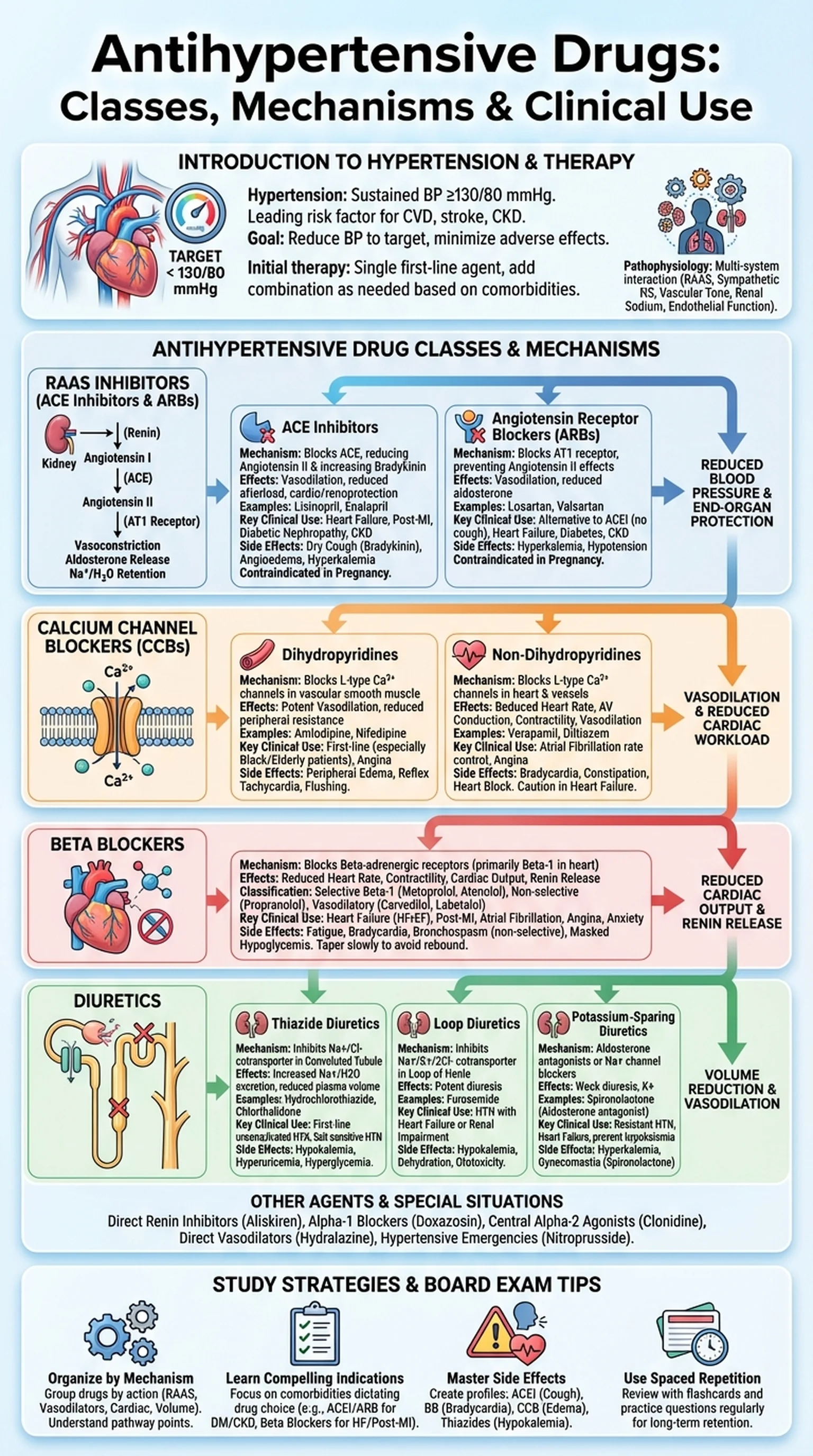
Comprehensive diagram of antihypertensive drug classes illustrating ACE inhibitors, ARBs, beta blockers, calcium channel blockers, and diuretics with their mechanisms of action and clinical indications.

Download
Antihypertensive drugs diagram showing ACE inhibitors, beta blockers, calcium channel blockers, and diuretics with their mechanisms and sites of action

Interactive Study Short

Swipe through 5 slides about Antihypertensive Drugs: Classes, Mechanisms & Clinical Use

1 / 5

Introduction to Hypertension and Antihypertensive Therapy

Hypertension, defined as a sustained systolic blood pressure of 130 mmHg or greater or a diastolic blood pressure of 80 mmHg or greater according to current ACC/AHA guidelines, affects approximately one in three adults worldwide and is the single largest modifiable risk factor for cardiovascular disease, stroke, and chronic kidney disease. Hypertension treatment is therefore a central focus of clinical medicine, and antihypertensive drugs represent one of the most commonly prescribed drug categories globally.

The pathophysiology of hypertension involves multiple interacting systems, including the renin-angiotensin-aldosterone system (RAAS), the sympathetic nervous system, vascular smooth muscle tone, renal sodium handling, and endothelial function. Antihypertensive drugs target these pathways at various points to lower blood pressure and reduce end-organ damage. The major classes of antihypertensive drugs include ACE inhibitors, angiotensin receptor blockers, calcium channel blockers, beta blockers, and diuretics, each with distinct mechanisms of action and clinical indications.

The goal of hypertension treatment is to reduce blood pressure to target levels while minimizing adverse effects and maximizing adherence. Current guidelines recommend a target of less than 130/80 mmHg for most adults with hypertension. Initial therapy typically involves a single first-line agent, with combination therapy added as needed to achieve blood pressure control. The choice of antihypertensive drug depends on the patient's age, race, comorbidities, and the presence of compelling indications such as heart failure, diabetes, or chronic kidney disease that favor certain drug classes over others.

Key Terms

Antihypertensive Drugs

Medications used to lower blood pressure and reduce the cardiovascular complications of hypertension, including ACE inhibitors, ARBs, CCBs, beta blockers, and diuretics.

Hypertension

A chronic condition defined by sustained elevated blood pressure (>=130/80 mmHg); the leading modifiable risk factor for cardiovascular disease.

Renin-Angiotensin-Aldosterone System (RAAS)

A hormonal cascade that regulates blood pressure and fluid balance through angiotensin II and aldosterone; the target of ACE inhibitors and ARBs.

End-Organ Damage

Damage to the heart, brain, kidneys, and vasculature caused by chronic uncontrolled hypertension.

ACE Inhibitors and Angiotensin Receptor Blockers

ACE inhibitors are among the most widely prescribed antihypertensive drugs and work by blocking angiotensin-converting enzyme, the enzyme responsible for converting angiotensin I to angiotensin II. Angiotensin II is a potent vasoconstrictor that also stimulates aldosterone secretion, promotes sodium and water retention, and drives cardiac and vascular remodeling. By inhibiting its production, ACE inhibitors lower blood pressure, reduce afterload, and provide cardioprotective and renoprotective benefits.

Common ACE inhibitors include lisinopril, enalapril, ramipril, and captopril. These drugs are first-line antihypertensive agents and have compelling indications in heart failure with reduced ejection fraction, post-myocardial infarction, diabetic nephropathy, and chronic kidney disease with proteinuria. ACE inhibitors also inhibit the degradation of bradykinin, a vasodilatory peptide, which contributes to their blood pressure-lowering effect but is also responsible for the most common side effect: a persistent dry cough that occurs in up to 15 percent of patients. Angioedema, though rare, is a potentially life-threatening adverse effect. ACE inhibitors are contraindicated in pregnancy due to teratogenic effects on fetal renal development.

Angiotensin receptor blockers (ARBs) such as losartan, valsartan, and irbesartan provide an alternative for patients who cannot tolerate ACE inhibitors. ARBs block the angiotensin II type 1 (AT1) receptor directly, preventing the vasoconstrictor and aldosterone-stimulating effects of angiotensin II without affecting bradykinin metabolism. As a result, ARBs produce a similar antihypertensive effect with a significantly lower incidence of cough. Both ACE inhibitors and ARBs are key components of hypertension treatment guidelines and are particularly valuable in patients with diabetes, heart failure, or renal disease where RAAS inhibition confers benefits beyond blood pressure reduction alone.

Key Terms

ACE Inhibitors

Antihypertensive drugs that block angiotensin-converting enzyme, reducing angiotensin II production and lowering blood pressure while providing cardio- and renoprotection.

Angiotensin II

A potent vasoconstrictor peptide that also stimulates aldosterone release; the primary effector molecule of the RAAS targeted by ACE inhibitors and ARBs.

Angiotensin Receptor Blocker (ARB)

An antihypertensive drug that blocks the AT1 receptor, preventing angiotensin II from exerting its vasoconstrictive and aldosterone-stimulating effects.

Bradykinin

A vasodilatory peptide degraded by ACE; its accumulation due to ACE inhibition contributes to blood pressure lowering and the characteristic dry cough.

Calcium Channel Blockers: Dihydropyridines and Non-Dihydropyridines

Calcium channel blockers (CCBs) are a major class of antihypertensive drugs that lower blood pressure by blocking voltage-gated L-type calcium channels in vascular smooth muscle and cardiac tissue. By preventing calcium influx, these drugs cause relaxation of vascular smooth muscle, leading to vasodilation and a reduction in peripheral vascular resistance. Calcium channel blockers are effective as monotherapy and are recommended as first-line hypertension treatment in many guidelines, particularly in Black patients and elderly patients where RAAS inhibitors may be less effective.

Calcium channel blockers are divided into two subclasses with important clinical differences: dihydropyridines and non-dihydropyridines. Dihydropyridines such as amlodipine, nifedipine, and felodipine act primarily on vascular smooth muscle, producing potent vasodilation with minimal effects on cardiac conduction. They are first-line antihypertensive agents and are also used for the treatment of Raynaud phenomenon and stable angina. Amlodipine, with its long half-life and once-daily dosing, is one of the most commonly prescribed antihypertensive drugs worldwide. Reflex tachycardia, peripheral edema, and flushing are common side effects of dihydropyridine calcium channel blockers.

Non-dihydropyridine calcium channel blockers, including verapamil and diltiazem, have significant effects on both vascular smooth muscle and cardiac tissue. They reduce heart rate, slow atrioventricular conduction, and decrease myocardial contractility in addition to their vasodilatory effects. These properties make them useful for rate control in atrial fibrillation and for angina in patients who cannot tolerate beta blockers. However, non-dihydropyridines should be used with caution in patients with heart failure due to their negative inotropic effects, and they should not be combined with beta blockers in most cases because of the risk of severe bradycardia and heart block. The versatility of calcium channel blockers across different clinical scenarios makes them indispensable in hypertension treatment.

Key Terms

Calcium Channel Blockers

Antihypertensive drugs that block L-type calcium channels in vascular smooth muscle and cardiac tissue, causing vasodilation and reducing blood pressure.

Dihydropyridine

A subclass of calcium channel blockers (e.g., amlodipine, nifedipine) that primarily causes vascular smooth muscle relaxation with minimal cardiac effects.

Non-Dihydropyridine

A subclass of calcium channel blockers (verapamil, diltiazem) that reduces heart rate and AV conduction in addition to vasodilation.

Reflex Tachycardia

A compensatory increase in heart rate triggered by vasodilation-induced drop in blood pressure, commonly seen with dihydropyridine CCBs.

Beta Blockers in Hypertension Management

Beta blockers are a class of antihypertensive drugs that antagonize beta-adrenergic receptors, primarily beta-1 receptors in the heart. By blocking the effects of catecholamines on the heart, beta blockers reduce heart rate, myocardial contractility, and cardiac output, all of which contribute to blood pressure reduction. Additionally, beta blockers suppress renin release from the juxtaglomerular cells of the kidney, which indirectly reduces angiotensin II and aldosterone levels and contributes to their antihypertensive effect.

Beta blockers are classified into non-selective agents (propranolol, nadolol), selective beta-1 agents (metoprolol, atenolol, bisoprolol), and agents with additional vasodilatory properties (carvedilol, labetalol, nebivolol). Selective beta-1 blockers are preferred in patients with asthma or peripheral vascular disease because they are less likely to cause bronchospasm or peripheral vasoconstriction mediated by beta-2 receptor blockade. Carvedilol and labetalol block both beta and alpha-1 adrenergic receptors, providing additional vasodilation that enhances their antihypertensive effect and makes them particularly useful in heart failure and hypertensive emergencies.

While beta blockers were historically considered first-line antihypertensive drugs, recent meta-analyses and updated guidelines have repositioned them as add-on therapy in uncomplicated hypertension, with ACE inhibitors, ARBs, calcium channel blockers, and thiazide diuretics preferred as initial agents. However, beta blockers retain compelling indications in patients with heart failure with reduced ejection fraction, post-myocardial infarction, rate control in atrial fibrillation, and certain anxiety disorders. Common adverse effects include fatigue, bradycardia, cold extremities, sexual dysfunction, and masking of hypoglycemia in diabetic patients. Abrupt discontinuation of beta blockers can cause rebound hypertension and tachycardia, so these agents should always be tapered gradually as part of any change in hypertension treatment.

Key Terms

Beta Blockers

Antihypertensive drugs that block beta-adrenergic receptors on the heart, reducing heart rate, contractility, and renin release to lower blood pressure.

Selective Beta-1 Blocker

A beta blocker that preferentially blocks cardiac beta-1 receptors, reducing the risk of bronchospasm compared to non-selective agents.

Carvedilol

A non-selective beta blocker with alpha-1 blocking properties used in heart failure and hypertension for combined cardiac and vasodilatory effects.

Renin Suppression

The reduction of renin release from juxtaglomerular cells caused by beta-1 receptor blockade, contributing to the antihypertensive effect of beta blockers.

Diuretics and Other Antihypertensive Agents

Diuretics are among the oldest and most cost-effective antihypertensive drugs available. They lower blood pressure primarily by promoting renal sodium and water excretion, which reduces plasma volume and subsequently decreases cardiac output and peripheral vascular resistance. Three major classes of diuretics are used in hypertension treatment: thiazides, loop diuretics, and potassium-sparing diuretics, each acting on different segments of the nephron.

Thiazide diuretics, including hydrochlorothiazide and chlorthalidone, inhibit the sodium-chloride cotransporter in the distal convoluted tubule and are recommended as first-line antihypertensive agents. They are particularly effective in salt-sensitive hypertension and in Black patients. Chlorthalidone has a longer half-life and stronger evidence base than hydrochlorothiazide and is increasingly preferred in clinical practice. Loop diuretics such as furosemide act on the thick ascending limb of Henle and are used for hypertension primarily in patients with heart failure or significant renal impairment. Potassium-sparing diuretics include aldosterone receptor antagonists (spironolactone, eplerenone) and epithelial sodium channel blockers (amiloride, triamterene); spironolactone is particularly effective in resistant hypertension.

Beyond the four major classes of antihypertensive drugs, additional agents are available for refractory or special cases. Direct renin inhibitors such as aliskiren block the RAAS at its first step. Centrally acting alpha-2 agonists like clonidine and methyldopa reduce sympathetic outflow from the brainstem. Alpha-1 blockers like doxazosin produce vasodilation but are not first-line due to increased heart failure risk. Direct vasodilators such as hydralazine and minoxidil are reserved for resistant hypertension treatment. Nitroprusside, an intravenous vasodilator, is used in hypertensive emergencies where rapid blood pressure reduction is critical. The breadth of available antihypertensive drugs allows clinicians to tailor hypertension treatment to each patient's specific pathophysiology and comorbidities.

Key Terms

Thiazide Diuretic

A diuretic that inhibits sodium reabsorption in the distal convoluted tubule, used as first-line antihypertensive therapy.

Spironolactone

An aldosterone receptor antagonist used as a potassium-sparing diuretic, particularly effective in resistant hypertension.

Hypertension Treatment

The pharmacological and lifestyle management of elevated blood pressure, typically targeting less than 130/80 mmHg to reduce cardiovascular risk.

Resistant Hypertension

Blood pressure that remains above goal despite concurrent use of three antihypertensive drugs at optimal doses, including a diuretic.

Direct Vasodilator

An antihypertensive drug that relaxes vascular smooth muscle directly, lowering peripheral resistance; examples include hydralazine and minoxidil.

Study Strategies for Antihypertensive Pharmacology

Antihypertensive pharmacology is one of the most commonly tested topics in medical and pharmacy board examinations, including the USMLE Step 1, Step 2 CK, and NAPLEX. Questions frequently test your ability to select appropriate antihypertensive drugs based on patient characteristics, identify mechanisms of action, and predict adverse effects. A systematic study approach is essential for mastering this complex but high-yield material.

First, organize the antihypertensive drug classes by mechanism of action. Group ACE inhibitors and ARBs together as RAAS inhibitors, calcium channel blockers as vascular smooth muscle relaxants, beta blockers as cardiac output reducers, and diuretics as volume reducers. Understand where each class acts in the blood pressure regulation pathway and how they complement one another in combination therapy. This mechanistic framework makes it straightforward to predict both therapeutic effects and adverse effects.

Second, learn the compelling indications that favor one drug class over another. ACE inhibitors are preferred in diabetes with proteinuria, heart failure, and post-MI. Beta blockers are preferred in heart failure with reduced ejection fraction and post-MI. Calcium channel blockers are first-line in Black patients and the elderly. Thiazide diuretics are first-line in uncomplicated hypertension. These clinical pearls are tested repeatedly and form the decision-making backbone of hypertension treatment questions on board exams.

Third, create side-effect profiles for each class. ACE inhibitors cause cough and angioedema. Beta blockers cause fatigue and bradycardia. Calcium channel blockers cause edema and reflex tachycardia. Thiazides cause hypokalemia and hyperuricemia. Finally, use platforms like LectureScribe to convert your lecture notes into flashcards, slide decks, and practice questions, testing yourself with spaced repetition to build lasting knowledge of antihypertensive drugs and their clinical applications.

Key Terms

Compelling Indication

A comorbid condition such as heart failure or diabetes that favors the use of a specific antihypertensive drug class based on evidence of outcome benefit.

Combination Therapy

The use of two or more antihypertensive drugs with complementary mechanisms to achieve blood pressure targets when monotherapy is insufficient.

Spaced Repetition

A learning strategy that involves reviewing material at increasing intervals to strengthen long-term memory retention.

Frequently Asked Questions

What are the main classes of antihypertensive drugs?

The main classes of antihypertensive drugs are ACE inhibitors, angiotensin receptor blockers (ARBs), calcium channel blockers, beta blockers, and diuretics (thiazide, loop, and potassium-sparing). Additional classes include direct renin inhibitors, central alpha-2 agonists, alpha-1 blockers, and direct vasodilators.

How do ACE inhibitors lower blood pressure?

ACE inhibitors lower blood pressure by blocking angiotensin-converting enzyme, which prevents the conversion of angiotensin I to angiotensin II. This reduces vasoconstriction, decreases aldosterone secretion, lowers sodium and water retention, and increases bradykinin levels, all contributing to blood pressure reduction.

What are calcium channel blockers and how do they work?

Calcium channel blockers are antihypertensive drugs that block L-type calcium channels in vascular smooth muscle and cardiac tissue. Dihydropyridines like amlodipine primarily cause vasodilation, while non-dihydropyridines like verapamil and diltiazem also reduce heart rate and cardiac conduction.

When are beta blockers indicated for hypertension?

Beta blockers are indicated for hypertension when patients have compelling indications such as heart failure with reduced ejection fraction, post-myocardial infarction, rate control in atrial fibrillation, or certain anxiety disorders. They are no longer first-line for uncomplicated hypertension in most current guidelines.

What is the first-line treatment for hypertension?

First-line hypertension treatment typically includes thiazide diuretics, ACE inhibitors, ARBs, or calcium channel blockers, depending on the patient's age, race, and comorbidities. Lifestyle modifications including sodium restriction, weight loss, exercise, and dietary changes are also essential components of treatment.

What are the side effects of ACE inhibitors?

Common side effects of ACE inhibitors include a persistent dry cough (due to bradykinin accumulation), hyperkalemia, angioedema (rare but potentially life-threatening), hypotension, and impaired renal function. They are contraindicated in pregnancy due to teratogenic effects on fetal kidney development.

How is resistant hypertension treated?

Resistant hypertension, defined as blood pressure remaining above goal despite three optimally dosed antihypertensive drugs including a diuretic, is often treated by adding spironolactone as a fourth agent. Evaluation for secondary causes and ensuring medication adherence are also essential steps in managing resistant hypertension treatment.

Study Pharmacology Smarter

Upload your lecture notes and get AI-generated flashcards, quizzes, infographics, and study guides tailored to your curriculum.

Try LectureScribe Free

Create Study Materials

Transform your Pharmacology lectures into flashcards, quizzes, and visual study guides with AI.

  • AI-generated flashcards & quizzes
  • Visual infographics from notes
  • Interactive study shorts
Start Studying Free

Quick Facts

SubjectPharmacology
Word Count2,500+
Slides5
InfographicIncluded
AuthorLectureScribe

Master Pharmacology with LectureScribe

Upload your lecture notes and get AI-powered flashcards, quizzes, infographics, and study guides in minutes.