LectureScribe Logo
lecturescribe.io

LOCK IN VALENTINE PRICING BEFORE SALE ENDS!

Use code — New joiners get 40% OFF on annual plans

Plans will have higher prices after this sale ends

0days
:
0hours
:
0minutes
:
0seconds
Biology2,500+ words5 slides
🧬

Lac Operon: Gene Regulation in Prokaryotes Explained

Master the lac operon and gene regulation in prokaryotes. Understand the operon model, inducible operon mechanisms, and how prokaryotic gene regulation controls gene expression.

L
LectureScribeAI-Powered Study Platform

Study Infographic

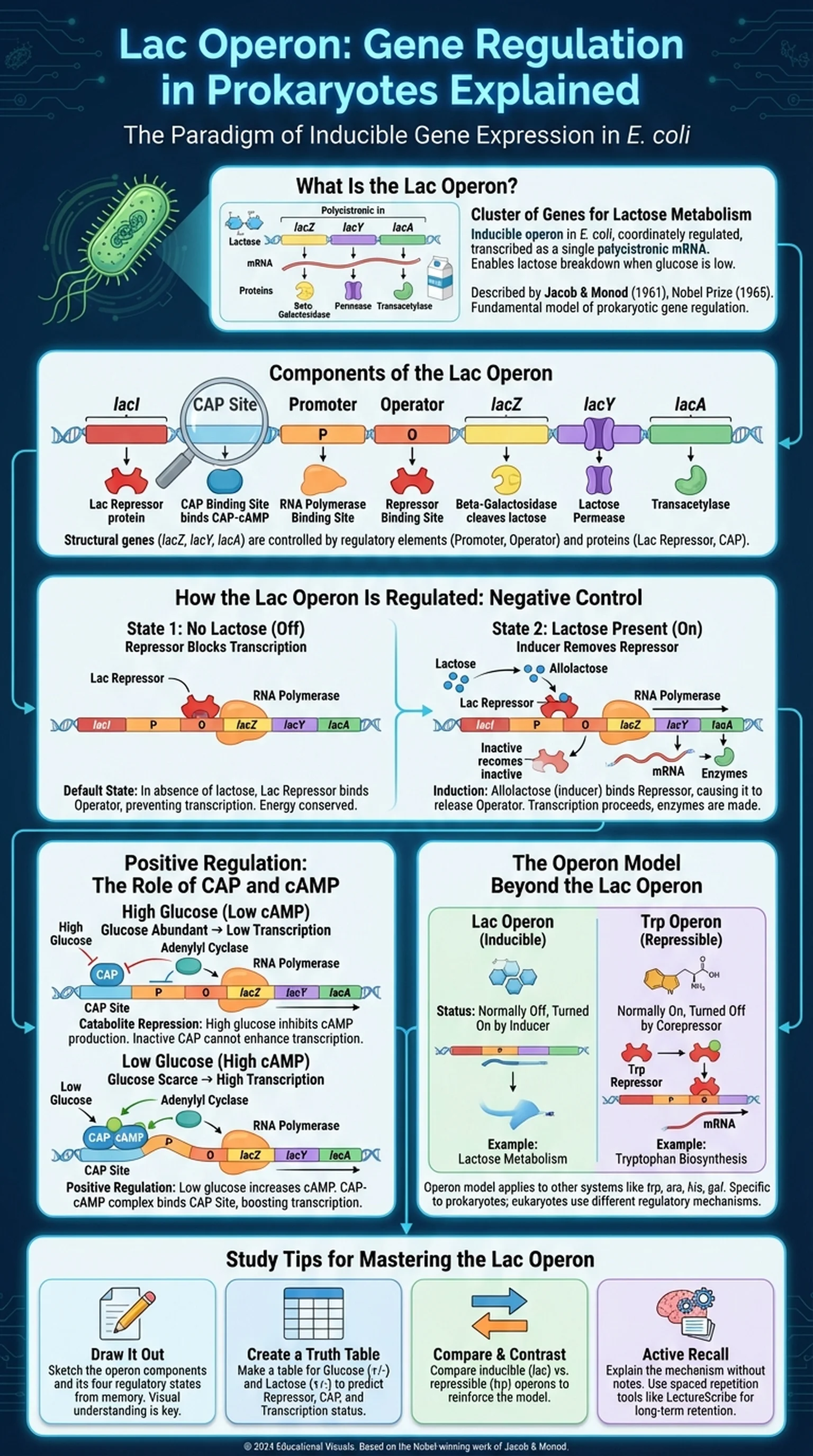
Complete lac operon diagram illustrating gene regulation through negative control by the lac repressor and positive control by the CAP-cAMP complex.

Download
Lac operon diagram showing the promoter, operator, structural genes lacZ lacY lacA, lac repressor, CAP binding site, and the four regulatory states

Interactive Study Short

Swipe through 5 slides about Lac Operon: Gene Regulation in Prokaryotes Explained

1 / 5

What Is the Lac Operon?

The lac operon is a cluster of genes in Escherichia coli (E. coli) that are coordinately regulated and transcribed as a single polycistronic mRNA molecule. It was the first genetic regulatory system to be fully characterized at the molecular level, making it one of the most important models in the history of molecular biology. The lac operon was described by French scientists Francois Jacob and Jacques Monod in 1961, work for which they shared the Nobel Prize in Physiology or Medicine in 1965. Their discoveries laid the groundwork for our modern understanding of gene regulation in both prokaryotic and eukaryotic organisms.

The lac operon encodes three structural genes involved in the metabolism of lactose, a disaccharide sugar found in milk. These genes are lacZ, which encodes beta-galactosidase (the enzyme that cleaves lactose into glucose and galactose), lacY, which encodes lactose permease (a membrane transporter that brings lactose into the cell), and lacA, which encodes transacetylase. Together, these proteins enable E. coli to import and break down lactose as an energy source when glucose, the preferred carbon source, is unavailable.

The lac operon is the classic example of an inducible operon, meaning its genes are normally turned off and are switched on only when the inducer molecule (allolactose, a metabolite of lactose) is present. This stands in contrast to repressible operons, which are normally on and are switched off by a corepressor. Understanding the lac operon provides a gateway to broader concepts of prokaryotic gene regulation and the operon model, both of which are fundamental topics in genetics and molecular biology courses.

Key Terms

Lac Operon

A cluster of three structural genes (lacZ, lacY, lacA) in E. coli, along with regulatory elements, that are coordinately controlled for lactose metabolism.

Inducible Operon

An operon whose genes are normally off and are activated only in the presence of a specific inducer molecule.

Operon Model

The concept that functionally related prokaryotic genes are organized in clusters under common regulatory control, transcribed as a single mRNA.

Polycistronic mRNA

A single mRNA molecule that encodes multiple proteins, characteristic of prokaryotic operons.

Components of the Lac Operon

To understand how the lac operon functions, it is essential to know the roles of its individual components. The operon model consists of both structural genes and regulatory elements that work together to control gene expression in response to environmental signals.

The three structural genes of the lac operon are transcribed together as a single mRNA. LacZ encodes beta-galactosidase, the key metabolic enzyme that hydrolyzes lactose into glucose and galactose. LacY encodes lactose permease, an integral membrane protein that actively transports lactose into the bacterial cell. LacA encodes thiogalactoside transacetylase, whose role in lactose metabolism is less well understood but may be involved in detoxifying non-metabolizable galactosides.

Upstream of the structural genes lie the critical regulatory elements. The promoter is the DNA sequence where RNA polymerase binds to initiate transcription. Immediately downstream of the promoter is the operator, a short DNA sequence that serves as the binding site for the lac repressor protein. When the repressor is bound to the operator, it physically blocks RNA polymerase from transcribing the structural genes. The lac repressor is encoded by the lacI gene, which is located upstream of the operon and is constitutively expressed at low levels.

Another important regulatory element is the CAP binding site (also called the CRP site), located upstream of the promoter. CAP (catabolite activator protein) is a positive regulator that enhances transcription of the lac operon when bound to cyclic AMP (cAMP). The interaction between the lac repressor (negative regulation) and CAP (positive regulation) provides the lac operon with a sophisticated dual-control mechanism that integrates information about both lactose availability and glucose levels. This multi-layered regulatory architecture is a hallmark of prokaryotic gene regulation and illustrates why the operon model remains a central teaching framework in biology.

Key Terms

Operator

A short DNA sequence in the operon where the repressor protein binds, blocking transcription of the structural genes.

Lac Repressor

A protein encoded by the lacI gene that binds the operator and prevents transcription of the lac operon in the absence of lactose.

Promoter

The DNA sequence upstream of the structural genes where RNA polymerase binds to initiate transcription.

CAP (Catabolite Activator Protein)

A positive regulatory protein that, when bound to cAMP, enhances transcription of the lac operon by helping RNA polymerase bind the promoter.

Beta-Galactosidase

The enzyme encoded by lacZ that cleaves lactose into glucose and galactose.

How the Lac Operon Is Regulated: Negative Control

The primary mode of gene regulation in the lac operon is negative control, mediated by the lac repressor protein. Understanding this mechanism is essential for mastering prokaryotic gene regulation and the operon model.

In the absence of lactose, the lac repressor protein, produced constitutively by the lacI gene, binds tightly to the operator sequence of the lac operon. When the repressor occupies the operator, RNA polymerase cannot proceed past the promoter to transcribe the structural genes lacZ, lacY, and lacA. As a result, the enzymes for lactose metabolism are not produced, conserving cellular energy. This is the default "off" state of the inducible operon.

When lactose is present in the environment and glucose is absent, a small amount of lactose enters the cell through basal-level expression of the permease and is converted to allolactose by beta-galactosidase. Allolactose acts as the inducer of the lac operon. It binds to the lac repressor and causes a conformational change that reduces the repressor's affinity for the operator DNA. The repressor releases from the operator, clearing the path for RNA polymerase to transcribe the structural genes. The resulting mRNA is translated into beta-galactosidase, permease, and transacetylase, enabling the cell to fully metabolize lactose.

This elegant regulatory mechanism ensures that the lac operon genes are expressed only when their products are needed. The concept of gene regulation through a repressor-operator interaction was a groundbreaking insight that transformed our understanding of how cells control gene expression. The negative control system of the lac operon remains one of the most studied examples of prokaryotic gene regulation and is a staple of genetics and molecular biology curricula.

Students should note that the lac repressor does not degrade or remove lactose. Its sole function is to act as a molecular switch: when the inducer (allolactose) is absent, the repressor blocks transcription; when the inducer is present, the repressor is inactivated and transcription proceeds. This binary switching behavior is a defining feature of the inducible operon mechanism.

Key Terms

Negative Control

A regulatory mechanism in which a repressor protein inhibits gene transcription by binding to the operator.

Allolactose

An isomer of lactose that acts as the natural inducer of the lac operon by binding to and inactivating the lac repressor.

Inducer

A molecule that binds to a repressor protein and causes it to release from the operator, allowing transcription to proceed.

Gene Regulation

The processes by which cells control when, where, and how much of a gene's product is made.

Positive Regulation: The Role of CAP and cAMP

While negative control by the lac repressor determines whether the lac operon is off or on, positive regulation by the catabolite activator protein (CAP) determines how strongly the operon is transcribed. This dual-control mechanism allows E. coli to fine-tune gene regulation based on the availability of both lactose and glucose, the bacterium's preferred energy source.

Glucose is the preferred carbon source for E. coli because it can be metabolized more efficiently than lactose. When glucose levels are high, the cell has no need to activate the lac operon, even if lactose is available. This phenomenon, known as catabolite repression (or the glucose effect), is mediated by the CAP-cAMP system. When glucose is abundant, intracellular levels of cyclic AMP (cAMP) are low because glucose inhibits the enzyme adenylyl cyclase, which synthesizes cAMP. Without sufficient cAMP, CAP remains inactive and cannot bind to the CAP binding site upstream of the lac operon promoter.

When glucose levels drop, adenylyl cyclase activity increases and cAMP accumulates in the cell. cAMP binds to CAP, causing a conformational change that enables the CAP-cAMP complex to bind to its specific DNA sequence near the lac operon promoter. The bound CAP-cAMP complex interacts directly with RNA polymerase, increasing the enzyme's affinity for the promoter and dramatically enhancing the rate of transcription. This positive regulation can boost transcription of the lac operon by as much as 50-fold compared to the basal level.

The interplay between negative and positive regulation creates four possible states for the lac operon. When glucose is present and lactose is absent, the operon is off (repressor bound, no CAP activation). When glucose is present and lactose is also present, the operon is expressed at a low basal level (repressor released, but no CAP activation). When glucose is absent and lactose is absent, the operon remains off (repressor bound, CAP active but irrelevant). When glucose is absent and lactose is present, the operon is fully induced (repressor released, CAP-cAMP activating transcription). This logic gate behavior exemplifies the sophistication of prokaryotic gene regulation.

Key Terms

Catabolite Repression

The phenomenon in which the presence of a preferred carbon source (glucose) suppresses the expression of genes for alternative carbon source metabolism.

Cyclic AMP (cAMP)

A second messenger molecule that binds to CAP to form an active complex that enhances lac operon transcription when glucose levels are low.

Adenylyl Cyclase

The enzyme that synthesizes cAMP from ATP; its activity is inhibited when glucose is abundant.

Prokaryotic Gene Regulation

The mechanisms by which prokaryotic cells control gene expression, primarily at the transcriptional level through operons, repressors, and activators.

The Operon Model Beyond the Lac Operon

The operon model established by the study of the lac operon extends to many other gene clusters in prokaryotes. Understanding the broader applications of this model reinforces why the lac operon is considered the paradigm for prokaryotic gene regulation.

The trp operon is the classic example of a repressible operon, contrasting with the inducible lac operon. The trp operon contains five structural genes encoding enzymes for tryptophan biosynthesis. When tryptophan levels are high, tryptophan acts as a corepressor, binding to the trp repressor and enabling it to bind the operator, thereby shutting down transcription. When tryptophan levels are low, the repressor cannot bind the operator, and the biosynthetic genes are transcribed. The trp operon also features attenuation, a regulatory mechanism unique to prokaryotes that modulates transcription based on the rate of translation of a leader peptide.

Other operons in E. coli and related bacteria follow variations of the operon model. The ara operon for arabinose metabolism uses a regulatory protein (AraC) that can act as both an activator and a repressor depending on the presence of arabinose. The his operon for histidine biosynthesis and the gal operon for galactose metabolism also demonstrate how the operon model is adapted for different metabolic needs.

It is important to recognize that the operon model is specific to prokaryotic gene regulation. Eukaryotic cells generally do not organize genes into operons or produce polycistronic mRNAs. Instead, eukaryotic gene regulation relies on individual promoters, enhancers, transcription factors, chromatin remodeling, and post-transcriptional mechanisms. However, the fundamental principles of gene regulation, including the use of activators, repressors, and environmental sensing, were first illuminated through the study of the lac operon and the operon model, making this system an indispensable part of every biology student's education.

Key Terms

Repressible Operon

An operon whose genes are normally transcribed and are turned off when a corepressor molecule binds to the repressor protein.

Trp Operon

A repressible operon in E. coli that controls the biosynthesis of tryptophan, regulated by tryptophan itself as a corepressor.

Attenuation

A regulatory mechanism in prokaryotes that controls gene expression by causing premature termination of transcription based on ribosome positioning.

Corepressor

A small molecule that binds to a repressor protein, activating it so it can bind the operator and inhibit transcription.

Study Tips for Mastering the Lac Operon

The lac operon is one of the most frequently tested topics in AP Biology, the MCAT, and college-level genetics and molecular biology courses. Its combination of molecular detail and regulatory logic makes it both challenging and rewarding to study. Here are strategies for mastering this essential topic.

First, draw the lac operon from memory. Include the lacI gene, the promoter, the operator, the CAP binding site, and the three structural genes (lacZ, lacY, lacA). Label all components and practice sketching what happens in each of the four regulatory states: glucose present/lactose absent, glucose present/lactose present, glucose absent/lactose absent, and glucose absent/lactose present. This exercise builds a visual understanding of gene regulation that is far more durable than text-based memorization.

Second, create a truth table for the lac operon. Along one axis, list glucose status (present or absent); along the other, list lactose status (present or absent). In each cell, note whether the repressor is bound or free, whether CAP-cAMP is active, and whether transcription is off, low, or high. This table is an efficient reference for answering exam questions about the inducible operon.

Third, compare the lac operon (inducible) with the trp operon (repressible). Understanding both systems reinforces the operon model and highlights the versatility of prokaryotic gene regulation. Make a comparison chart listing the inducer or corepressor, the default state (on or off), and the regulatory logic for each operon.

Fourth, practice explaining the lac operon in your own words without looking at notes. If you can clearly articulate how the repressor, inducer, CAP, and cAMP interact, you have a deep understanding of the system. Finally, use active recall and spaced repetition to maintain your knowledge over time. Platforms like LectureScribe can generate flashcards and quiz questions from your notes on the lac operon, ensuring consistent review of this high-yield topic.

Key Terms

Active Recall

A study technique in which learners actively retrieve information from memory rather than passively reviewing notes.

Spaced Repetition

A learning strategy that involves reviewing material at increasing intervals to strengthen long-term memory retention.

MCAT

The Medical College Admission Test; a standardized exam required for admission to medical schools in the United States and Canada.

Frequently Asked Questions

What is the lac operon and what does it do?

The lac operon is a cluster of three structural genes (lacZ, lacY, lacA) in E. coli that encode enzymes for lactose metabolism. It is regulated by a repressor and an activator protein so that the genes are expressed only when lactose is available and glucose is absent.

Why is the lac operon called an inducible operon?

The lac operon is called an inducible operon because its genes are normally turned off and are induced (turned on) only when the inducer molecule allolactose is present. Allolactose binds to the lac repressor, releasing it from the operator and allowing transcription to proceed.

What is the operon model?

The operon model is the concept that functionally related prokaryotic genes are organized into clusters under common regulatory control. An operon includes structural genes, a promoter, an operator, and a regulatory gene. The genes are transcribed together as a single polycistronic mRNA.

How does CAP regulate the lac operon?

CAP (catabolite activator protein) provides positive regulation of the lac operon. When glucose is absent, cAMP levels rise and bind to CAP. The CAP-cAMP complex binds near the promoter and helps RNA polymerase bind more effectively, dramatically increasing transcription rates.

What is the difference between inducible and repressible operons?

An inducible operon like the lac operon is normally off and is turned on by an inducer molecule. A repressible operon like the trp operon is normally on and is turned off when a corepressor molecule activates the repressor protein to bind the operator.

What is prokaryotic gene regulation?

Prokaryotic gene regulation refers to the mechanisms by which bacteria control gene expression, primarily at the transcriptional level. It includes negative control (repressors blocking transcription) and positive control (activators enhancing transcription), often organized through the operon model.

Why does E. coli prefer glucose over lactose?

E. coli prefers glucose because it is metabolized more efficiently. Through catabolite repression, high glucose levels keep cAMP levels low, preventing CAP activation and keeping the lac operon at minimal expression even if lactose is present. Only when glucose is depleted does the cell fully activate the lac operon.

Study Biology Smarter

Upload your lecture notes and get AI-generated flashcards, quizzes, infographics, and study guides tailored to your curriculum.

Try LectureScribe Free

Create Study Materials

Transform your Biology lectures into flashcards, quizzes, and visual study guides with AI.

  • AI-generated flashcards & quizzes
  • Visual infographics from notes
  • Interactive study shorts
Start Studying Free

Quick Facts

SubjectBiology
Word Count2,500+
Slides5
InfographicIncluded
AuthorLectureScribe

Master Biology with LectureScribe

Upload your lecture notes and get AI-powered flashcards, quizzes, infographics, and study guides in minutes.