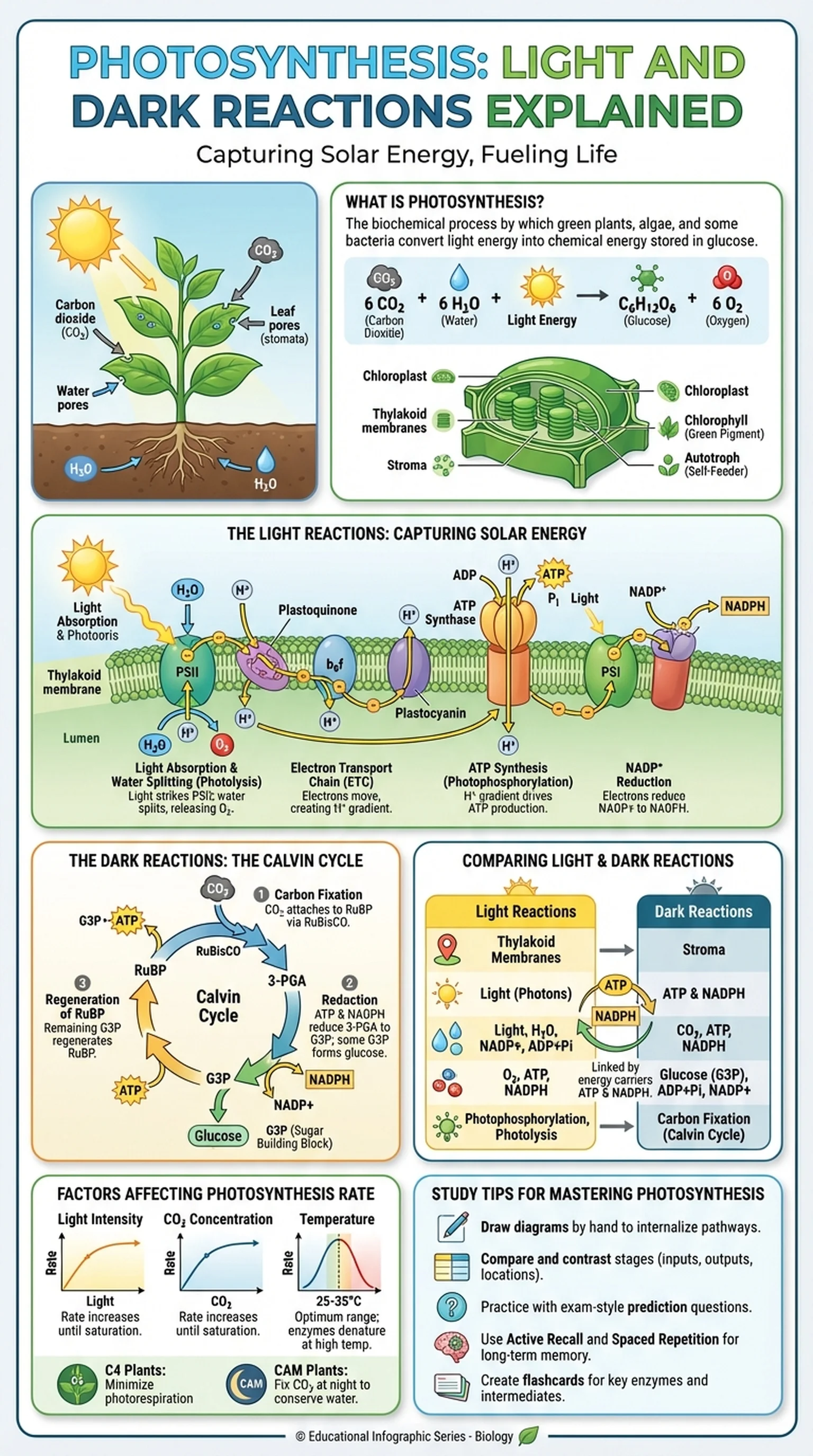
What Is Photosynthesis?
Photosynthesis is the biochemical process by which green plants, algae, and certain bacteria convert light energy into chemical energy stored in glucose and other organic molecules. This process is arguably the most important biological reaction on Earth, as it provides the foundation for virtually all food chains and is responsible for producing the oxygen that aerobic organisms depend on for survival. The overall equation for photosynthesis is deceptively simple: six molecules of carbon dioxide plus six molecules of water, powered by light energy, yield one molecule of glucose and six molecules of oxygen.
The process of photosynthesis takes place primarily in the chloroplasts of plant cells, organelles that contain the green pigment chlorophyll. Chlorophyll absorbs light most efficiently in the blue and red wavelengths of the visible spectrum, reflecting green light and giving plants their characteristic color. Within the chloroplast, photosynthesis is divided into two major stages: the light reactions and the dark reactions. These two stages are spatially separated within the chloroplast and are biochemically distinct, yet they are tightly coupled to ensure the continuous conversion of solar energy into stable chemical bonds.
Understanding the photosynthesis steps in detail is essential for students of biology, ecology, and environmental science. Photosynthesis not only sustains life on Earth by producing food and oxygen, but it also plays a critical role in the global carbon cycle by removing carbon dioxide from the atmosphere. As concerns about climate change intensify, a thorough understanding of how photosynthesis works has never been more relevant. The following sections break down each stage of this remarkable process.
Key Terms
The process by which green plants and other organisms convert light energy, carbon dioxide, and water into glucose and oxygen.
A membrane-bound organelle found in plant cells and algae where photosynthesis occurs.
A green pigment in chloroplasts that absorbs light energy, primarily in the blue and red wavelengths, to drive photosynthesis.
An organism capable of producing its own food from inorganic substances using light or chemical energy.