LectureScribe Logo
lecturescribe.io

LOCK IN VALENTINE PRICING BEFORE SALE ENDS!

Use code — New joiners get 40% OFF on annual plans

Plans will have higher prices after this sale ends

0days
:
0hours
:
0minutes
:
0seconds
Biology2,500+ words5 slides
🧬

Protein Synthesis: Transcription and Translation Steps

Master protein synthesis with a step-by-step guide to transcription and translation. Learn the protein synthesis steps from DNA to mRNA to functional proteins.

L
LectureScribeAI-Powered Study Platform

Study Infographic

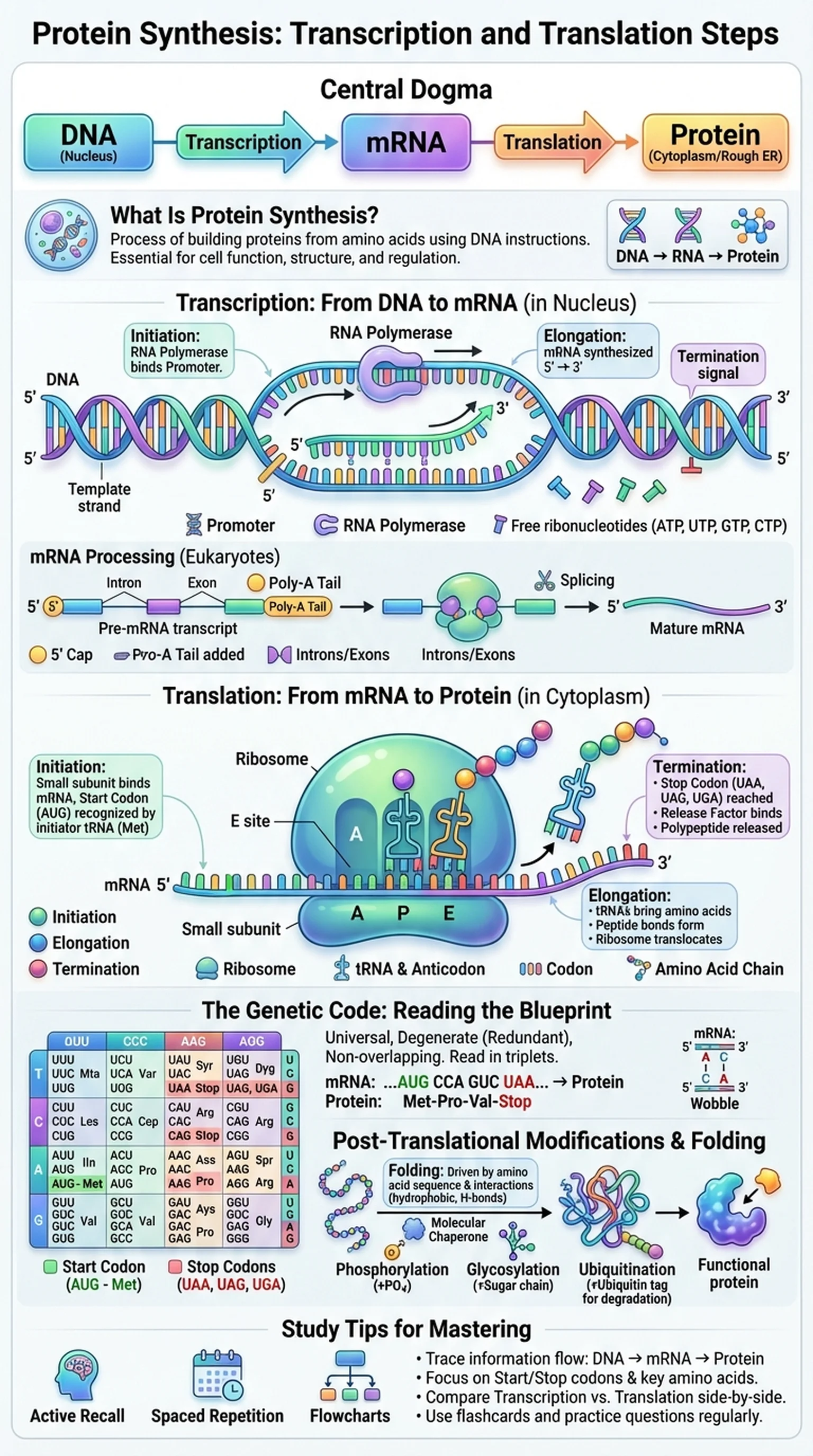
Complete protein synthesis diagram illustrating transcription in the nucleus and translation at the ribosome, with mRNA, tRNA, and amino acid assembly.

Download
Protein synthesis diagram showing transcription of DNA to mRNA in the nucleus and translation of mRNA to protein on ribosomes

Interactive Study Short

Swipe through 5 slides about Protein Synthesis: Transcription and Translation Steps

1 / 5

What Is Protein Synthesis?

Protein synthesis is the biological process by which cells build proteins from amino acids using the genetic instructions encoded in DNA. Proteins are the workhorses of the cell, performing an enormous range of functions including catalyzing metabolic reactions (enzymes), providing structural support (collagen, keratin), transporting molecules (hemoglobin), defending against pathogens (antibodies), and regulating gene expression (transcription factors). Understanding protein synthesis is therefore central to understanding how cells function, grow, divide, and respond to their environment.

The process of protein synthesis occurs in two major stages: transcription and translation. During transcription, the information in a gene's DNA sequence is copied into a messenger RNA (mRNA) molecule. During translation, the mRNA sequence is read by ribosomes, which assemble amino acids into a polypeptide chain according to the genetic code. These two stages are the core protein synthesis steps that connect genotype to phenotype, converting the abstract information stored in DNA into the functional molecules that carry out cellular activities.

Protein synthesis is a foundational topic in molecular biology, genetics, and biochemistry. It is the molecular basis of the central dogma of molecular biology, which states that genetic information flows from DNA to RNA to protein. Errors in protein synthesis can lead to dysfunctional proteins, which are implicated in numerous diseases including sickle cell anemia, cystic fibrosis, and many forms of cancer. A thorough understanding of how transcription and translation work is essential for any student preparing for exams in biology or the medical sciences.

Key Terms

Protein Synthesis

The cellular process of building proteins from amino acids based on the genetic instructions encoded in DNA, involving transcription and translation.

Central Dogma

The principle that genetic information flows from DNA to RNA to protein through the processes of transcription and translation.

Gene

A segment of DNA that contains the instructions for building a specific protein or functional RNA molecule.

Amino Acid

The building blocks of proteins; twenty different amino acids are joined in specific sequences during translation to form polypeptide chains.

Transcription: From DNA to mRNA

Transcription is the first of the two major protein synthesis steps and involves copying the genetic information from a DNA template into a complementary mRNA molecule. In eukaryotic cells, transcription occurs in the nucleus, where the DNA is housed, and the resulting mRNA must be processed and exported to the cytoplasm before translation can begin. In prokaryotic cells, which lack a nucleus, transcription and translation can occur simultaneously.

Transcription proceeds in three phases: initiation, elongation, and termination. During initiation, the enzyme RNA polymerase binds to a specific DNA sequence called the promoter, located upstream of the gene to be transcribed. In eukaryotes, transcription factors first bind to the promoter region and recruit RNA polymerase II to the transcription start site. Once the transcription complex is assembled, RNA polymerase unwinds a short stretch of the DNA double helix, exposing the template strand.

During elongation, RNA polymerase reads the template strand of DNA in the 3' to 5' direction and synthesizes a complementary mRNA strand in the 5' to 3' direction. The mRNA is built using ribonucleotide triphosphates (ATP, UTP, GTP, CTP) according to base-pairing rules: adenine pairs with uracil (instead of thymine), and guanine pairs with cytosine. The growing mRNA strand peels away from the DNA template as it is synthesized. Termination occurs when RNA polymerase reaches a termination signal in the DNA, causing the enzyme and the newly synthesized mRNA to dissociate from the template.

In eukaryotes, the primary mRNA transcript (pre-mRNA) undergoes several processing steps before it can be translated. These include the addition of a 5' cap, the addition of a poly-A tail at the 3' end, and the removal of non-coding sequences called introns through RNA splicing. The mature mRNA is then exported from the nucleus to the cytoplasm, where it serves as the template for translation.

Key Terms

Transcription

The process of copying genetic information from DNA into a complementary mRNA molecule, catalyzed by RNA polymerase.

mRNA (Messenger RNA)

The RNA molecule produced during transcription that carries the genetic code from the nucleus to the ribosome for translation.

RNA Polymerase

The enzyme that synthesizes mRNA by reading the DNA template strand during transcription.

Promoter

A DNA sequence upstream of a gene where RNA polymerase and transcription factors bind to initiate transcription.

RNA Splicing

The removal of introns (non-coding sequences) from pre-mRNA and joining of exons to produce a mature mRNA ready for translation.

Translation: From mRNA to Protein

Translation is the second major stage of protein synthesis, in which the nucleotide sequence of mRNA is decoded to build a polypeptide chain of amino acids. Translation occurs in the cytoplasm on ribosomes, which are complex molecular machines composed of ribosomal RNA (rRNA) and proteins. The ribosome reads the mRNA in sets of three nucleotides called codons, each of which specifies a particular amino acid according to the genetic code.

Translation also proceeds in three phases: initiation, elongation, and termination. During initiation, the small ribosomal subunit binds to the 5' end of the mRNA and scans along until it reaches the start codon, AUG, which codes for the amino acid methionine. A special initiator transfer RNA (tRNA) carrying methionine recognizes the AUG codon through complementary base pairing between its anticodon (UAC) and the mRNA codon. The large ribosomal subunit then joins the complex, forming the complete ribosome with the mRNA threaded through it.

During elongation, amino acids are added to the growing polypeptide chain one at a time. Each amino acid is brought to the ribosome by a specific tRNA molecule whose anticodon is complementary to the mRNA codon in the ribosome's A site. A peptide bond forms between the incoming amino acid and the growing chain, catalyzed by the ribosome's peptidyl transferase activity. The ribosome then translocates one codon along the mRNA, and the process repeats. This is the heart of the protein synthesis steps where the linear information in mRNA is converted into a three-dimensional protein.

Termination occurs when the ribosome encounters a stop codon (UAA, UAG, or UGA) on the mRNA. No tRNA molecules recognize stop codons. Instead, release factors bind to the stop codon, triggering the release of the completed polypeptide chain and the disassembly of the ribosomal complex. The new polypeptide may then undergo folding and post-translational modifications to become a functional protein.

Key Terms

Translation

The process of decoding mRNA into a polypeptide chain of amino acids on the ribosome.

Codon

A sequence of three mRNA nucleotides that codes for a specific amino acid or a stop signal during translation.

tRNA (Transfer RNA)

An RNA molecule that carries a specific amino acid to the ribosome and has an anticodon that pairs with the mRNA codon.

Ribosome

The cellular organelle composed of rRNA and proteins that serves as the site of translation, reading mRNA to synthesize proteins.

Anticodon

A three-nucleotide sequence on tRNA that is complementary to an mRNA codon, ensuring the correct amino acid is added during translation.

The Genetic Code: Reading the mRNA Blueprint

The genetic code is the set of rules by which the nucleotide sequence of mRNA is translated into the amino acid sequence of a protein during translation. Understanding the genetic code is essential for grasping how protein synthesis steps convert genetic information into functional molecules. The code is written in triplets called codons, with each codon consisting of three consecutive nucleotides that specify one of the twenty standard amino acids or a translation stop signal.

The genetic code has several important properties. First, it is nearly universal, meaning that the same codons specify the same amino acids in almost all organisms, from bacteria to humans. This universality is powerful evidence for the common ancestry of life. Second, the code is degenerate (or redundant), meaning that most amino acids are encoded by more than one codon. For example, leucine is specified by six different codons. This redundancy provides a buffer against mutations: a single nucleotide change in the third position of a codon often does not alter the amino acid it encodes, a phenomenon known as wobble. Third, the code is non-overlapping and is read in a continuous frame starting from the AUG initiation codon.

There are 64 possible codons (4 nucleotides raised to the power of 3), of which 61 code for amino acids and 3 serve as stop codons (UAA, UAG, UGA). The start codon AUG not only signals the beginning of translation but also codes for methionine, making it the first amino acid in virtually every newly synthesized polypeptide. Frameshift mutations, caused by insertions or deletions of nucleotides that are not multiples of three, can shift the reading frame and dramatically alter every downstream codon, typically producing a nonfunctional protein. This illustrates how precisely the mRNA must be read during protein synthesis for proper gene expression.

Key Terms

Genetic Code

The set of rules mapping each three-nucleotide codon in mRNA to a specific amino acid or stop signal during translation.

Degeneracy (Redundancy)

The property of the genetic code in which multiple codons can specify the same amino acid.

Wobble

Flexibility in base pairing at the third position of a codon, allowing a single tRNA to recognize more than one codon for the same amino acid.

Frameshift Mutation

A mutation caused by insertion or deletion of nucleotides not in multiples of three, shifting the reading frame and altering all downstream codons.

Post-Translational Modifications and Protein Folding

The completion of translation is not the end of protein synthesis. Newly synthesized polypeptide chains must fold into precise three-dimensional structures and often undergo chemical modifications before they become fully functional proteins. These post-translational events are critical protein synthesis steps that determine where a protein goes in the cell, how long it lasts, and what it does.

Protein folding is driven primarily by the amino acid sequence itself. The polypeptide chain folds spontaneously as hydrophobic side chains cluster in the interior of the molecule, away from water, while hydrophilic side chains orient toward the surface. Secondary structures such as alpha helices and beta sheets form through hydrogen bonding between backbone atoms. The final three-dimensional shape, called the tertiary structure, is stabilized by hydrophobic interactions, disulfide bonds, ionic bonds, and hydrogen bonds between side chains. Many proteins also assemble into multi-subunit complexes (quaternary structure). Molecular chaperones assist in protein folding by preventing misfolding and aggregation, particularly under cellular stress conditions.

Post-translational modifications (PTMs) add another layer of regulation. Common PTMs include phosphorylation (the addition of phosphate groups, often regulating enzyme activity), glycosylation (the addition of carbohydrate chains, important for protein stability and cell recognition), ubiquitination (the attachment of ubiquitin molecules, targeting proteins for degradation by the proteasome), and proteolytic cleavage (the removal of signal peptides or activation of inactive precursor proteins). These modifications allow cells to fine-tune the function, localization, and lifespan of each protein.

Misfolded proteins are a significant concern for cell health. When proteins fail to fold correctly, they can aggregate and form toxic structures associated with diseases such as Alzheimer's, Parkinson's, and prion diseases. Quality control mechanisms, including chaperones and the ubiquitin-proteasome system, identify and degrade misfolded proteins. The study of these processes connects protein synthesis to some of the most important questions in medicine and pharmacology.

Key Terms

Post-Translational Modification

Chemical changes to a protein after translation, such as phosphorylation, glycosylation, or ubiquitination, that affect protein function and fate.

Molecular Chaperone

A protein that assists in the correct folding of other proteins and prevents aggregation of misfolded polypeptides.

Ubiquitination

The attachment of ubiquitin molecules to a protein, marking it for degradation by the proteasome.

Tertiary Structure

The overall three-dimensional shape of a single polypeptide chain, determined by interactions between amino acid side chains.

Study Tips for Mastering Protein Synthesis

Protein synthesis is one of the most heavily tested topics in biology and biochemistry, appearing on the AP Biology exam, the MCAT, and medical school assessments. Mastering the protein synthesis steps from transcription through translation and beyond requires both conceptual understanding and attention to molecular detail. Here are effective strategies to build your mastery.

First, follow the information flow. The best way to learn protein synthesis is to trace the path of genetic information from DNA to mRNA to protein. Start with transcription: identify the promoter, the template strand, and the direction of RNA synthesis. Then follow the mRNA to the ribosome for translation: locate the start codon, track the reading of each codon by tRNA anticodons, and identify when a stop codon terminates the process. Drawing this pathway as a flowchart reinforces the sequential logic of the protein synthesis steps and helps you see how transcription and translation connect.

Second, memorize the genetic code table strategically. You do not need to memorize all 64 codons. Focus on the start codon (AUG), the three stop codons (UAA, UAG, UGA), and a few key amino acids. Understand the principle of degeneracy and wobble so you can deduce amino acid assignments from the table during exams. Third, compare transcription and translation in a side-by-side table. List the location, enzyme, template, product, direction, and phases for each process. This comparison clarifies what is unique to each stage and what they share.

Finally, use active recall and spaced repetition to solidify your knowledge. Platforms like LectureScribe can generate flashcards, slide decks, and practice questions from your lecture notes on protein synthesis, mRNA processing, and the genetic code. Regular self-testing on the protein synthesis steps, the roles of mRNA, tRNA, and ribosomes, and the consequences of mutations is far more effective than passive rereading. Consistent, structured review will prepare you for any exam question on this topic.

Key Terms

Active Recall

A study technique that involves actively retrieving information from memory rather than passively reviewing notes.

Spaced Repetition

A learning strategy that involves reviewing material at increasing intervals to strengthen long-term memory retention.

MCAT

The Medical College Admission Test; a standardized exam required for admission to medical schools in the United States and Canada.

Frequently Asked Questions

What is protein synthesis?

Protein synthesis is the process by which cells build proteins from amino acids using genetic instructions from DNA. It involves two main stages: transcription, where DNA is copied into mRNA, and translation, where mRNA is decoded by ribosomes to assemble a polypeptide chain.

What is transcription in protein synthesis?

Transcription is the first stage of protein synthesis in which RNA polymerase copies a gene's DNA sequence into a complementary mRNA molecule. In eukaryotes, this occurs in the nucleus, and the mRNA is processed before being exported to the cytoplasm for translation.

What is translation in protein synthesis?

Translation is the second stage of protein synthesis in which ribosomes read the mRNA sequence and assemble amino acids into a polypeptide chain. Transfer RNA molecules bring amino acids to the ribosome, matching their anticodons to mRNA codons according to the genetic code.

What are the main protein synthesis steps?

The main protein synthesis steps are: (1) transcription of DNA to mRNA in the nucleus, (2) mRNA processing (capping, polyadenylation, splicing), (3) export of mature mRNA to the cytoplasm, and (4) translation of mRNA into a polypeptide chain on ribosomes.

What is the role of mRNA in protein synthesis?

mRNA serves as the messenger molecule that carries the genetic code from DNA in the nucleus to the ribosomes in the cytoplasm. It provides the template that ribosomes read during translation to determine the sequence of amino acids in the protein.

What is the difference between transcription and translation?

Transcription occurs in the nucleus and copies DNA into mRNA using RNA polymerase. Translation occurs on ribosomes in the cytoplasm and decodes mRNA into a chain of amino acids. Both are essential stages of protein synthesis but involve different molecular machinery and locations.

What happens if there is an error in protein synthesis?

Errors in protein synthesis can produce misfolded or nonfunctional proteins. Mutations in DNA can alter mRNA codons, leading to incorrect amino acids (missense), premature stops (nonsense), or shifted reading frames (frameshift). These errors are linked to diseases such as sickle cell anemia and cystic fibrosis.

Study Biology Smarter

Upload your lecture notes and get AI-generated flashcards, quizzes, infographics, and study guides tailored to your curriculum.

Try LectureScribe Free

Create Study Materials

Transform your Biology lectures into flashcards, quizzes, and visual study guides with AI.

  • AI-generated flashcards & quizzes
  • Visual infographics from notes
  • Interactive study shorts
Start Studying Free

Quick Facts

SubjectBiology
Word Count2,500+
Slides5
InfographicIncluded
AuthorLectureScribe

Master Biology with LectureScribe

Upload your lecture notes and get AI-powered flashcards, quizzes, infographics, and study guides in minutes.